Knowledge Management in 2026: How to Build Living Operational Knowledge People Actually Use

Knowledge Management in 2026: How to Build Living Operational Knowledge People Actually Use

Avery Brooks
February 21, 2026

Best Practices For Knowledge Management In 2026

Most knowledge management programs don’t fail because the tool is bad.

They fail because the knowledge isn’t trusted, isn’t current, and isn’t owned.

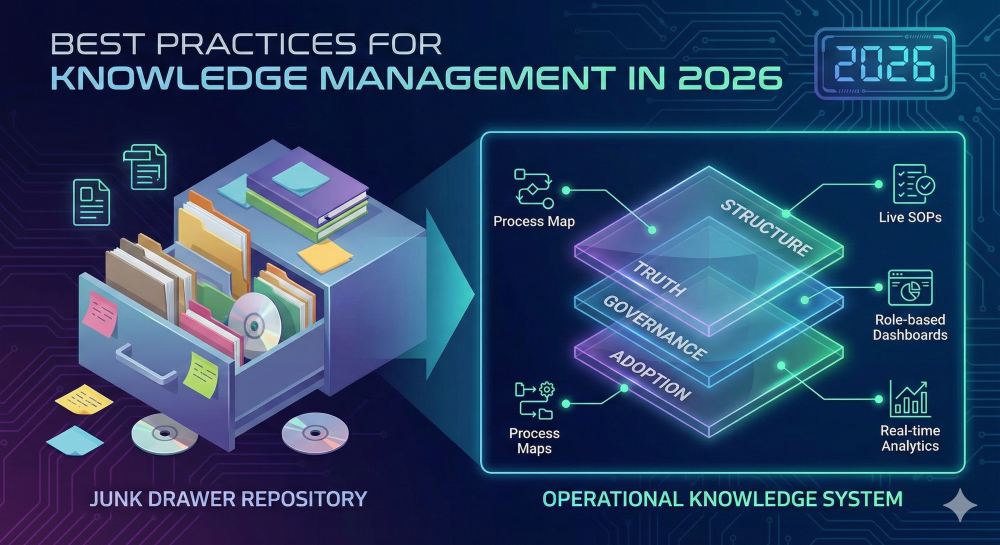
So the “knowledge base” turns into what everyone secretly knows it is: a junk drawer. Duplicated SOPs. Outdated process docs. Random PDFs. “Final_v7” files. A handful of pages that are accurate, and a whole lot that aren’t. Meanwhile, the real knowledge lives in people’s heads, in Slack threads, in side spreadsheets, and in the one person everyone pings when something breaks.

In 2026, the teams who win at knowledge management stop treating it like a repository problem and start treating it like an operating system: capture → validate → publish → maintain → measure.

This post lays out a practical approach to operational knowledge management that drives adoption, reduces tribal knowledge, and turns documentation into living assets your teams actually use.

The real problem isn’t “no knowledge” — it’s “no trust”

Most organizations have plenty of knowledge. They just can’t rely on it.

Why knowledge bases become junk drawers

1) Too many sources, no single truth.
Wikis, shared drives, Confluence pages, Google Docs, Notion, email… knowledge gets duplicated and then diverges.

2) Content is written from memory, not reality.
The “official” process is captured, but exceptions, workarounds, and real handoffs don’t make it into the docs. The moment someone uses the doc and it doesn’t match what they’re seeing, trust collapses.

3) No ownership, no cadence.
If nobody is accountable for accuracy, everything drifts. And drift isn’t gradual—one system change can make ten pages wrong overnight.

4) Findability breaks as the library grows.
Tagging becomes inconsistent. Naming conventions vary. Search returns too much or nothing useful. People stop trying.

5) Knowledge isn’t connected to workflows.
Even if the knowledge exists, it’s not where people need it, when they need it—so they default to “ask someone.”

The hidden cost of bad knowledge management

Bad KM doesn’t just feel messy. It creates real operational drag:

  • longer onboarding and slower time-to-proficiency
  • more escalations and rework
  • inconsistent customer/employee experiences
  • delivery teams rebuilding what already exists
  • audit and compliance risk during system and policy changes

KM fails when it’s a place to store information. KM works when it helps people make correct decisions in the flow of work.

What knowledge management is in 2026 (and what it isn’t)

To build a KM program that actually gets used, you need a modern definition.

Knowledge management in 2026 = operational knowledge management

Operational KM is the practice of maintaining trusted, current, role-based knowledge about how work actually gets done:

  • processes and handoffs
  • SOPs and decision rules
  • exceptions and escalations
  • controls (where relevant)
  • templates, forms, and system instructions
  • definitions and data fields that drive work

The goal isn’t “more documentation.” The goal is usable clarity.

What it’s not

  • Not a document dump
  • Not a wiki that quietly decays
  • Not “AI chat over random files” with no governance
  • Not knowledge that’s disconnected from roles and workflows

The biggest shift in 2026: moving from a repository mindset to living documentation.

The 4 layers of KM that actually works

If you want a KM program that survives beyond the kickoff, you need four layers: Truth, Structure, Governance, Adoption.

Layer 1: Truth — ground knowledge in reality

If the knowledge doesn’t reflect reality, it won’t be used.

The most reliable backbone for operational KM is process visibility:

  • what triggers the work
  • who does what
  • what systems are involved
  • where decisions happen
  • where exceptions occur
  • how handoffs actually work

This is why process intelligence and automatic process mapping are becoming foundational. Not because “AI is cool,” but because it creates documentation people recognize and trust.

Layer 2: Structure — make knowledge usable

Knowledge becomes usable when it’s structured into consistent formats.

The formats that scale:

  • SOPs (roles, steps, decisions, exceptions)
  • process maps (swimlanes are usually the best default)
  • process narratives (1-page overview: purpose, scope, triggers, key variations)
  • checklists / controls (where compliance matters)
  • templates/forms (so execution is consistent)

Structure also means taxonomy:

  • domain (e.g., HR Ops)
  • process family (Onboarding)
  • subprocess (Equipment provisioning)
  • artifacts (SOP + map + narrative + templates)

Layer 3: Governance — keep it current

Governance is what protects trust.

If knowledge drifts, adoption dies. So you need:

  • clear owners
  • review cadence
  • change triggers
  • versioning
  • approvals where necessary

This doesn’t have to be heavy. It just has to exist.

Layer 4: Adoption — embed KM in how people work

Adoption happens when knowledge is:

  • easy to find
  • easy to trust
  • and delivered in context (role/process/task)

If someone has to go hunting for documentation, they won’t. They’ll ping a person. Your KM system should beat “ask someone” on speed and confidence.

What to standardize vs what to keep flexible

A common KM mistake is trying to standardize everything. That creates resistance, especially when teams know reality varies.

Standardize these (to reduce chaos)

  • required sections for SOPs and narratives
  • naming conventions (“Verb + Object + Outcome” works well)
  • ownership model (who’s accountable)
  • review cadence and triggers
  • taxonomy (domain → process → artifacts)
  • publishing workflow (draft → review → approved → live)

Keep these flexible (because reality varies)

  • regional or team variations
  • exception paths
  • tool differences across teams
  • depth of detail based on risk (high-risk processes need more rigor)

The principle: standardize the system, not the lived reality.

The KM backbone: processes, SOPs, and diagrams

If your knowledge base is mostly random documents, you’ll always fight duplication and drift.

The most scalable approach is to anchor KM around processes and generate consistent “knowledge packs” per process.

Why process documentation is the anchor

Process documentation is reusable because it:

  • supports onboarding
  • supports execution
  • supports audits and controls
  • supports transformation and delivery work
  • reduces duplication (everyone references the same backbone artifacts)

Random docs grow endlessly. Process-based knowledge stays organized.

The “KM pack” per process (what you should aim to publish)

For each process, publish a compact set of artifacts:

  1. Process map (swimlane default for cross-team work)
  2. SOP (roles, steps, decisions, exceptions)
  3. Narrative (one page: purpose, scope, triggers, key variations)
  4. Controls/checklist (if required)
  5. Templates/forms + links (so people can execute consistently)

When people know “every process has the same pack,” usage goes up instantly—because the library becomes predictable.

AI in knowledge management: what works and what backfires

AI can make KM dramatically better—or dramatically noisier.

The difference is governance and grounding.

What AI helps with (when done right)

  • drafting SOPs and narratives from existing materials
  • summarizing and consolidating overlapping documents
  • identifying duplicates and conflicts
  • creating role-based variants (new hire version vs expert version)
  • surfacing gaps based on search behavior (“zero results” queries)
  • detecting drift signals (knowledge doesn’t match observed reality)

The big win: AI can reduce the effort of producing knowledge packs—so SMEs spend time reviewing and correcting, not writing from scratch.

What backfires

  • AI confidently answering questions using outdated or contradictory content
  • chatbots layered over a messy repository with no taxonomy
  • no source traceability (people can’t tell what’s true)
  • no review workflow (misinformation spreads faster than truth)

Practical guardrails that keep AI trustworthy

  • publish only approved knowledge as “official”
  • maintain version history
  • show sources and last-updated dates
  • use role-based permissions
  • define escalation paths (“if unsure, route to owner”)

If your KM system can’t tell you what’s authoritative, it isn’t knowledge management—it’s content storage.

Governance that doesn’t become bureaucracy

You don’t need a “KM council.” You need ownership and cadence.

The lightweight model

Knowledge Owner (Accountable): responsible for accuracy and approvals
Knowledge Steward (Operational): maintains structure, versioning, cadence
SME Review Group (Consulted): validates changes and exceptions

This is enough to keep things alive.

Cadence + triggers

Set cadence:

  • quarterly for stable domains
  • monthly for high-change areas

Trigger updates when:

  • systems change
  • policies change
  • KPIs drift
  • escalations recur
  • audits find gaps

That’s how you prevent drift without slowing everything down.

Measuring KM success (beyond “docs created”)

If you measure outputs, you’ll get outputs.

If you measure outcomes, you’ll get adoption.

Findability and usage metrics

  • search success rate (“did they find something helpful?”)
  • time-to-answer
  • self-serve resolution rate (especially in support/internal ops)
  • “zero results” searches (these are your knowledge gaps)
  • page usage by role and process

Quality and trust metrics

  • stale content percentage
  • update frequency
  • duplicates/conflicts reduced
  • feedback loops: “Was this accurate?” signals

Business outcomes

  • onboarding time-to-proficiency
  • fewer escalations / less dependency on experts
  • reduced rework in delivery and operations
  • improved audit readiness and control consistency

The strongest KM teams treat metrics as a discovery tool: usage patterns tell you where knowledge is missing or untrusted.

A practical 30-day rollout plan

If you want to modernize KM without turning it into a multi-quarter program:

Week 1: Pick the domain + define your structure

  • choose one domain (HR Ops, Finance Ops, Support, etc.)
  • define your taxonomy (process family → subprocess → artifacts)
  • define formats (SOP, map, narrative) and naming conventions
  • assign owners and stewards

Week 2: Gather inputs + generate KM packs for 1–2 processes

  • pull existing docs (even messy)
  • capture reality (exceptions, handoffs, approvals)
  • generate the SOP + process map + narrative pack
  • identify key templates/forms and link them

Week 3: Validate + publish v1

  • SME confirm/correct review
  • publish with versioning and “last updated” dates
  • set cadence and change workflow

Week 4: Drive adoption + measure gaps

  • embed KM in onboarding and key workflows
  • track search gaps and recurring “ask someone” topics
  • prioritize the next processes based on real demand signals

Your goal isn’t to “document everything.” Your goal is to build a KM system people trust—then expand based on usage.

Knowledge Management FAQ

1) What is knowledge management in 2026, and why do most KM programs fail?

In 2026, knowledge management is less about storing documents and more about maintaining living operational knowledge that’s trusted, current, and owned. Most KM programs fail because knowledge drifts, no one is accountable for accuracy, and content isn’t structured in a way people can find and use in the flow of work.

2) What should be the foundation of operational knowledge management?

Processes. SOPs, process maps, narratives, and decision rules create a backbone that’s reusable across onboarding, execution, audits, and transformation work. A process-based structure reduces duplication and gives teams a predictable way to find what they need.

3) How do you keep knowledge current without a massive KM team?

Use lightweight governance: assign owners, set a review cadence, and define triggers that require updates (system changes, policy updates, KPI drift, repeated escalations, audit findings). The goal is to prevent drift before it erodes trust.

4) Can AI be trusted in knowledge management—and how do you prevent misinformation?

AI can be trusted when it’s grounded in approved sources, shows traceability, and sits behind a review and publishing workflow. Without governance, AI can spread confident wrong answers faster than humans can correct them—so versioning, approvals, and clear “official vs draft” status are essential.

5) How do you measure KM success in a way the business cares about?

Measure outcomes: faster onboarding time-to-proficiency, fewer escalations, reduced rework, higher self-serve resolution, and improved audit readiness. Pair those with leading indicators like search success rate, “zero results” queries, stale content percentage, and usage by role/process.

To see how leading organizations are taking advantage of modern tools tostreamline knowledge management, check out ClearWork's Knowledge Management Capabilities.

image of team collaborating on a project

If you want knowledge management built on trusted process visibility—SOPs, diagrams, and living documentation that stays current—try ClearWork

Most knowledge bases fail because they’re repositories, not operating systems—outdated, duplicated, and disconnected from real work. ClearWork helps teams capture how work actually happens, generate structured knowledge packs (maps, SOPs, narratives), and keep them current with lightweight governance and collaboration.

Subscribe to our newsletter to stay up to date on all things digital transformation

Continue Your Education

Best Process Discovery Tools for 2026: Automated Discovery, Process Mining, and Task Mining Compared

Read More

From Discovery to Delivery: How Process Excellence Teams Convert Process Discovery into Jira Epics, Stories, and Test Coverage

Read More

BPM Software 2026: Best Business Process Management Platforms Compared (for Process Excellence & Transformation Teams)

Read More
Table of Contents