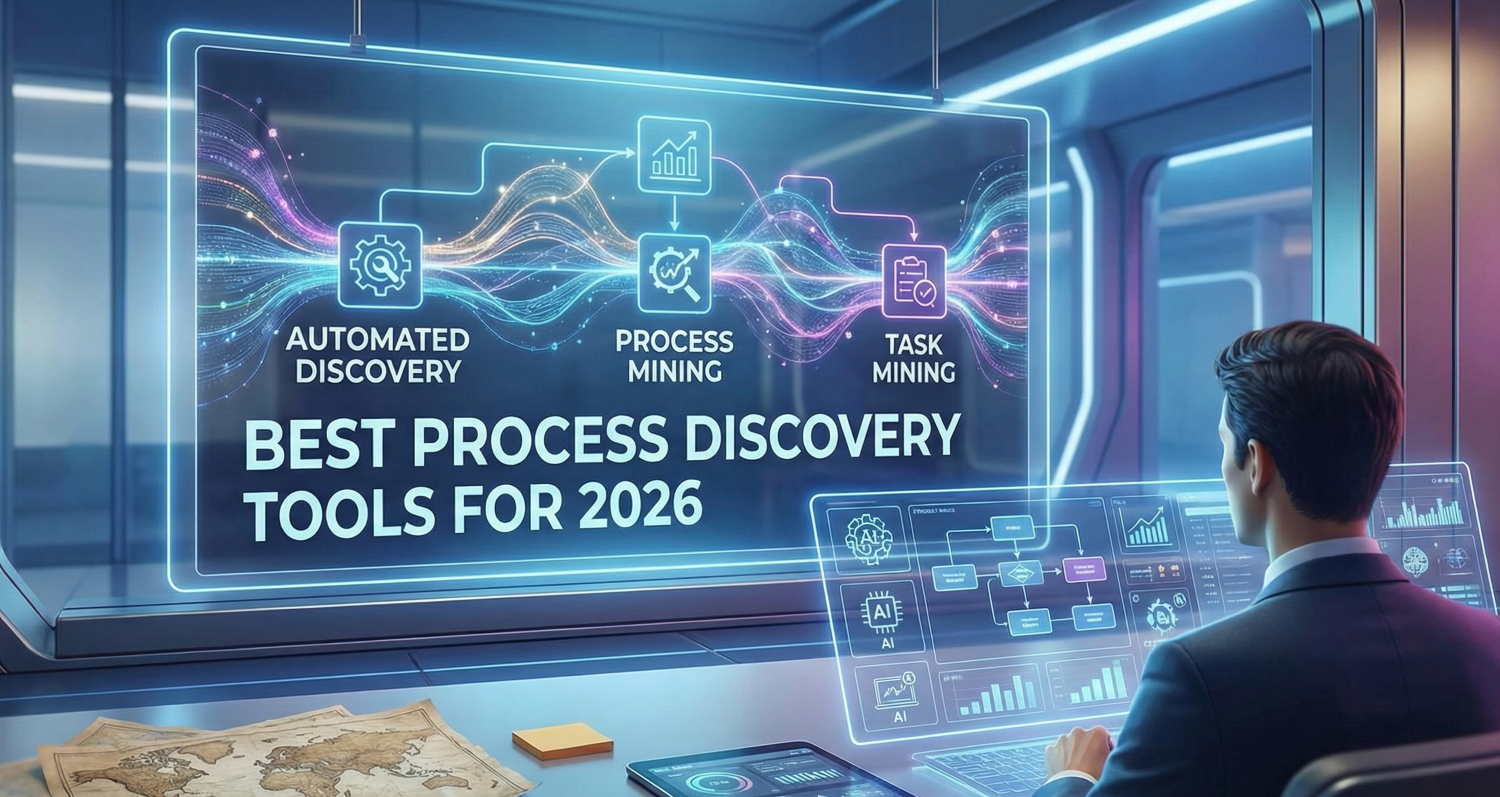
Best Process Discovery Tools for 2026: Automated Discovery, Process Mining, and Task Mining Compared
Avery Brooks
January 11, 2026
Most transformation programs don’t fail because the software was wrong.
They fail because teams tried to build the future on top of assumptions—outdated process maps, incomplete workshop notes, and “tribal knowledge” that never made it out of people’s heads.
In 2026, process excellence and transformation leaders are holding discovery to a higher standard:
If you can’t explain how work actually happens—across systems, roles, variants, and exceptions—you can’t plan, scope, estimate, or deliver with confidence.
That’s why “process discovery tools” have become a category buyers actively search for. And it’s also why the market is confusing: some tools are built for system event logs (process mining), others are built for human work capture (task mining), and a newer category is emerging that’s changing how teams plan transformations from day one: Automated Process Discovery.
This guide compares the best process discovery tools for 2026, explains what each category is best at, and gives you a practical decision framework to choose the right approach.
Process discovery tools help you capture, document, and analyze how work gets done so you can improve it—whether that means standardizing a process, preparing for a system implementation, redesigning operating models, or getting ready for AI automation.
But “process discovery” is often used as a blanket term for three different approaches:
Process mining uses system event logs (ERP, CRM, ITSM, etc.) to reconstruct process flows, measure cycle times, and identify bottlenecks and conformance issues.
Best for: system-driven processes where the majority of work is captured in transactional logs.
Common limitation: what happens between systems (emails, spreadsheets, handoffs, workarounds, approvals, shadow tools) can be invisible.
Task mining captures human work patterns—often at the desktop or user interaction level—to see how people actually execute tasks, including steps that never hit system event logs.
Best for: shared services, operational teams, and processes with heavy manual work, context switching, and “how it really gets done” variance.
Common limitation: it can be hard to translate raw task data into end-to-end process design and project-ready deliverables without significant interpretation.
Here’s the clean definition you can use going forward:
Automated Process Discovery is the use of AI to pull tribal knowledge out of people’s heads and turn it into structured documentation—process maps, narratives, requirements, risks/controls, and project plans—so teams can power the planning and discovery phases of a transformation with clarity instead of assumptions.
It’s not “AI that draws a diagram.” It’s AI that helps teams:
Best for: transformation programs where planning quality determines delivery success (ERP, CRM, shared services redesign, agent readiness, automation roadmaps).
Teams are moving away from “choose one data source” toward system + human discovery—because no single source contains the full truth.
If discovery takes months, it’s already behind the project. 2026 buyers want usable outputs in days or weeks—not quarters.
Process maps that die after sign-off are no longer acceptable. Leaders want documentation that stays aligned with operational reality as changes roll out.
Organizations want to deploy copilots and agents, automate workflows, and modernize systems—but that only works when the process is clearly understood and structured.
Executives don’t fund “insights.” They fund outcomes. Process discovery tools increasingly need to produce deliverables that translate into execution: scope, requirements, stories, test cases, governance, and plans.
If you’re shortlisting fast, use this lens:
No one tool is perfect for every scenario. The best results usually come from matching the tool category to your goal.
Below is a skimmable breakdown using the same structure across tools: Overview → Best for → Strengths → Trade-offs → When to choose it.
Overview: ClearWork focuses on turning real operational knowledge into structured project deliverables—so discovery becomes an engine for planning and delivery, not just documentation.
Best for: process excellence and transformation teams who need to move quickly from “how work happens” to:
Strengths:
Trade-offs:
When to choose it: when your biggest risk is missed requirements, unclear scope, or discovery quality—and you want discovery outputs that directly power delivery.
Overview: One of the best-known process mining platforms for deep analysis of ERP/CRM event logs and enterprise process performance.
Best for: organizations with strong system log access, mature data teams, and a desire to quantify and improve end-to-end system-driven workflows.
Strengths: strong process analytics, performance metrics, conformance-style insight, enterprise footprint.
Trade-offs: event-log coverage doesn’t always capture human work, workarounds, and shadow processes; time-to-value depends on integration and data readiness.
When to choose it: when the process is primarily in system logs and you want deep quantitative insights at scale.
Overview: Often shortlisted when organizations want discovery connected to automation execution.
Best for: automation-first programs where discovery is tied to RPA and automation pipelines.
Strengths: strong alignment to automation delivery; practical path from insights to bots/workflows.
Trade-offs: discovery can be shaped by an automation lens (which is great when that’s the strategy, less ideal if the goal is broader transformation planning).
When to choose it: when your primary success metric is automation throughput and you want a tight ecosystem loop.
Overview: Common in SAP-heavy transformations where process governance and standardization matter.
Best for: ERP modernization programs with strong emphasis on governance, standardization, and process ownership.
Strengths: process governance positioning, alignment to ERP-driven transformation agendas.
Trade-offs: value depends on SAP ecosystem depth and implementation maturity; may be heavier than what smaller teams need.
When to choose it: when your organization is tightly aligned to SAP transformation programs and governance structures.
Overview: Focuses on understanding human work patterns—how tasks are executed on the ground.
Best for: shared services and operational teams where the truth lives in daily work patterns, not system logs.
Strengths: strong visibility into manual work, task-level variation, and operational reality.
Trade-offs: translating task-level insight into end-to-end transformation deliverables can take additional structure and interpretation.
When to choose it: when the biggest gap is understanding what people actually do step-by-step.
Overview: Often considered by teams that want flexibility in how they model, analyze, and deploy process mining approaches.
Best for: teams with strong internal capability that want control and customization.
Strengths: flexible approach, adaptable across different environments.
Trade-offs: success depends on internal expertise and operating model.
When to choose it: when flexibility and control are priorities and you have internal maturity to support it.
Use this decision tree to avoid long vendor debates.
Choose process mining when:
Choose task mining / human capture when:
Choose Automated Process Discovery when:
You can reduce risk by aligning discovery tooling to the stack you’re standardizing on—especially when governance and integration are priorities.
Don’t start with “pick the tool.” Start with “prove value.”
They’re used to understand how work is actually performed so teams can improve, standardize, automate, or redesign processes—especially ahead of system implementations and transformation programs.
Automated Process Discovery uses AI to pull tribal knowledge out of people’s heads and turn it into structured documentation and project-ready outputs—so planning and discovery phases become faster, more complete, and less dependent on workshops.
Process mining uses system event logs to reconstruct flows; task mining captures human work patterns and steps. Many organizations need both to see the full process.
If your last project had missed exceptions, scope creep, requirements rework, or UAT surprises—your discovery method didn’t capture reality well enough.
At minimum: process map + narrative + variants/exceptions + ownership. The best tools also generate planning and delivery outputs like requirements, epics/stories, controls, SOPs, and governance-ready documentation.
In 2026, process excellence leaders aren’t being measured by how many workshops they ran or how many diagrams they produced.
They’re being measured by whether discovery:
If you want a discovery approach that turns tribal knowledge into structured deliverables—and powers the full planning and discovery phases of a project or transformation—explore ClearWork Automated Discovery:
https://www.clearwork.io/clearwork-automated-discovery
Ready to replace workshop assumptions with reality-based discovery that turns tribal knowledge into project deliverables—see how ClearWork Automated Process Discovery works
Fourteen days, full access, no card required.
No credit card required.