How to Operationalize Collaboration Spaces: A Practical Playbook for Process Governance, Ownership, and Continuous Improvement

How to Operationalize Collaboration Spaces: A Practical Playbook for Process Governance, Ownership, and Continuous Improvement

Avery Brooks
January 20, 2026

How to Operationalize Collaboration Spaces:

A Practical Playbook for Process Governance, Ownership, and Continuous Improvement

By now, most process excellence and transformation teams agree on two things:

  1. Process knowledge is critical to improvement, standardization, and transformation.
  2. Traditional documentation models don’t hold up once the business starts changing.

The harder question—the one teams get stuck on—is this:

“How do we actually operationalize collaboration around process knowledge without creating overhead, bureaucracy, or shelfware?”

This final article in the Collaboration Spaces series answers that question. It’s a practical playbook for turning Collaboration Spaces into a working operating model—not just another repository.

Why most process repositories fail after launch

Many organizations successfully launch a process repository. Few sustain it.

The breakdown usually looks like this:

  • Initial enthusiasm fades after the project ends
  • Ownership becomes unclear
  • Updates rely on “someone remembering”
  • Governance feels heavy and slow
  • Teams revert to tribal knowledge and side conversations

This isn’t a tooling problem. It’s an operating model problem.

The difference with Collaboration Spaces is that they are designed to be operated, not just populated.

The operating principle: governance without friction

Before getting tactical, it’s important to reset expectations.

Effective process governance does not mean:

  • more approval layers
  • longer review cycles
  • centralized bottlenecks
  • heavyweight committees

It means:

  • clear ownership
  • explicit lifecycle states
  • visible accountability
  • lightweight, repeatable rituals

Collaboration Spaces support this by embedding governance directly into how artifacts are created, reviewed, and evolved—rather than bolting it on afterward.

Step 1: Define the right Collaboration Spaces (don’t over-structure)

The most common early mistake is creating too many spaces.

A good rule of thumb:

  • One Collaboration Space per major business domain
    • Finance
    • HR
    • IT
    • Customer Support
    • Procurement

Each space should represent an area with:

  • shared accountability
  • common process language
  • recurring improvement initiatives

Avoid creating spaces for every team or project. That fragmentation defeats the purpose.

Step 2: Start with a small, high-impact process set

You don’t need to migrate everything.

Instead:

  • pick 2–3 processes that are:
    • frequently referenced
    • frequently debated
    • frequently changed
    • critical to outcomes

Examples:

  • Finance: month-end close, invoice exception handling
  • HR: onboarding, role changes
  • IT: incident escalation, access provisioning
  • Support: case triage, swarming

These processes become your anchor artifacts—the foundation others will trust.

Step 3: Promote artifacts deliberately (project → space)

Artifacts should not be authored directly in the Collaboration Space by default.

The recommended flow:

  1. Create artifacts inside a discovery or planning project
  2. Validate them with stakeholders
  3. Promote them into the Collaboration Space in draft status

This matters because:

  • the project remains a snapshot in time
  • the Collaboration Space becomes the long-lived source of truth
  • governance starts after discovery, not during it

Promotion is a signal: “This artifact now represents shared knowledge.”

Step 4: Assign ownership without creating new roles

Governance breaks when it feels like extra work.

Collaboration Spaces avoid this by:

  • reusing existing roles (process owners, managers, SMEs)
  • assigning ownership at the artifact level, not globally
  • keeping permissions simple

Every artifact should have:

  • one clear owner
  • a visible status (draft, approved, under review)
  • a review cadence

Ownership answers one question clearly:
“Who is accountable for keeping this accurate?”

Step 5: Establish a lightweight review cadence

You do not need weekly governance meetings.

Most teams succeed with:

  • Quarterly review for stable processes
  • Monthly review for high-change processes
  • Ad hoc review triggered by metrics, incidents, or transformation activity

The review checklist is simple:

  • Has the process changed in reality?
  • Are exceptions still accurate?
  • Do metrics still reflect outcomes?
  • Are there unresolved collaboration comments?

If the answer is “no change,” the review takes minutes—not hours.

Step 6: Use collaboration intentionally (not as discussion sprawl)

Collaboration in Collaboration Spaces is artifact-centric by design.

Best practices:

  • comments should reference a specific step, exception, or assumption
  • suggestions should propose a change, not just raise a concern
  • discussions should resolve into a version update or a documented decision

This prevents:

  • endless comment threads
  • duplicated debates
  • “we talked about this somewhere” confusion

Every conversation leaves a traceable outcome.

Step 7: Let AI reduce friction—not replace judgment

AI in Collaboration Spaces should do the uncomfortable work humans avoid:

  • summarizing feedback
  • highlighting conflicts or inconsistencies
  • suggesting revisions based on evidence
  • identifying impacted processes or metrics

AI should not:

  • silently rewrite approved knowledge
  • override ownership decisions
  • introduce unverified assumptions

Used correctly, AI accelerates clarity without undermining trust.

Step 8: Tie collaboration to value metrics (or it won’t stick)

Process repositories fail when they feel academic.

Collaboration Spaces stay relevant because they connect artifacts to:

  • cycle time
  • rework rates
  • exception frequency
  • SLA performance
  • adoption or compliance indicators

When teams see:

“This change reduced escalation volume by 18%”

process knowledge stops being “documentation” and starts being operational infrastructure.

Step 9: Expand gradually—don’t mandate adoption

Once one Collaboration Space is working:

  • expand to adjacent processes
  • bring in neighboring teams
  • reuse the same structure and governance model

Avoid mandates. Let success pull adoption forward.

Teams trust what works.

What changes when Collaboration Spaces are operational

When implemented well, teams notice:

  • fewer debates about “how things work”
  • faster onboarding and handoffs
  • cleaner transformation planning
  • clearer ownership
  • less rework after change

Most importantly, process knowledge stops decaying between projects.

Common failure modes to avoid

  • Treating Collaboration Spaces as just another document library
  • Creating too many spaces too quickly
  • Over-engineering governance
  • Letting AI operate without context or evidence
  • Ignoring metrics

The goal is continuity—not perfection.

The real shift in 2026

The most effective process teams are no longer asking:

“How do we document processes?”

They’re asking:

“How do we operate process knowledge as a living system?”

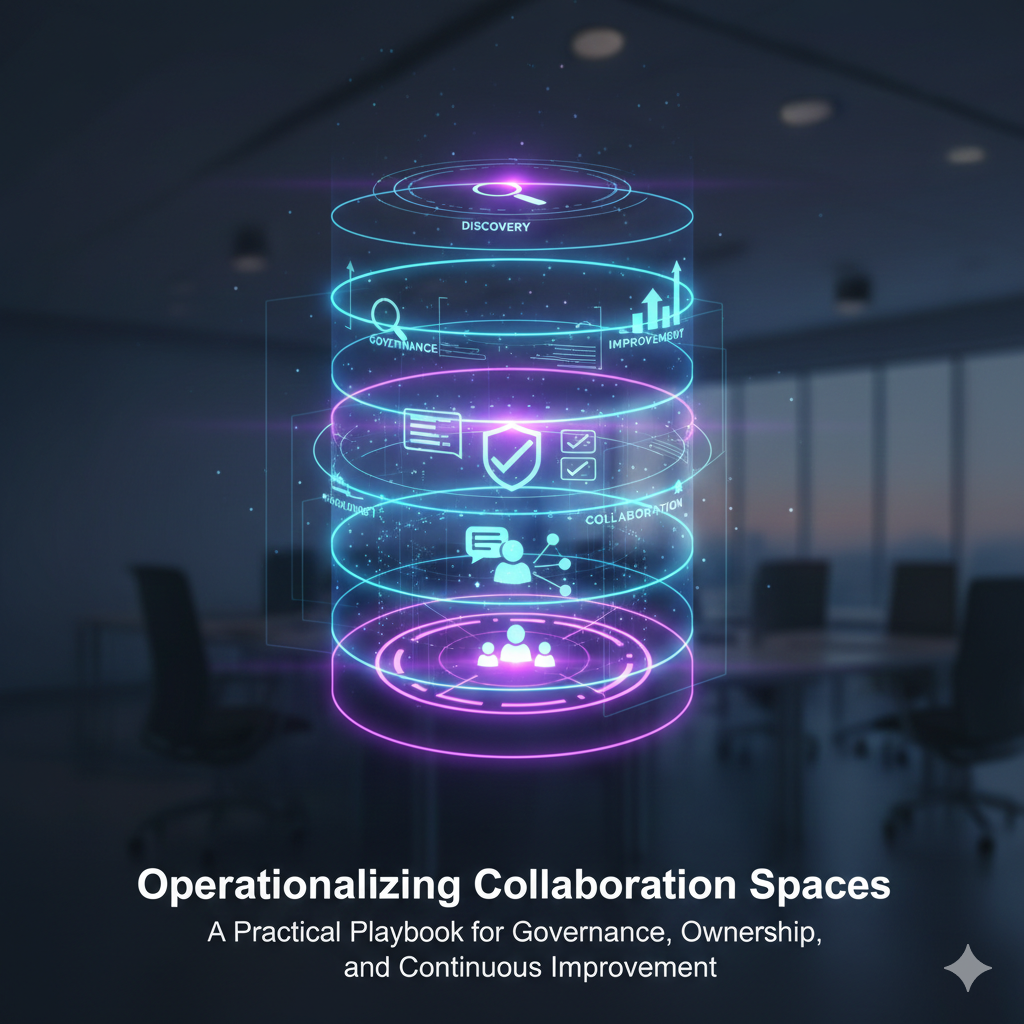
Collaboration Spaces answer that question by combining:

  • discovery
  • governance
  • collaboration
  • AI reasoning
  • continuous improvement

into one coherent operating model.

Final thought

Process excellence isn’t sustained by better documentation tools.

It’s sustained by clarity, ownership, and continuity.

Collaboration Spaces don’t replace how teams work—they make how teams work visible, improvable, and durable over time.

That’s what turns process knowledge into a long-term advantage, not a forgotten artifact.

Process Excellence Collaboration Q&A

Q1: How are Collaboration Spaces different from Confluence or Notion?

A: Confluence and Notion are excellent document collaboration tools, but they treat processes as static pages. Collaboration Spaces are process-centric: artifacts are connected to real processes, roles, systems, dependencies, and value metrics, not just text. The result is a living system of process knowledge that stays accurate as work actually changes.

Q2: How do Collaboration Spaces prevent SOPs from going stale?

A: Staleness happens when documentation is disconnected from ownership, evidence, and outcomes. Collaboration Spaces tie each artifact to a clear owner, a lifecycle (draft, approved, versioned), and real discovery evidence from projects. Combined with lightweight review cadences and AI-assisted change analysis, updates become part of normal operations—not an afterthought.

Q3: What role does AI play in Collaboration Spaces?

A: AI in Collaboration Spaces is designed to reason, not just write. Instead of summarizing whatever text happens to be on the page, the AI is grounded in discovery interviews, observed behavior, process relationships, and historical versions. This allows it to explain why a process exists, highlight conflicts or gaps, and suggest improvements—while keeping humans in control of final decisions.

Q4: Do Collaboration Spaces require heavy governance or new roles?

A: No. Collaboration Spaces are intentionally lightweight. They reuse existing roles like process owners and SMEs, apply governance at the artifact level (not via committees), and rely on simple review cadences. Governance becomes part of how artifacts evolve, rather than a separate layer that slows teams down.

Q5: Who benefits most from Collaboration Spaces?

A: Collaboration Spaces are built for process excellence, transformation, and operations teams who need their process knowledge to remain accurate beyond a single project. They’re especially valuable for organizations managing frequent change—new systems, reorganizations, automation, or regulatory pressure—where stale documentation quickly becomes a risk. In short, they’re for teams who care about process truth, not just process documentation.

image of team collaborating on a project

If your process repository works at launch but fades over time, Collaboration Spaces provide a practical operating model to keep process knowledge owned, governed, and continuously improved.

If your process repository works at launch but fades over time, Collaboration Spaces provide a practical operating model to keep process knowledge owned, governed, and continuously improved.

Subscribe to our newsletter to stay up to date on all things digital transformation

Continue Your Education

AI-Powered Collaboration Spaces: From Process Discovery to Continuous Improvement Without Stale Documentation

Read More

Collaboration Spaces for Process Excellence (2026): The Modern Process Repository Beyond Confluence & Notion

Read More

Process Discovery Tools for Oracle ERP Transformations (2026): How to Choose the Right Approach for Fusion Cloud Success

Read More
Table of Contents