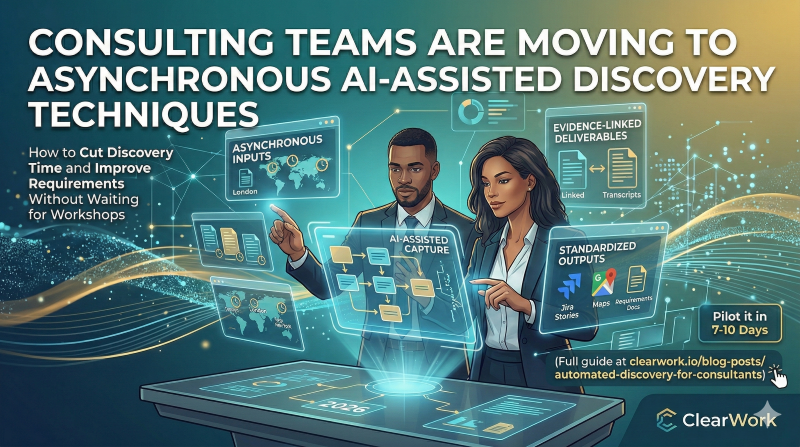
Workshops Don’t Scale (2026): The Asynchronous Discovery Playbook Consulting Teams Use to Move Faster
Avery Brooks
March 1, 2026
The hidden cost of consulting discovery isn’t analysis.
It’s scheduling.
Weeks disappear coordinating calendars. The right SMEs can’t attend every session. Workshops capture the “happy path,” and the real complexity shows up later as scope churn and change requests.
If you’ve read the full guide to Automated Discovery for Consulting (2026), you know the bigger system: messy inputs → async SME capture → evidence-linked deliverables → standardized outputs across teams.
(Full post here: https://www.clearwork.io/blog-posts/automated-discovery-for-consultants)
This post zooms in on one critical layer of that system:
Asynchronous discovery — and how to use it without sacrificing quality.
Workshops aren’t bad.
They’re just fragile when they become the only engine of discovery.
Here are the patterns most firms recognize.
Discovery timelines stretch because progress depends on calendar alignment, not actual analysis.
Managers attend. The people handling escalations, rework, and edge cases often don’t.
Politics, hierarchy, and consensus bias push the discussion toward the clean narrative—not the messy operational reality.
Workshops are optimized for clarity. Reality is optimized for survival. Exceptions get compressed or skipped.
Synthesis happens days later, when context is gone. That’s where requirement gaps form.
The downstream impact is predictable:
This is exactly the bottleneck described in the consulting automated discovery approach: workshops take weeks to schedule, decisions get lost across artifacts, and deliverables take forever.
https://www.clearwork.io/clearwork-for-consultants---automated-discovery
Asynchronous discovery is not:
It’s a structured way for SMEs to contribute on their own time, so discovery isn’t controlled by calendars.
The idea is simple:
This is one layer of the larger automated discovery model outlined in the pillar post:
https://www.clearwork.io/blog-posts/automated-discovery-for-consultants
Asynchronous discovery works especially well when:
Workshops still matter for:
The strongest consulting model is hybrid—not dogmatic.
Here’s what this looks like in practice.
Define:
Pick 1–2 process slices for a pilot. Avoid enterprise-wide scope creep.
Don’t only invite managers.
Include:
These are your exception magnets. They are more valuable than polished narratives.
Before asking SMEs anything, gather:
Use those to create a v1 outline.
This compresses ramp time and gives SMEs something concrete to react to—rather than asking them to start from memory.
This mirrors the first stage of ClearWork’s automated discovery model: analyze messy materials first, then capture what’s missing.
A strong async model balances coverage and nuance.
Mode A: Unstructured (voice or conversational input)
Best for surfacing:
Mode B: Structured prompts
Best for ensuring consistent coverage across roles:
This two-mode approach prevents both blind spots and shallow summaries.
Don’t wait until “everything is complete.”
Produce:
Generating early drafts reduces interpretation drift and gives the team something concrete to validate.
Avoid a 3-hour “review workshop.”
Instead:
The goal isn’t perfection.
The goal is confidence.
At the end of 7–10 days, you should have:
Now delivery can start without waiting for weeks of alignment.
The biggest fear leaders have: “Won’t this be shallow?”
Only if you remove the quality controls.
1. Evidence-first
Start from real artifacts, not blank prompts.
2. Exception-first
Explicitly ask:
3. Tight validation loop
SMEs confirm and correct drafts quickly.
The most effective consulting teams use:
This improves:
Fewer meetings. Better coverage. Faster outputs.
If you want to test this model:
Day 1–2
Scope + SME selection + artifact collection
Day 3–6
Async interviews + draft deliverables
Day 7–8
Validation and refinement
Day 9–10
Publish discovery bundle + delivery handoff
Measure:
If you want to better understand how AI platforms can support moving towards asynchronous process discovery, check out ClearWork for consultants.
No. Workshops are still useful for kickoff and conflict resolution. Async capture replaces the scheduling bottleneck and improves coverage.
Start from real artifacts, ask targeted prompts about exceptions and handoffs, and validate drafts quickly with SMEs.
You need coverage across each handoff point and at least one escalation-heavy contributor. Depth matters more than volume.
Ask directly about top exceptions, common rework triggers, and decision rules. Exception-first prompts surface truth more reliably than open-ended mapping sessions.
At minimum: process maps, exception catalogs, requirements drafts, and executive summaries—all validated and ready for delivery.
Workshops are valuable, but they shouldn’t control your timeline or determine how much truth you capture. A structured async discovery model—grounded in evidence, focused on exceptions, and validated quickly—lets consulting teams move faster without sacrificing depth. When combined with the full automated discovery system outlined in the pillar post, it becomes a repeatable engine for consistent, high-quality consulting delivery.
Fourteen days, full access, no card required.
No credit card required.