Two consulting jobs. One platform.
Whether you're advising the client on what to do or implementing it for them, Clarity shapes around the engagement — not the other way around.
The nuance that turns a credible recommendation into one a partner can poke holes in.
Everything you already have goes in
Scope docs, prior strategy decks nobody has read in eighteen months, kickoff recordings, existing SOPs.

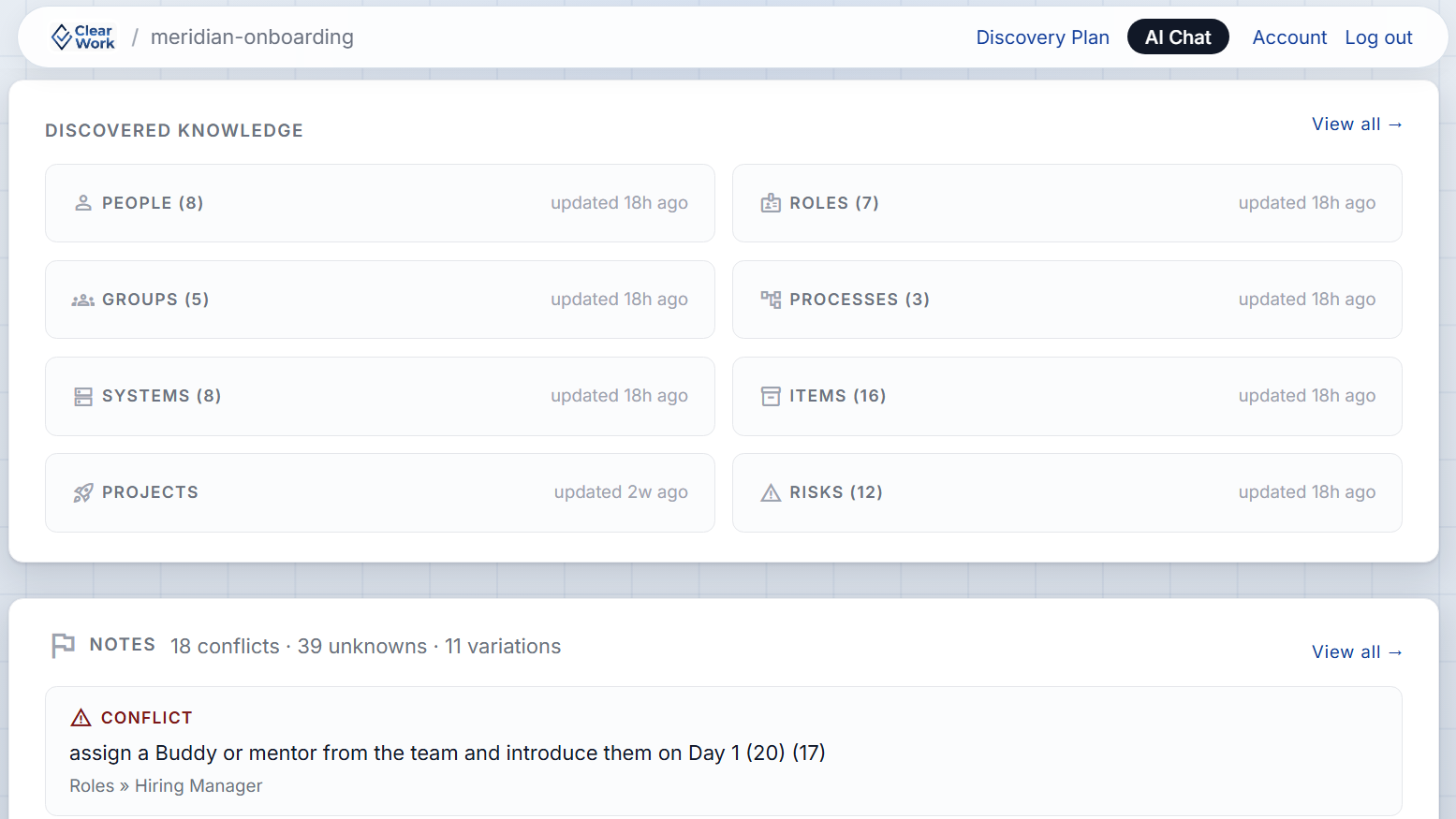
Async interviews extend your reach
You still lead the live sessions. Interview links go to all twelve stakeholders — including the ones who'd never make the workshop — answered on their own time.
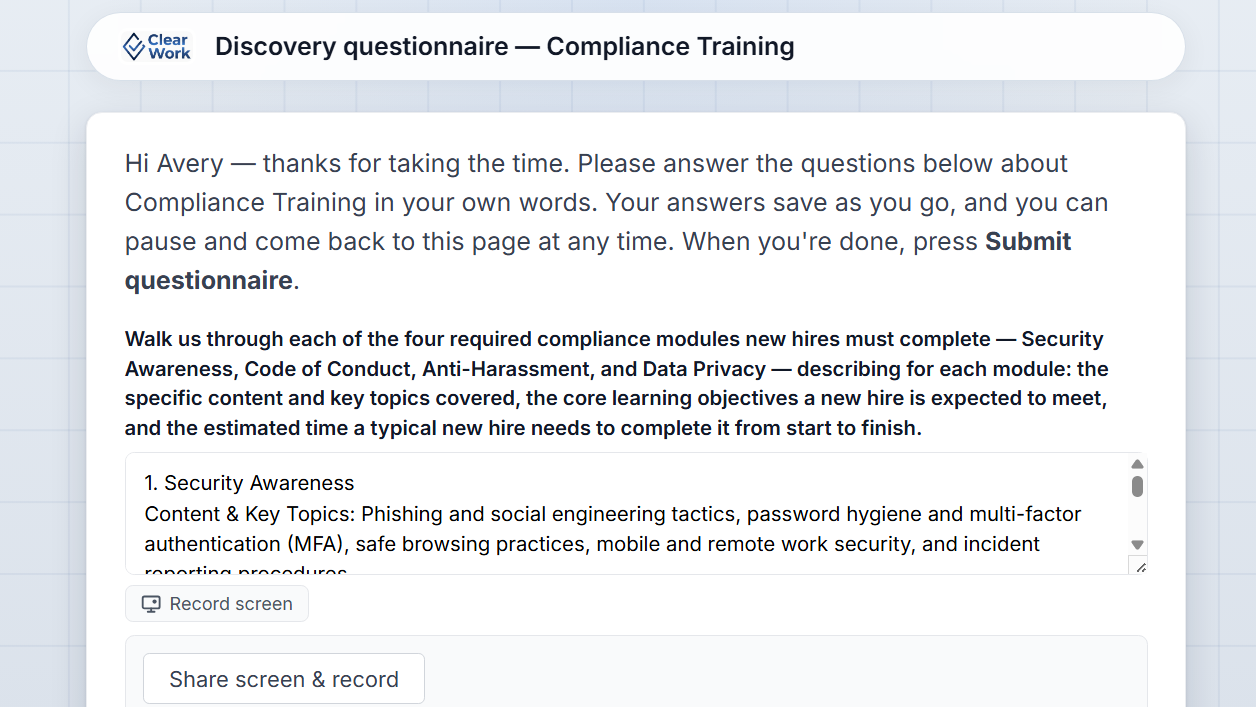
Conflicts surface before the readout
Where two stakeholders disagree, both views are shown with their sources. Where a step appears three ways, all three are surfaced — not averaged.

Generate the diagnosis from validated truth
Current-state assessment, gap analysis and executive presentation from one dataset. When the CFO challenges a finding, you click the line and show the source.

A build that starts on shallow discovery — and scope misses that surface in UAT.
Load the client's existing material
Process documentation, policy manuals, legacy system exports, workshop notes. Clarity reads all of it and drafts the first version of the record.
Process owners contribute in parallel
Across all four entities at once. SMEs explain exceptions, answer follow-ups, or share their screen for a day-in-the-life walkthrough — by voice or chat.
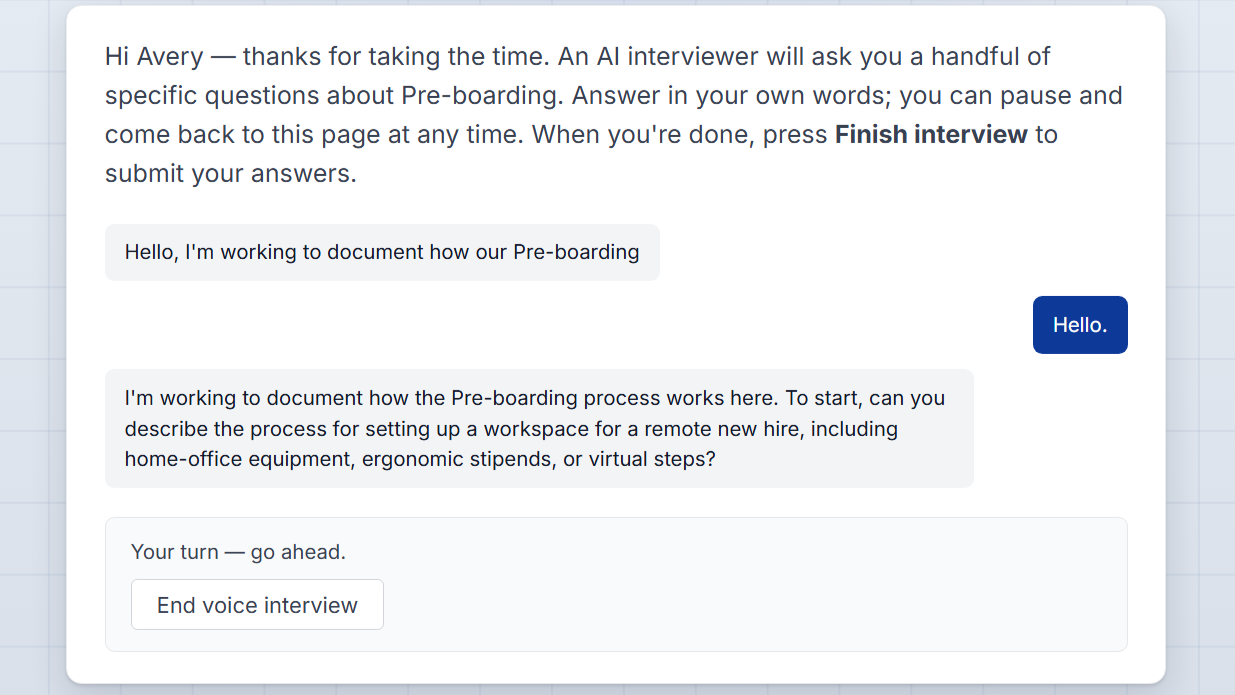
Gaps exposed before design assumptions form
Missing process owners, conflicting procedures, untested SOPs, ambiguous requirements. You approve follow-ups before a gap becomes a design assumption.

Build-ready requirements, sourced
Requirements docs, as-is process maps, fit-gap analysis, SOPs and user stories from one dataset — exported in standard formats and ready to move into your delivery tooling. Build starts on evidence.

Every engagement is sealed.
Client isolation, access control, and where your client's data actually goes.
Complete separation between clients
No leakage, no cross-project retrieval, no shared context. Each engagement behaves like its own system — because to your client, it is.
You decide what the client sees
Run it as a consultant-only workspace and present finished deliverables. Or bring named client stakeholders in with role-scoped access — interview participation, read-only review, or full collaboration.
No AI training on client data
Client documents, interviews, transcripts and recordings are never used to train a model. Data sent to AI providers is contractually excluded from training.
"It's like its own client."
Independent transformation consultant · ex-Gartner, ex-SAP
Every other tool waits for someone to write it down.
Point an LLM at the client's document set and you get a very good summary of the client's document set. It can't reach the workaround nobody wrote down, the approval threshold that isn't in the policy, or the entity doing it differently. Someone has to go and ask — that's what Clarity does.
The question isn't whether an AI could draft this.
It's who maintains it in week six.
Correct something in ClearWork and it becomes a fact the system honours for the rest of the engagement. Every deliverable built on it re-surfaces for review.
"Where can I continue to deliver value?"
They were never paying you to interview twelve people.
They were paying you to know what to do with what those twelve people said. Discovery was the tax you charged for the real work — weeks of calendar wrangling, transcription and synthesis the client experienced as an invoice and a delay.
Take the tax off the bill and you win more proposals, because you can walk into a pitch with a real read on their operation instead of a promise to go find one. And you spend the engagement on the recommendation instead of the notes.
On the proposal
Don't hand over the full readout before the contract. Hand over the shape of it: this is what three documents and six recordings produced — imagine the full engagement. The teaser wins the work.
On the hours
If your fee is defensible only because discovery is slow, it was already fragile. Outcome-priced work gets more profitable when discovery gets faster, not less.
On what you're selling
Your client cannot buy your judgment from anyone else. They can buy note-taking from a $20 chat subscription.
Your numbers, your assumptions.
With banded core pricing from $200/mo and client interview participants always free and uncapped, software cost is recovered in a fraction of your first engagement.
Practice inputs
Estimated annual impact
Client SMEs participate in interviews and screen walkthroughs for free with no cap. The first 10 read-only stakeholder viewer licences are included free on every band.
Every work product, from one engagement.
Not blank templates to fill in — populated deliverables Clarity drafts from the validated client record, every line linked to the source it came from.

Process maps & swimlanes
Role-based flows with handoffs, decision points and the exception paths that only surfaced in interviews.
Requirements, BRDs, RTMs & user stories
Functional and non-functional requirements, traceability matrices, epics and acceptance criteria — exported in standard formats your delivery team can work from.
Every line source-linked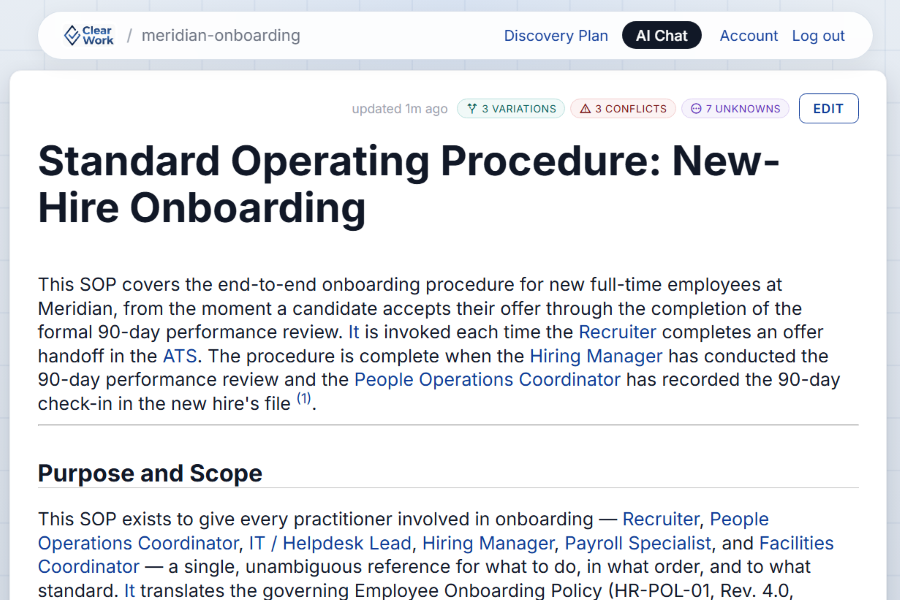
SOPs & work instructions
Procedure documents drafted from how the work is actually done, not from a template you fill in.
Roadmaps & executive briefs
Current-state reads, gap analyses and client-ready narratives grounded in the validated record.
Built for every kind of engagement.
Because they all start with the same truth: if you don't understand the process, you don't understand the requirements.
Process improvement
Capture reality, find bottlenecks, standardise across teams.
ERP / CRM implementation
Workflows, exceptions and requirements before the build phase.
Technology selection
Fit-gap grounded in real operations, not vendor feature lists.
AI / agent deployment
Define safe scope and human handoffs before automating anything.
Operating model redesign
Clarify ownership, decisions and cross-team responsibilities.
Shared services
Standardise processes across teams, regions and entities.
Post-merger integration
Align processes, cut duplication, ramp the combined org.
Compliance & controls
Capture approval points, evidence trails and policy adherence.
For consulting teams, answered.
How is this different from just using Claude or ChatGPT?
A good model can draft a process map from documents you paste into it. That was never the hard part.
Two things are. An LLM can only work with what someone already wrote down — it can't identify that the US entity approves outside the ERP and then go ask the AP manager about it. Clarity does. And a chat thread doesn't persist: ask twice, get two different answers; correct it, and the correction survives until the context window forgets.
Correct something in ClearWork and it becomes a fact the system honours for the rest of the engagement — navigable, reviewable, and handed to whoever picks up the next phase.
How do you know the extraction was right in the first place?
Fair question, and a different one from traceability. Traceability tells you where a line came from — not that the system read the document correctly.
So the record shows its work. Every claim carries what it pulled and how confident it is. Ambiguity is flagged rather than resolved quietly. Where two sources disagree, both are surfaced with their sources rather than one being silently chosen. Then a person on your team confirms it before it enters the record. The gate is the answer, not the citation.
Can clients see ClearWork, or is it consultant-only?
Both. Many teams run it as a consultant-only workspace and present finished deliverables. Others bring named client stakeholders in with role-scoped access — interview participation only (always free and uncapped), read-only review of the knowledge base (first 10 free), or full core collaboration. You decide per person.
How do client SMEs take part without scheduling meetings?
You send a secure link by email and they respond on their own time. They can talk to a conversational voice agent, answer guided questions by typing, record their screen and narrate a day-in-the-life walkthrough, or attach files and context.
Whether your client's culture takes to async interviews varies a lot. Some use them constantly; others upload their own transcripts and never touch them. Both produce the same record.
What happens when the engagement ends?
Your core band covers your firm's practitioners across all active client accounts. When an engagement concludes, export the deliverables, archive the workspace, or keep the client record live for reference. You can scale your core team or read-only viewer bands up and down month to month without lock-in.
Can we standardise our firm's discovery approach?
Yes. ClearWork gives you a repeatable discovery workflow and consistent deliverable formats across engagement types and client teams. Your core practitioners conduct the work, while all client SMEs participate as free, uncapped interview contributors.
Can we get the outputs into the tools we already use?
Documents export to Word and PDF. Diagrams export to Visio and draw.io. Requirements, epics, user stories and acceptance criteria come out in standard structured formats your team can move into whatever tracker or delivery tool you run.
To be straight with you: we don't have native two-way integrations with delivery tools yet. Everything comes out clean and structured — but it's an export, not a live sync.
Bring a live engagement. We'll build the record from your client's real materials.
Scope docs, a kickoff recording, a couple of SOPs. You'll see the process maps, requirements and gaps it produces — not a canned demo on invented data.