Most SOP initiatives stall before they even begin.
Not because teams don’t understand the process—but because they’re staring at a blank page trying to document it.
Writing SOPs from memory creates predictable problems:
This is why many SOP initiatives start strong and then quietly fade away.
The organizations that produce accurate, useful documentation don’t begin with writing. They begin with process discovery—capturing how work actually happens and generating documentation from those insights.
A broader guide on AI-powered SOP creation explains how teams can generate process documentation from real operational workflows rather than guesswork.
In this article, we’ll walk through a practical workflow that consulting teams, operations leaders, and process excellence groups use to move from process discovery to fully structured SOPs—without starting from a blank page.
The biggest challenge in documentation is trying to 1) figure out the process and 2) figuring out how to translate that knowledge into structured documentation.
When teams start writing SOPs manually, several issues appear quickly.
Even experienced SMEs forget important operational details when documenting processes from memory.
What gets lost most often:
These are often the very details that determine whether a process actually works.
When documentation skips these elements, the resulting SOP becomes a simplified version of reality.
SOP drafts created from scratch tend to be long and unstructured.
SMEs are asked to review large documents that attempt to reconstruct their work from notes. This review process becomes tedious and time-consuming.
As a result, feedback slows down or stops entirely.
When SOPs are written manually, they often represent how teams believe work should happen rather than how work actually occurs.
Over time, this gap widens.
Teams adapt their workflows, but the documentation remains unchanged.
Eventually the SOP becomes outdated and stops being used.
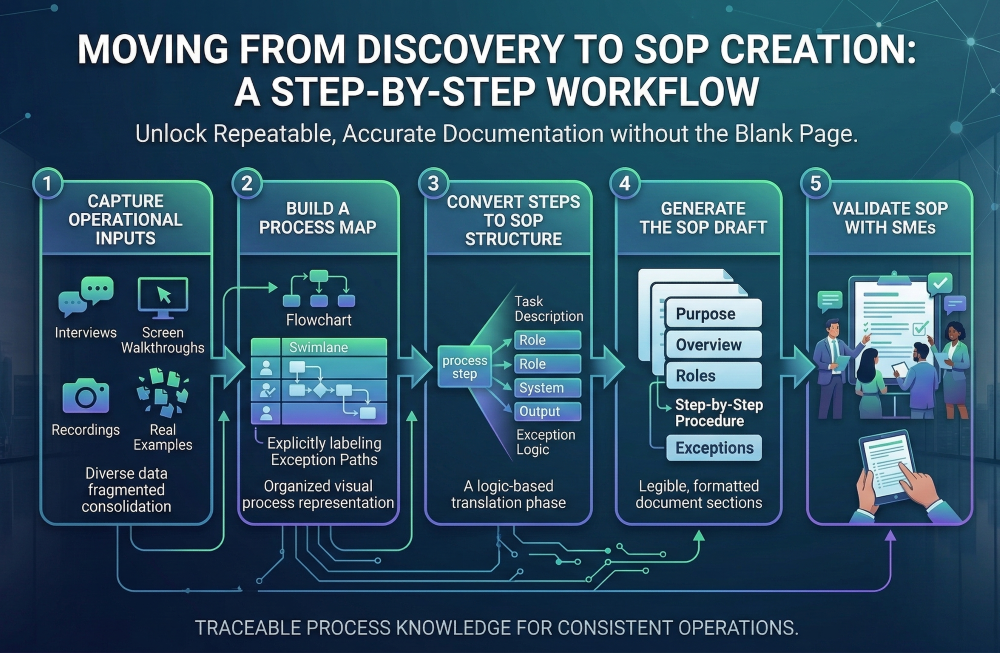
Instead of writing SOPs manually, modern documentation workflows generate SOPs from operational discovery outputs.
The process typically follows a structured progression:
Operational discovery → process model → structured steps → SOP documentation.
This approach removes the blank-page problem entirely.
Rather than inventing documentation, teams transform existing operational knowledge into structured process documentation.
The first step in creating strong SOPs is understanding how work actually happens.
This means gathering operational inputs from the people and systems involved in the process.
Typical sources include:
These inputs reveal the real operational behavior behind the process.
Capturing these inputs thoroughly is essential because they form the foundation for every step that follows.
Once operational inputs are gathered, the next step is organizing them into a structured representation of the workflow.
Process maps provide this structure.
Common formats include:
These models make it easier to visualize how work moves across teams and systems.
More importantly, they create a logical structure for SOP documentation.
Instead of writing procedures arbitrarily, documentation can follow the actual sequence of operational steps.
Once a process map exists, each step in the workflow can be translated into structured documentation.
A typical SOP step includes several key elements:
Because these elements come directly from the process map, the documentation process becomes much more systematic.
Teams are no longer guessing how to structure the SOP.
They simply document the workflow that already exists.
At this stage, creating the SOP document becomes straightforward.
The structure of the document usually includes:
Because these sections are generated from the underlying process model, the draft documentation is typically much more complete than manually written SOPs.
Teams spend far less time writing and far more time validating.
The final step in the workflow is validation.
But instead of reviewing a blank document, SMEs are reviewing documentation generated from the workflow they helped describe.
This makes the validation process significantly easier.
SMEs can focus on confirming details such as:
Because the structure already reflects the operational workflow, most validation sessions focus on small corrections rather than major rewrites.
Historically, even structured documentation workflows required significant manual effort.
Today, many organizations use automation tools to accelerate the process.
Modern platforms can:
This allows operations teams and consulting teams to move from discovery to documentation far more quickly.
Platforms like ClearWork are designed to support this workflow by capturing operational inputs, generating process documentation, and maintaining traceability between workflows and documentation.
https://www.clearwork.io/ai-sop-generator-process-documentation-software-clearwork
When discovery insights and documentation remain connected, SOPs stay aligned with real operational processes.
Even teams that understand the value of documentation can run into challenges if the workflow isn’t structured properly.
SOPs should emerge from process discovery, not precede it.
Exceptions often define the most critical steps in a process.
When documentation is separated from the operational workflow, it becomes difficult to maintain.
SOPs should always be confirmed by the people who actually perform the work.
Starting from a blank page forces teams to reconstruct operational workflows from memory, which often leads to incomplete or inaccurate documentation.
Process discovery focuses on understanding how work actually happens, while SOP documentation translates those insights into structured instructions.
Process mapping should come first because it provides the structure needed to organize SOP documentation logically.
The timeline depends on process complexity, but using a structured discovery-to-documentation workflow significantly reduces documentation time.
Tools that support automated discovery, process intelligence, and document generation can help teams produce SOPs faster while maintaining alignment with operational workflows.
When teams capture operational inputs, structure workflows through process models, and generate documentation from those insights, the blank-page problem disappears. Modern platforms like ClearWork make it possible to automate much of this workflow, helping organizations produce reliable SOPs faster and keep documentation aligned with real operational processes.
Enjoy our newsletter!