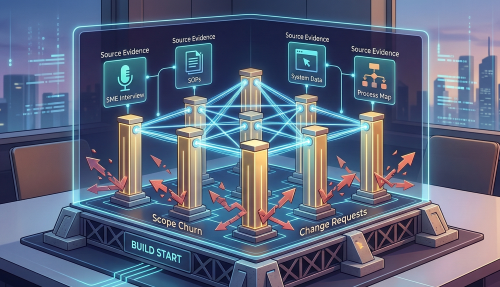
Most consulting projects don’t struggle because teams fail to write requirements.
They struggle because the requirements lose their connection to reality.
A project begins with thoughtful discovery, a few workshops, and a clean requirements document. Then the implementation phase starts, and suddenly the team discovers:
That’s when change requests begin.
Scope churn rarely starts during build. It starts during discovery when requirements drift away from the real operational workflows they were supposed to describe.
In the previous article on asynchronous discovery, we explored how consulting teams capture operational knowledge faster without relying entirely on workshops. That approach dramatically improves discovery coverage because SMEs contribute on their own time rather than waiting for meetings.
But faster discovery alone isn’t enough. The real breakthrough happens when requirements stay directly connected to the evidence that created them.
That’s where evidence-linked requirements come in.
Most consulting teams follow a reasonable discovery process. They hold workshops, capture notes, document processes, and translate those insights into requirements.
Yet scope churn still happens.
The problem isn’t effort. The problem is information drift.
Workshops naturally simplify complexity.
People describe the standard workflow because it’s easier to explain and easier to map. Unfortunately, operational reality rarely follows the standard path.
The most important requirements usually come from:
When these aren’t captured during discovery, they show up later as “unexpected requirements.”
In reality, they were always there.
Discovery usually produces multiple outputs:
But the reasoning behind decisions often disappears between those artifacts.
Someone remembers a conversation about an exception rule. Someone else remembers a different interpretation. Weeks later, nobody is certain which one was correct.
The requirement becomes a guess rather than a verified outcome.
Requirements are often written long after the conversations that produced them.
When documentation happens days or weeks later:
That’s how the final requirements document becomes slightly disconnected from the real workflow.
And small gaps become large implementation surprises.
Evidence-linked requirements solve a simple but powerful problem:
They keep requirements connected to the operational inputs that created them.
Those inputs might include:
Instead of treating requirements as independent statements, this approach treats them as conclusions supported by evidence.
The requirement isn’t just written.
It’s grounded in what the organization actually does.
Traditional discovery workflows often look like this:
Interview → notes → interpretation → requirements document
Each step introduces interpretation risk.
Evidence-linked discovery changes the order:
Evidence → process step → requirement → acceptance criteria
In other words, requirements emerge from the operational workflow rather than being written separately from it.
That small shift dramatically improves clarity.
When requirements are connected to source evidence, teams gain three advantages.
First, validation becomes easier. Instead of debating whether a requirement is correct, teams review the underlying operational evidence.
Second, disagreements resolve faster. If two stakeholders interpret something differently, the team can revisit the source material rather than arguing over memory.
Third, exceptions surface earlier. Because discovery focuses on real operational behavior, unusual scenarios appear sooner rather than during implementation.
The result is fewer surprises during build.
Evidence-linked requirements are less about documentation tools and more about workflow discipline.
Here is the practical framework consulting teams can use.
Before writing requirements, define the operational flow of work.
This includes:
Capturing the workflow first ensures requirements reflect how work actually happens, not how people assume it happens.
Many consulting teams now gather this information asynchronously through SME interviews and operational walkthroughs. This approach improves coverage because it removes scheduling bottlenecks and allows SMEs to provide input in context.
The asynchronous discovery playbook discussed here explains how teams capture these inputs quickly and reliably.
Once the workflow is visible, focus on the decision points within it.
For each step ask questions like:
Decision logic often produces the most important system requirements.
It’s also where most scope surprises originate.
Now translate operational steps into implementation requirements.
For each requirement define:
This structured approach ensures requirements map clearly to operational behavior.
This is the critical step.
Each requirement should reference the evidence that generated it.
That evidence may include:
This creates traceability, which makes validation and future updates much easier.
Validation should focus on reality, not wording.
Instead of asking stakeholders:
“Do you agree with this requirement?”
Ask:
“When this situation occurs, does this describe what actually happens?”
That question quickly exposes missing logic or incorrect assumptions.
When requirements remain connected to operational evidence, several improvements appear almost immediately.
Exceptions and edge cases are identified during discovery instead of during build.
That means fewer last-minute requirement changes.
Evidence removes ambiguity.
Instead of debating interpretations, teams review the operational source behind each requirement.
Alignment becomes easier because discussions focus on reality.
Development teams receive requirements grounded in real workflows.
This reduces the number of clarification cycles that typically slow implementation projects.
Clients trust deliverables more when they can see how insights were generated.
Evidence-linked discovery demonstrates that outputs reflect their actual operations, not consultant assumptions.
Evidence-linked requirements work best as part of a modern discovery workflow that combines several capabilities.
First, operational inputs must be captured efficiently. Asynchronous SME interviews and artifact analysis help gather a more complete view of the process.
Second, process understanding must be structured through process maps, narratives, and documented workflows.
Third, deliverables must remain connected to their sources so validation remains easy throughout the project.
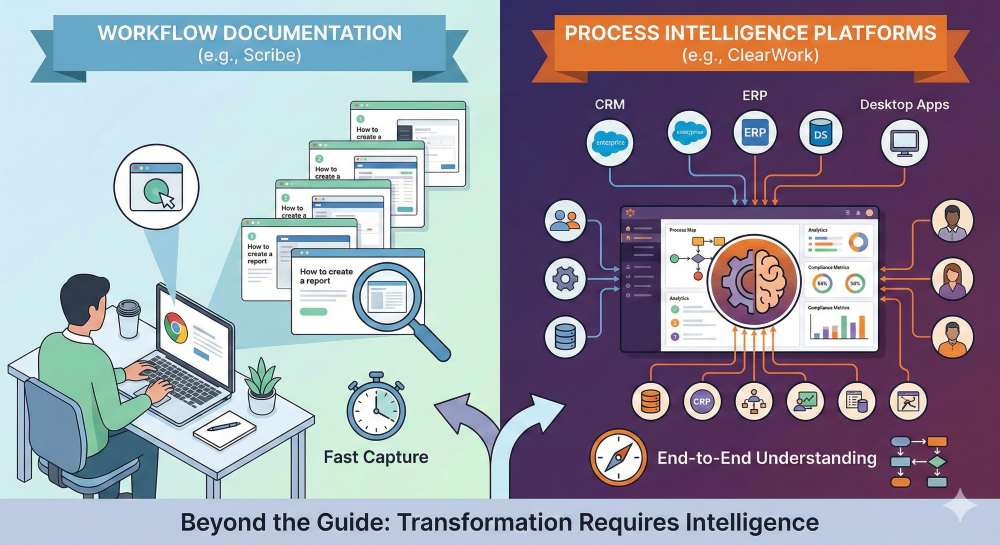
Automated discovery platforms like ClearWork support this model by capturing SME inputs, generating discovery artifacts, and keeping outputs tied to source evidence.
https://www.clearwork.io/clearwork-for-consultants---automated-discovery
When discovery follows this pattern, requirements become far more stable and implementation becomes far more predictable.
Even strong consulting teams can weaken discovery if they fall into common traps.
Requirements should follow process discovery, not precede it.
Exceptions often define the most critical system requirements.
Requirements, process maps, and documentation should remain connected so teams can revisit source evidence easily.
Validation should happen continuously during discovery rather than at the end of the process.
Evidence-linked requirements are requirements that trace directly back to operational inputs such as SME interviews, documents, walkthroughs, or system examples.
Scope churn typically occurs because discovery captures simplified workflows while missing the exceptions and decision logic that shape real operational behavior.
They allow teams to verify requirements against source evidence early in the project, reducing interpretation errors and preventing missed scenarios.
Yes. Workshops are valuable for alignment and validation. However, relying on them as the primary discovery mechanism often limits coverage and slows timelines.
Tools that combine asynchronous discovery, process intelligence, and automated artifact generation can help maintain the connection between requirements and their source inputs.
When requirements stay connected to the operational evidence that produced them, consulting teams dramatically reduce scope churn and enter implementation with far fewer surprises.
Enjoy our newsletter!