Your team just completed a process documentation project. Forty SOPs written, reviewed, approved, and published to the company wiki. Six months later, three of your best employees are working around them entirely — relying on tribal knowledge, Slack threads, and informal workarounds instead.
This is not a compliance problem. It is not a training problem. It is a documentation architecture problem.
The issue is that most organizations treat SOPs as finished deliverables. They build them once, publish them, and assume the job is done. But processes are not finished things — they change constantly as tools upgrade, teams shift, and business conditions evolve. When documentation can't keep pace, it becomes noise employees learn to ignore.
What separates high-performing operations teams is not better SOPs. It's a fundamentally different approach to how documentation lives and grows. The broader guide on AI SOP generation and process documentation explains the structural difference between building SOPs and maintaining them — and why most organizations conflate the two.
Most SOP initiatives start with a sprint: gather subject matter experts, interview them, write up the steps, get sign-off, publish. That sprint produces something real and valuable on day one. The problem is what happens next: nothing. No owner, no trigger to update, no feedback loop from the people actually doing the work.
The document decays in real time. Process steps change, systems get updated, new exceptions emerge — and the SOP just sits there, confidently wrong.
Business cycles are accelerating. A software team ships features weekly. An operations team adopts a new CRM. A compliance update changes a required approval step. Any of these events can make an existing SOP inaccurate overnight. Traditional documentation cycles — quarterly reviews, annual audits — cannot absorb that rate of change.
The result: employees learn that checking the SOP is not worth their time. They know from experience it won't reflect what they're actually supposed to do.
Without a single authoritative source, versions multiply. Someone updates the SOP in Confluence, someone else edits the PDF on SharePoint, and a team lead has a third version saved locally from the last training session. New hires learn quickly that asking a colleague is more reliable than finding the right document.
This is not a technology problem — it is a governance problem compounded by the wrong format.
When SOPs consistently lag behind reality, teams treat them as optional. Experienced employees skip them entirely. New employees get a fast informal education: "The wiki shows X, but we actually do Y." This creates operational inconsistency, onboarding gaps, and real audit risk.
Research from MaintainX and ProcessDriven shows that when documentation is out of sync with actual practice, employees don't flag the error — they simply stop consulting the docs at all.
Static documentation is authoritative by design — it flows downward from a documentation team or management layer to the people doing the work. But the people doing the work are the ones who know when the process has changed. Without a mechanism to capture that knowledge, the documentation will always lag.
A living SOP is not a document with a "last updated" date. It is a process artifact that reflects how work is actually being done right now — with mechanisms to keep it current as reality changes.
It is not a wiki that employees can technically edit. It is not an automated flowchart with no ownership. It is not a PDF in a shared drive with a version number.
A living SOP is characterized by three things: it is grounded in how work actually happens (not how someone assumed it would happen), it has a clear owner and update trigger, and it has a feedback mechanism that captures exceptions and deviations as they occur.
This approach is particularly important for processes involving multiple handoffs, compliance requirements, or onboarding-sensitive steps — places where version drift creates real operational and legal risk.
Before writing a single step, capture how the work actually happens. Interview the people doing it. Ask about exceptions. Ask what the written process misses. Ask what they do when something goes wrong.
This evidence-gathering phase is what most documentation projects skip. They start with a template, fill it in based on a meeting with a manager, and call it done. The resulting document reflects the ideal process — not the operational reality.
Every SOP needs an owner: a named person responsible for keeping it accurate. And that owner needs a clear set of triggers that signal when an update is required: a system change, a new tool rollout, a compliance update, a recurring exception that keeps surfacing.
Without triggers, ownership is meaningless. The owner has no signal to act until someone complains — and by then, the damage is done.
Build a lightweight mechanism for the people following the SOP to flag when something is wrong. This does not need to be sophisticated — a comment field, a form, a Slack channel tied to the document. The point is to close the loop between documentation and execution.
When practitioners can flag drift easily, your SOP improves continuously. When they can't, you get a document that's confidently outdated.
Quarterly review cycles make sense for low-change processes. For everything else, reviewing on use is more reliable: every time an SOP is consulted in a high-stakes situation (onboarding, an audit, a system change), that's a trigger to verify its accuracy.
Basing review cadence on change velocity rather than the calendar is what separates living documentation from static documentation with a review schedule stamped on it.
Identify every active SOP. Categorize each one by change velocity — how often does the underlying process actually change? Flag the five highest-risk documents: the ones that are process-critical and most likely to be out of date.
For each high-risk SOP, conduct a brief process interview with the person who actually does the work. Not a manager. Not the original author. The practitioner. Compare what they say against what the document says. Note every gap.
This exercise almost always surfaces significant deviations — exceptions that have become standard practice, steps that were automated months ago, approval chains that changed after an org restructure.
For each SOP, assign a named owner. Work with them to define a short list of events that would trigger an update. Publish the updated document with the owner's name and a clear update-trigger list visible in the header.
Add a simple feedback mechanism to every SOP. Make it easy for practitioners to flag inaccuracies. Set a calendar reminder for the owner to review flagged items monthly. This single change — a feedback loop — is what transforms static documentation into living documentation over time.
Organizations that operate on living documentation see measurable benefits across three areas.
Onboarding speed. When documentation accurately reflects how work is done, new hires reach productivity faster. They don't spend their first weeks unlearning the SOP and re-learning the informal process.
Audit readiness. Living SOPs reduce the scramble that precedes every audit. When documentation reflects actual practice, it can be submitted with confidence rather than quietly corrected at the last minute.
Operational consistency. When every team member follows a process grounded in reality — not assumptions — variance decreases. Handoffs improve. Exceptions get handled correctly the first time.
The financial impact compounds over time. Studies estimate that employees waste up to two hours daily searching for information that may not even be current. Even partial recovery of that time has measurable ROI.
Capturing how work actually happens — before writing a single word of documentation — is the step most organizations skip. It's also the hardest to do at scale.
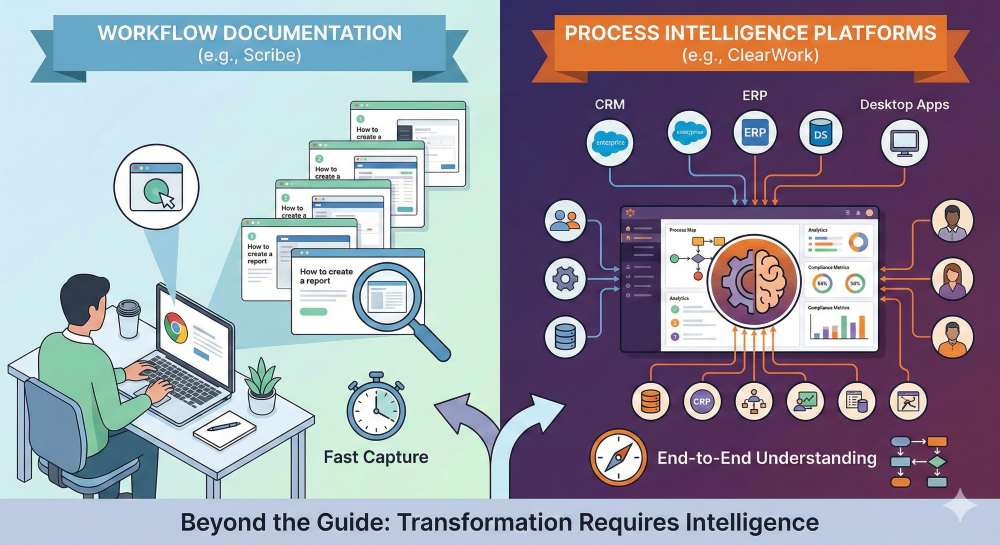
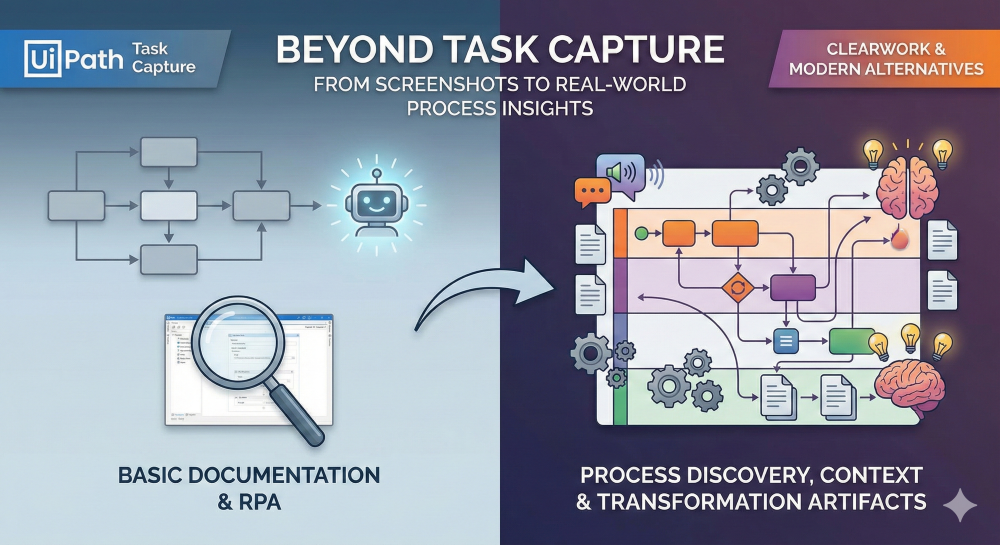
Platforms like ClearWork support this by using AI agents to interview practitioners asynchronously, capturing real process steps, exceptions, and handoffs without the coordination overhead of live workshops. The output isn't a template — it's an evidence-linked process map that reflects what the team actually does.
For operations teams managing dozens of SOPs across multiple functions, this approach means documentation starts accurate — and has the structural foundation to stay that way.
A wiki is a platform. A living SOP is a practice — documentation that is grounded in how work actually happens, owned by a named practitioner, and updated by defined triggers rather than arbitrary schedules. A wiki can host living SOPs, but a wiki alone does not make documentation "living."
It depends on the change velocity of the underlying process. High-change processes (software workflows, onboarding steps tied to specific tools) may need updates monthly or after every system change. Stable processes (annual compliance checks, rarely-changing supplier procedures) can be reviewed quarterly or annually.
The person closest to the process — ideally the team lead or senior practitioner who performs the work regularly. Ownership should not sit with a documentation team or a central ops function unless that team is directly involved in the process.
Operational drift: the gap between what the SOP says and what teams actually do. Left unchecked, this drift creates onboarding failures, audit exposure, and process inconsistency that compounds over time.
System migrations are the highest-risk moment for documentation. Assign a documentation owner to each impacted SOP before the migration begins. Build SOP review into the project plan — not as an afterthought, but as a go-live requirement. Treat any SOP that references the old system as immediately outdated and schedule a re-grounding interview within the first two weeks post-migration.
Most process documentation isn't failing because of poor writing — it's failing because it was designed to be finished rather than maintained. Living SOPs close that gap by treating documentation as an operational system with real ownership, real feedback loops, and a foundation in how work actually happens. When documentation reflects reality, teams use it — and the compounding benefits show up in onboarding speed, audit readiness, and day-to-day operational consistency.
Enjoy our newsletter!