Most organizations don’t have a collaboration problem.
They have a trust problem.
Teams collaborate constantly—commenting on documents, debating changes, suggesting improvements—but they rarely agree on one thing:
What is actually true about how the process works today?
That gap between collaboration and truth is why process documentation goes stale, why governance becomes political, and why “continuous improvement” often means repeating the same conversations every quarter.
In 2026, leading process excellence and transformation teams are addressing this gap with a new model:
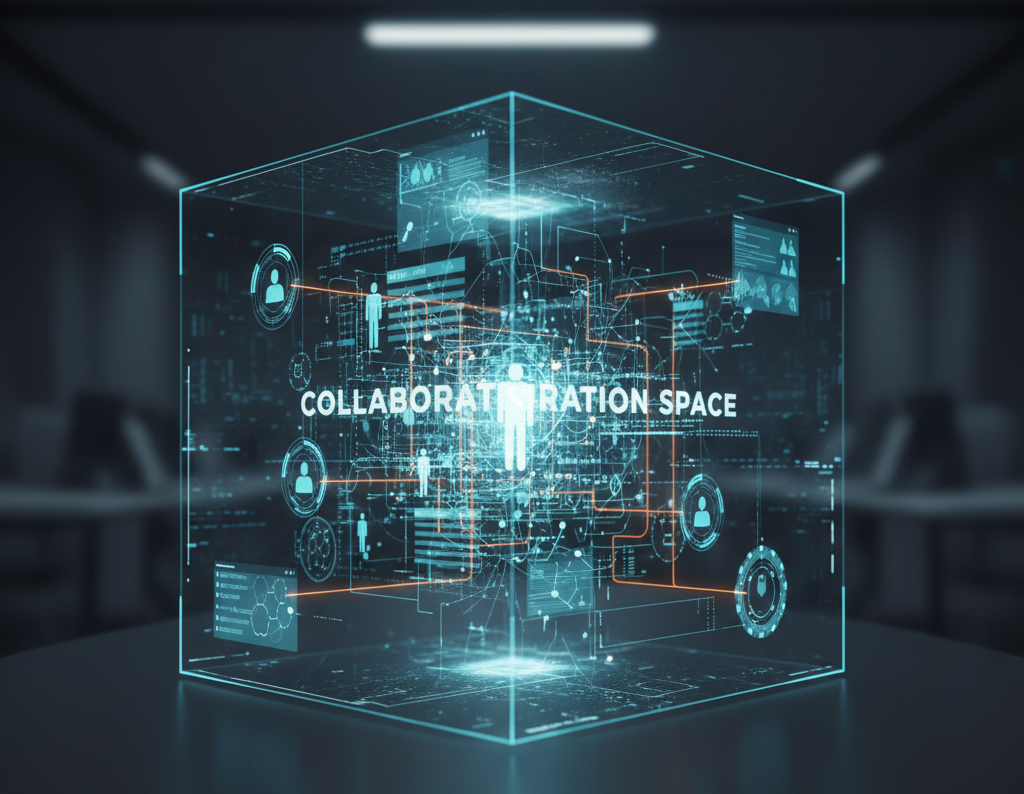
AI-powered Collaboration Spaces that are grounded in discovery evidence, connected through a process knowledge graph, and designed to evolve with the business.
This article explains why generic AI copilots fall short for process collaboration—and how evidence-grounded AI changes the game. If you want a broad view into the changing landscape of these types of collaboration spaces, check out: Collaboration Spaces for Process Excellence (2026): The Modern Process Repository Beyond Confluence & Notion
AI is now embedded in nearly every collaboration tool.
You can:
And yet, process teams still struggle with the same problems:
The reason is simple:
Most AI today reasons over text, not over reality.
If the underlying documentation is incomplete, outdated, or aspirational, AI doesn’t fix the problem—it accelerates it.
Traditional collaboration tools treat processes as static documents. AI layers on top of those tools inherit the same limitations.
Common failure modes include:
In other words, AI becomes a faster way to produce confident answers to the wrong question.
For AI to be useful in process collaboration, it needs more than text.
It needs context—structured, explainable, and grounded in evidence.
That context includes:
Most collaboration tools don’t model these elements explicitly. They rely on humans to infer relationships mentally.
Collaboration Spaces make those relationships explicit.
Collaboration Spaces are designed around a simple but powerful idea:
Collaboration happens on artifacts, and artifacts are connected through a process knowledge graph.
This graph isn’t an abstract technical construct—it’s what allows AI to reason instead of guess.
In ClearWork, artifacts are connected to:
As a result, AI operates within guardrails:
This distinction is critical for positioning.
These capabilities are useful—but they don’t solve process truth.
In Collaboration Spaces, AI is not just a writing assistant.
It’s a reasoning layer over real operational knowledge.
The most important difference in ClearWork’s model is that Collaboration Spaces are not created in isolation.
They are fed by discovery.
ClearWork Automated Process Discovery captures:
When artifacts are promoted from projects into Collaboration Spaces:
This ensures that collaboration and refinement never drift too far from reality.
AI-powered Collaboration Spaces enable a repeatable improvement loop:
This is what “living documentation” looks like in practice—not just in theory.
Process governance often fails because it’s disconnected from daily work.
AI-powered Collaboration Spaces change that by:
Instead of governance being a quarterly meeting, it becomes a continuous, lightweight practice.
AI can identify where similar processes diverge across regions or teams—and explain why—before standardization decisions are made.
Instead of exceptions being tribal knowledge, they become explicit, versioned, and measurable.
Evidence, approvals, and historical context are attached to the artifact—not scattered across email threads.
As new systems roll out, Collaboration Spaces ensure documentation evolves alongside execution—not months later.
ClearWork isn’t trying to replace:
It fills the gap between them.
Collaboration Spaces sit where process knowledge needs to live:
They become the connective tissue between planning, execution, and improvement.
Can AI really be trusted with process knowledge?
Yes—when it’s grounded in evidence and constrained by context. Without that, AI is just summarizing assumptions faster.
Will this create more overhead?
No. The model removes overhead by eliminating rework, duplicate documentation, and repeated debates.
Do teams need to change how they collaborate?
No. Collaboration stays simple—commenting, refining, approving—but it happens in a more structured, meaningful context.
Process excellence teams are no longer asking:
“How do we document this better?”
They’re asking:
“How do we make sure our process knowledge stays true as the business changes?”
AI-powered Collaboration Spaces answer that question by connecting collaboration, discovery, governance, and improvement into one continuous system.
AI doesn’t replace process expertise.
But when it’s grounded in real discovery data and structured context, it becomes a force multiplier—helping teams collaborate with confidence instead of assumptions.
That’s the future of process collaboration.
If your teams are collaborating more than ever but still debating what’s true, it’s time for AI-powered Collaboration Spaces that keep process knowledge grounded in reality as it evolves.
Enjoy our newsletter!