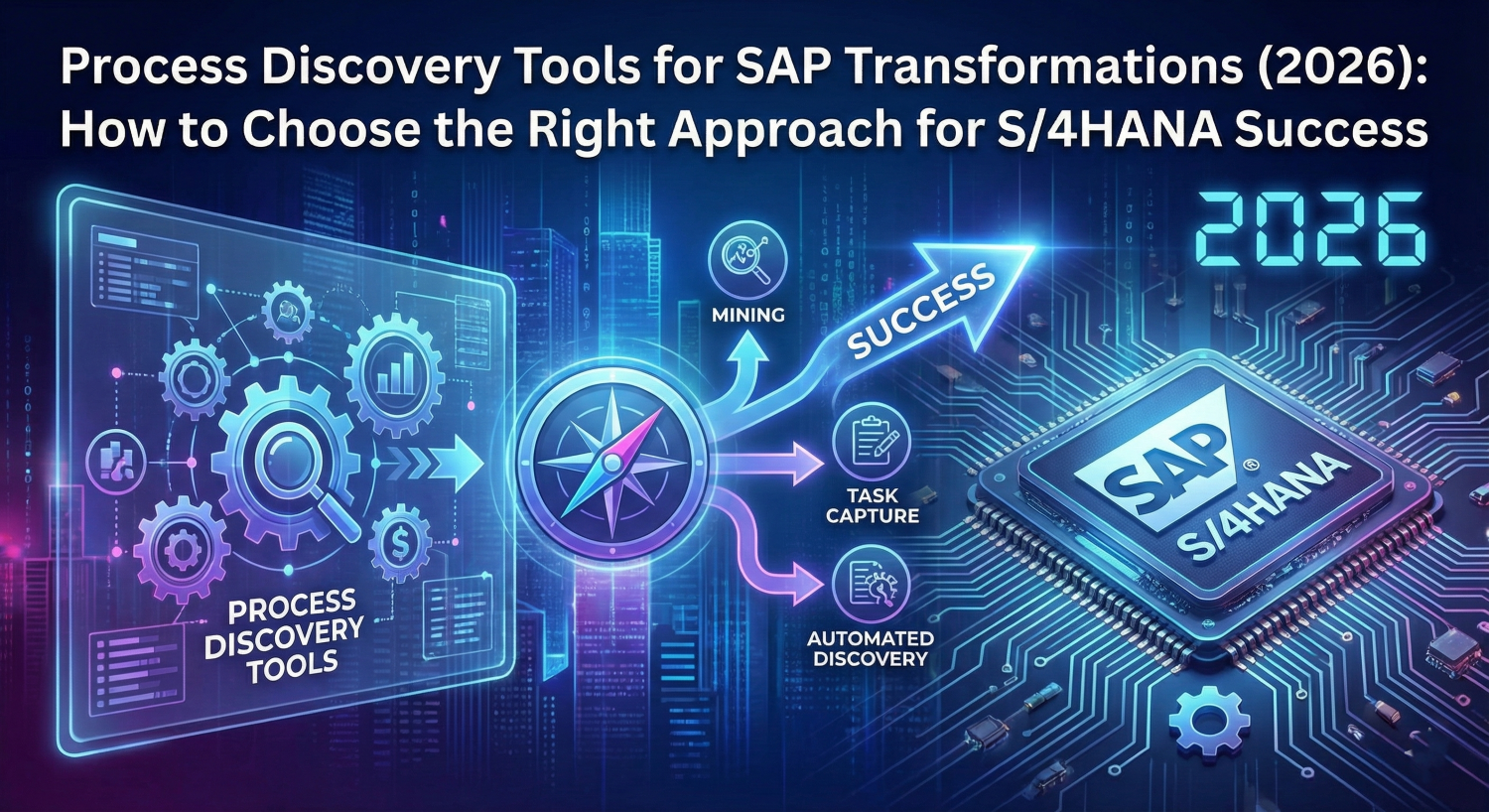
Process Discovery Tools for SAP Transformations (2026): How to Choose the Right Approach for S/4HANA Success

Process Discovery Tools for SAP Transformations (2026): How to Choose the Right Approach for S/4HANA Success

Avery Brooks
January 11, 2026

SAP Transformation Projects Are Safeguarded Or Set Up For Failure Based On Planning & Discovery

SAP transformations don’t fail because teams picked the wrong ERP features.

They fail because teams underestimated the real process.

In SAP programs, “the process” is rarely just what happens inside SAP. It’s also:

  • approvals that happen in email or Teams
  • master data workarounds living in spreadsheets
  • unofficial handoffs that keep the business moving
  • region-by-region variants that no one documented because “that’s just how we do it”
  • exceptions that only show up during UAT—when it’s too late to absorb change without pain

That’s why process excellence and transformation leaders are investing in process discovery tools earlier in the SAP lifecycle. In 2026, the strongest SAP programs have learned a simple lesson:

If you don’t capture the real current state—including variants and exceptions—you’ll pay for it later in rework, scope creep, and delayed go-live.

This article breaks down the best process discovery approaches for SAP transformations, how to choose between them, and the discovery “stack” that reduces risk in S/4HANA programs.

Before we dive in, if you want the broader view across tools and categories, here’s the main pillar post this article builds on:
https://www.clearwork.io/blog-posts/best-process-discovery-tools-for-2026-automated-discovery-process-mining-and-task-mining-compared

Why SAP discovery is uniquely hard (and why workshops aren’t enough)

SAP environments amplify process complexity because they’re rarely “clean” implementations:

  • ECC legacy logic that lived for a decade
  • custom transactions and Z-objects
  • multiple approval paths depending on thresholds
  • inconsistent master data practices across plants, regions, or business units
  • shadow tools that fill gaps (Excel trackers, shared inboxes, offline checklists)

Traditional SAP discovery relies heavily on workshops and a small set of SMEs. That creates two predictable problems:

  1. You document the idealized process, not the operational one.
  2. You miss the variants and exceptions that create 80% of downstream rework.

In 2026, teams aren’t asking “Did we do discovery?” They’re asking:
Did discovery produce the truth we can plan around?

What “process discovery” means in a SAP transformation

The term “process discovery” is used broadly, but for SAP programs there are three distinct approaches—with different strengths.

Process mining (SAP system truth)

Process mining uses SAP event logs and transaction histories to reconstruct process flows and measure performance:

  • cycle time
  • bottlenecks
  • rework loops
  • conformance to desired standards
  • process variants captured in system data

Where it shines: highly transactional processes where SAP captures most steps reliably.

Where it falls short: SAP logs often don’t capture the human reality around the process—approvals, handoffs, manual checks, and “between-system” steps.

Task mining / task capture (SAP human truth)

Task mining captures how people execute work on the ground—often the steps surrounding SAP:

  • the “before SAP” preparation work
  • the workarounds for missing data
  • the approvals that happen outside the system
  • the manual reconciliations and checks

Where it shines: shared services and operational work that lives in email/Excel and bridges systems.

Where it falls short: task data can be difficult to convert into end-to-end transformation deliverables without a structured conversion model.

Automated Process Discovery (the 2026 shift)

Automated Process Discovery uses AI to pull tribal knowledge out of people’s heads and convert it into structured deliverables—so discovery powers the planning and delivery phases of the SAP program.

In SAP terms, this means:

  • scaling stakeholder input beyond the handful of “usual SMEs”
  • capturing variants and exceptions early
  • producing project-ready outputs like scope, requirements, epics/stories, and test-ready acceptance criteria
  • documenting the SAP + non-SAP steps as one operational reality

If your biggest risk is missed requirements and scope drift—not just “insight dashboards”—this category is becoming a go-to starting point.

2026 trends: What’s changing in SAP process discovery

1) Discovery is moving earlier in the program

Teams are shifting discovery left—because SAP programs can’t afford late surprises. The goal is to reduce design churn before build begins.

2) Hybrid discovery is becoming the default

SAP transformations are too cross-functional to rely on a single source of truth. Teams increasingly blend:

  • SAP system truth (event logs / mining)
  • human truth (task capture + stakeholder input)
  • delivery truth (requirements, stories, tests, and governance outputs)

3) Time-to-value expectations are rising

Teams want discovery outputs in days or weeks—not months of integration work before they learn anything useful.

4) “Agent readiness” and automation are raising the bar

As organizations explore automation and AI on top of SAP, discovery needs to be structured enough to power design, controls, and downstream delivery artifacts—not just documentation.

5) Deliverables matter more than diagrams

The winning teams aren’t judged by number of process maps. They’re judged by whether discovery produces:

  • a clear scope
  • fewer missed requirements
  • fewer change requests
  • smoother UAT
  • faster go-live confidence

Quick picks: best process discovery tools for SAP transformations (by outcome)

Here’s the shortest path to a shortlist:

  • Best overall for SAP planning + transformation deliverables: ClearWork Automated Process Discovery
  • Best SAP-native path for process intelligence in SAP programs: SAP Signavio Process Intelligence
  • Best deep enterprise process mining platform commonly used with SAP: Celonis
  • Best automation-led route (mining aligned to automation ecosystem): UiPath Process Mining
  • Best visibility into SAP-adjacent human work (manual steps and workarounds): a task capture tool like Skan

The right answer depends on what you’re trying to achieve: performance analysis, standardization, automation, or end-to-end transformation planning.

The SAP discovery evaluation framework (what to look for)

To choose the right tool, evaluate against criteria specific to SAP realities.

1) SAP data extraction readiness

How hard is it to access the SAP data needed for mining?
Do you have the internal capacity and governance to support it?

2) Coverage across SAP + non-SAP work

Does the tool capture what happens outside SAP (email/Excel approvals, manual checks, handoffs)?

3) Variant and exception visibility

Can the tool surface:

  • regional variants
  • threshold-based approval differences
  • exceptions like blocked invoices, missing master data, and rework loops?

4) Outputs that power the program

Does it produce deliverables that accelerate the SAP transformation—not just insights?

  • scope inputs
  • process narratives
  • requirements backlogs
  • epics/stories and test-ready clarity

5) Governance and sign-off support

SAP transformations live or die by ownership and decision governance.

6) Integration into delivery systems

Does it fit into the tools your program runs on (Jira, ServiceNow, ALM/test tools, documentation repositories)?

7) Speed to value

How quickly can you generate usable truth—especially early, when planning decisions are made?

The “SAP Process Discovery Stack” that prevents rework

If your SAP program is high-stakes, the smartest move isn’t choosing one tool—it’s building the right discovery stack.

Layer 1: System truth (SAP event logs)

This is where process mining platforms shine: conformance, bottlenecks, measurable performance inside SAP.

Layer 2: Human truth (how work actually happens)

This is where task capture and scaled stakeholder input matter:

  • the steps outside SAP
  • the workarounds
  • the exceptions that never show up in system logs

Layer 3: Delivery truth (artifacts that drive execution)

This is where transformations gain speed:

  • clear scope boundaries
  • requirements and epics/stories
  • acceptance criteria and test coverage
  • governance-ready documentation

Most SAP programs have some Layer 1 visibility. Many struggle with Layers 2 and 3. That’s exactly where time is lost.

Tool-by-tool breakdown (SAP lens)

Below is a practical view of how common tools fit SAP transformation needs.

ClearWork (Automated Process Discovery for SAP programs)

What it is: AI-driven discovery designed to bring tribal knowledge out of people’s heads and convert it into structured deliverables that power planning and discovery phases of SAP programs.

Best for: transformation teams who need:

  • SAP + non-SAP reality captured together
  • variants and exceptions surfaced early
  • project-ready outputs that translate into delivery artifacts

Strengths:

  • Scales discovery across many stakeholders, not just a few SMEs
  • Captures operational reality beyond system logs
  • Produces deliverables that accelerate planning and reduce rework (scope, requirements-ready outputs, delivery-ready clarity)

Trade-offs:

  • It’s not “just a mining dashboard”
  • It’s best used as the discovery foundation, then validated/quantified with mining where needed

When to choose it: when scope clarity and requirements completeness are the biggest risk—and you want discovery outputs that directly power delivery.

SAP Signavio Process Intelligence

What it is: Often used in SAP-centric programs for process visibility and governance alignment.

Best for: organizations that want a SAP-aligned approach to process insight and standardization.

Strengths:

  • Natural fit for SAP ecosystems and governance conversations
  • Useful for standardization programs and process ownership alignment

Trade-offs:

  • Value depends on how mature your governance model is
  • Still needs complementary methods to capture the work outside SAP

When to choose it: when your SAP program is governance-led and you want SAP-aligned process intelligence.

Celonis (Process Mining)

What it is: Enterprise process mining platform often used for deep analysis of SAP-driven processes.

Best for: large organizations with mature data access and a desire to quantify and optimize process performance.

Strengths:

  • Strong quantitative insight when SAP logs are accessible and reliable
  • Good for bottleneck analysis, conformance, and performance measurement

Trade-offs:

  • Time to value depends on integration, data readiness, and governance
  • Can miss SAP-adjacent work that drives operational reality

When to choose it: when the process is primarily system-driven and you want deep analytical insight at scale.

UiPath Process Mining (Mining tied to automation)

What it is: Often selected when process discovery is tightly connected to automation execution.

Best for: automation-first organizations that want a path from discovery to automation.

Strengths:

  • Strong alignment to automation delivery and execution ecosystem
  • Practical when the program goal is workflow automation or RPA scale-out

Trade-offs:

  • Discovery can skew toward automation candidates rather than full transformation planning
  • Still needs human reality capture for end-to-end truth

When to choose it: when your primary KPI is automation throughput and speed to automation delivery.

Task capture (e.g., Skan) for SAP-adjacent work

What it is: Task-level visibility into how people execute work around SAP.

Best for: shared services and operational teams where manual steps and workarounds are the source of cycle time and errors.

Strengths:

  • Surfaces manual effort, rework loops, and shadow processes
  • Great for revealing what SAP doesn’t show

Trade-offs:

  • Needs a structured framework to convert task data into transformation deliverables
  • Task signals alone don’t automatically create a clean end-to-end “future state”

When to choose it: when the biggest unknown is how work actually happens outside SAP.

Choose your SAP discovery approach in 5 minutes (decision tree)

Use this to align stakeholders fast.

If your program is performance-driven inside SAP

Choose a mining-first approach when:

  • you have strong log access
  • most steps happen in SAP transactions
  • you need cycle time, conformance, and quantitative bottleneck analysis

If your program is struggling with workarounds and manual steps

Bring in human truth when:

  • a big part of the process happens outside SAP
  • teams rely on email/Excel approvals and manual checks
  • regional variants dominate the execution reality

If your biggest risk is rework, scope creep, and missed requirements

Start with Automated Process Discovery when:

  • stakeholders disagree on how work actually happens
  • your program needs deliverables that power planning and delivery
  • you want to surface variants and exceptions before build

In practice, many SAP programs succeed by pairing approaches:

  • Automated Discovery to structure reality into deliverables
  • Process mining to quantify and validate performance where logs are strong
  • Task capture to reveal the “between-system” work SAP doesn’t show

A practical 30-day pilot plan for SAP transformations

If you want to avoid big-bang tool rollouts, run a targeted pilot on one process.

Week 1: Choose one SAP process and define success

Pick a high-impact process with measurable outcomes:

  • Procure-to-Pay (P2P)
  • Order-to-Cash (O2C)
  • Record-to-Report (R2R)

Define:

  • scope boundaries
  • key stakeholders
  • 2–3 metrics (cycle time, rework, blocked exceptions, SLA performance)

Week 2: Capture system truth + human truth

  • validate what SAP can tell you
  • capture the SAP-adjacent steps (approvals, workarounds, spreadsheets)

Week 3: Convert discovery into deliverables

Produce:

  • current-state narrative + map
  • variants and exception inventory
  • prioritized improvement opportunities
  • requirements/backlog-ready outputs

Week 4: Validate and operationalize

  • review findings with stakeholders
  • establish owners and governance cadence
  • align delivery artifacts for design/build/UAT

FAQs

What are the best process discovery tools for SAP transformations in 2026?

The best choice depends on your goal: SAP-native process intelligence, deep process mining, task capture for manual work, or automated discovery that turns tribal knowledge into deliverables.

What data do you need from SAP for process mining?

Typically, you need event-level records that represent key process milestones. Readiness depends on system configuration, logging consistency, and governance for extraction and access.

Can Signavio replace process mining tools like Celonis?

They can overlap in visibility and standardization, but the best fit depends on your goals: governance and SAP alignment versus deep cross-system mining and quantitative optimization.

How do we capture steps that happen outside SAP?

You need human truth—through task capture and structured stakeholder input—because approvals and workarounds often live outside SAP transactions.

When should we run discovery in an SAP program?

Earlier than most teams expect. If discovery starts after design assumptions are locked, you’ll pay for gaps later through change requests and UAT surprises.

Wrap: SAP transformations move faster when discovery becomes delivery-ready truth

In 2026, the fastest SAP programs aren’t the ones with the most workshops.

They’re the ones that can quickly answer:

  • how work actually happens (including exceptions)
  • what needs to change
  • what should be built first
  • and how to prove readiness before go-live

If you want a discovery approach that brings tribal knowledge out of people’s heads and converts it into structured deliverables that power SAP transformation planning, explore ClearWork Automated Process Discovery:
https://www.clearwork.io/clearwork-automated-discovery

And for the full landscape across categories and tools, see the pillar post here:
https://www.clearwork.io/blog-posts/best-process-discovery-tools-for-2026-automated-discovery-process-mining-and-task-mining-compared

image of team collaborating on a project

If you want your SAP transformation to start with reality—not assumptions—see how ClearWork uses AI to bring tribal knowledge out of people’s heads and turn it into delivery-ready discovery outputs.

If you want your SAP transformation to start with reality—not assumptions—see how ClearWork uses AI to bring tribal knowledge out of people’s heads and turn it into delivery-ready discovery outputs

Subscribe to our newsletter to stay up to date on all things digital transformation

Continue Your Education

Top Process Excellence Trends for 2026: AI-Native Operations, Automated Discovery & the New Era of Continuous Improvement

Read More

What Is Process Intelligence? A 2026 Guide to Process Mining, Task Mining, Automated Discovery & AI

Read More

Modern Process Excellence: How Process Intelligence Is Reshaping Continuous Improvement in 2026

Read More
Table of Contents