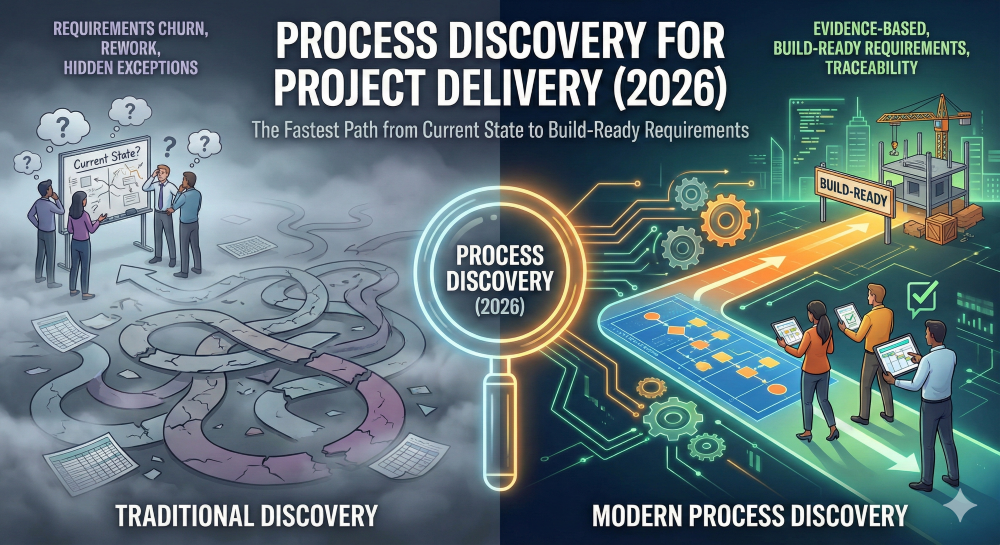
Process Discovery for Project Delivery (2026): The Fastest Path from Current State to Build-Ready Requirements

Process Discovery for Project Delivery (2026): The Fastest Path from Current State to Build-Ready Requirements

Avery Brooks
February 25, 2026

Process Discovery for Project Delivery (2026): The Fastest Path from Current State to Build-Ready Requirements

Most projects don’t derail in build.

They derail in discovery—quietly, early, and expensively.

It usually starts with good intentions: a few workshops, some interviews, a spreadsheet of requirements, and a “current state” process map that looks plausible. Then the project moves into design and build… and reality shows up. Exceptions. Workarounds. Missing approvals. Data definitions nobody agreed on. Cross-team handoffs that weren’t captured. And suddenly you’re in the most painful phase of any transformation:

requirements churn.

In 2026, the teams shipping the fastest aren’t doing “more discovery.” They’re doing better discovery—grounded in how work actually happens, validated quickly, and converted into build-ready requirements with clear traceability.

This pillar post breaks down why traditional discovery fails, what modern process discovery looks like, and a practical 2-week playbook to produce trusted process maps, requirements, and living documentation that keeps projects moving.

Why projects fail in discovery (not delivery)

Delivery teams can build almost anything—if the inputs are clear. The trouble is that most discovery approaches produce inputs that sound clear until you try to implement them.

Here are the patterns that show up over and over.

The 5 discovery failure patterns

1) “Current state” becomes a narrative, not evidence.
People describe what should happen. Or what happens on a good day. Or what’s written in policy. But projects fail on what happens on the messy days—the reality that never makes it into the documents.

2) Workshops capture the happy path and miss exceptions.
Workshops are great for alignment. They’re not great for surfacing the five most common exceptions, the rework loops, and the “here’s what we actually do” steps people don’t mention unless you ask directly.

3) Nobody agrees on scope boundaries.
Discovery teams often map “the process,” but don’t define where it starts and ends. That’s how your project scope quietly expands into adjacent processes, other systems, and “while we’re here…” requests.

4) Requirements are captured as opinions, not decisions.
A requirements log becomes a list of statements without resolution:

  • “We need automation.”
  • “We need approvals.”
  • “We need better reporting.”
    But what approvals? In which cases? Who owns them? What’s the decision rule? Those details matter—and they’re usually missing.

5) Documentation drifts immediately.
Even if you get a good map, it goes stale fast. And once stakeholders stop trusting the artifacts, you lose the single source of truth that keeps build moving.

The real cost of weak discovery

When discovery is fuzzy, you pay for it later:

  • scope creep and missed requirements
  • rework, timeline slips, and budget overruns
  • frustrated stakeholders and change fatigue
  • delivery teams translating ambiguity into specs (and getting blamed when assumptions are wrong)

What “modern process discovery” means in 2026

Let’s make this plain.

Process discovery for projects is a method—not a meeting series

Modern process discovery is a repeatable way to:

  1. capture how work actually happens (including exceptions)
  2. validate quickly with the people doing the work
  3. convert that into build-ready requirements
  4. publish artifacts as living documentation, not one-time deliverables

That’s it.

What it’s not

  • not “a bunch of workshops”
  • not documenting what everyone thinks happens
  • not a process map that gets created and forgotten
  • not a requirements spreadsheet with no traceability

The new standard: Evidence → validation → build-ready outputs

The best discovery approach follows a simple logic:

Evidence → Draft artifacts → SME validation → Build-ready requirements → Living documentation

This is where process intelligence and automatic process mapping become valuable—not as buzzwords, but as a way to get to trusted reality faster and stop debating assumptions.

The core deliverables: what good discovery produces

If your discovery outputs don’t make build easier, discovery didn’t work.

A strong discovery package is not “a map.” It’s a bundle that connects reality to delivery.

The discovery bundle (what you should aim to produce)

  • Process map (swimlane is usually the best default)
  • Process narrative (1–2 pages that explain what’s happening and why)
  • SOP-level steps where needed (especially for operational processes)
  • Requirements package: epics/stories/tasks with acceptance criteria
  • Exceptions/variants catalog (the top 5–10 that actually matter)
  • Approvals and controls (who approves what, and what triggers it)
  • Baseline KPIs + target outcomes (cycle time, rework, escalations, etc.)
  • RACI-light ownership notes (who owns the process post-go-live)
  • Risks/assumptions log (what’s still unknown, and how it will be resolved)

Why this bundle reduces requirements churn

Because churn happens when the build team discovers things the discovery team didn’t capture:

  • hidden exceptions
  • ambiguous decision rules
  • unclear ownership
  • missing data definitions
  • scope boundaries that were never agreed on

When those elements are explicit—and tied to process steps—you dramatically reduce late surprises.

The 2-week process discovery playbook (practical and repeatable)

You do not need a three-month discovery phase to produce reliable outputs.

You need a disciplined approach that scopes correctly, captures reality, and validates fast.

Week 1: Scope + evidence capture

Step 1: Define scope boundaries (the most important step)

Answer these in writing:

  • What triggers the process to start?
  • What counts as “done”?
  • What’s in scope and explicitly out of scope?
  • Which systems are involved?
  • Which roles touch the process end-to-end?

A typical end-to-end process involves 3–7 roles. If you’re at 15 roles, you probably didn’t define boundaries well.

Step 2: Gather existing materials (even if they’re messy)

You’re not looking for perfect documentation. You’re looking for signals.

Collect:

  • old SOPs and process maps
  • policies and training decks
  • forms and templates
  • reports and dashboards that reflect outcomes
  • ticket categories, email instructions, macros
  • any “unofficial” guides that people actually use

This does two things:

  1. it accelerates draft creation
  2. it reveals where the organization’s “official truth” differs from reality

Step 3: Capture “real work” (especially exceptions)

This is where most discovery falls short.

Your goal is to capture:

  • the happy path
  • the top exceptions
  • the rework loops
  • the handoffs and approvals
  • the off-system work (spreadsheets, email approvals, side tools)

A useful technique: for every step, ask “When does this go wrong?” and “What do you do then?”
Those answers are where your most important requirements live.

Outputs by end of Week 1

  • v1 process map (swimlane default)
  • top exceptions and variants list
  • glossary of key terms/data fields (especially for ERP/CRM work)
  • narrative outline (purpose, scope, systems, handoffs)

Week 2: Artifact generation + validation + requirements conversion

Step 4: Generate the discovery bundle

By early Week 2, you should have drafts of:

  • process map + narrative
  • step-level procedure details for key segments
  • approvals/controls list
  • exception paths and rework loops
  • initial requirements (epics/stories) mapped to process steps
  • baseline KPI hypotheses (what you expect to improve)

The point is not perfection. The point is to create drafts that are close enough for SMEs to validate quickly.

Step 5: Validate fast (review, don’t rewrite)

Stop asking SMEs to “write requirements.”

Ask them to:

  • confirm sequence and ownership
  • correct missing steps and handoffs
  • confirm decision rules and approvals
  • add or rank the most common exceptions
  • flag unclear terms or data fields

Aim for 20–30 minutes of async review per SME.
This is almost always more productive than two hours in a room where people default to the happy path.

Step 6: Convert to build-ready requirements

This is the part teams skip—and then wonder why build struggles.

Translate the validated artifacts into requirements with traceability:

  • Process phases → epics
  • Steps → user stories/tasks
  • Decision points → acceptance criteria
  • Exceptions → edge-case stories and negative test cases
  • Approvals/controls → compliance requirements and audit checkpoints
  • System touchpoints → integration and data requirements

Outputs by end of Week 2

  • validated process map + narrative
  • build-ready requirements package (ready for Jira/Azure DevOps/etc.)
  • prioritized backlog (with dependencies and risks)
  • assumptions log with owners and resolution plan

Preventing requirements churn without heavy bureaucracy

Most teams respond to churn by adding process: change boards, templates, more approvals.

That often slows delivery without fixing the root problem.

Churn happens because reality wasn’t captured or validated early enough.

Why churn happens (in plain language)

  • scope boundaries were fuzzy
  • exceptions were hidden
  • decision points weren’t resolved
  • data definitions weren’t agreed on
  • requirements weren’t traceable to process steps

A simple anti-churn system that works

1) Definition of Ready (DoR) for stories
Before build starts, a story must have:

  • clear user/role
  • acceptance criteria
  • process step linkage
  • exception handling (if relevant)
  • data fields defined (if relevant)

2) Traceability that isn’t painful
You don’t need a massive traceability matrix. You need simple links:

  • requirement ↔ process step ↔ decision point ↔ exception ↔ control (if relevant)

3) Lightweight change control
When changes happen (they will), capture:

  • what changed
  • why it changed
  • which process steps it affects
  • who approved it
  • which requirements need updating

That’s enough to keep alignment without slowing everything down.

Choosing the right discovery approach (decision framework)

Not every project needs the same level of discovery rigor.

When workshops are enough

  • small scope
  • single team
  • low exception volume
  • low risk
  • minimal integrations

When you need process intelligence + automatic process mapping

  • cross-functional, multi-team processes
  • compliance-heavy work
  • high exception volume
  • ERP/CRM implementations
  • multiple regions/teams with real variations
  • projects where requirements churn has burned you before

Quick cheat sheet

  • ERP rollout: start with swimlanes + approvals + exceptions + data definitions
  • Customer support transformation: focus on triage decision points + escalation paths
  • Finance ops: focus on controls, approvals, and exception handling (that’s where the time is)

Beyond week two: a practical 30-day rollout plan

Discovery shouldn’t end when build starts. The best teams keep the artifacts alive.

Weeks 3–4: Turn discovery into delivery momentum

  • publish the artifacts as living documentation (not “a deck”)
  • align process ownership post-go-live
  • start build using a validated backlog
  • baseline KPIs and define how you’ll measure impact
  • keep a tight loop: changes in build update the process artifacts and requirements

When discovery outputs stay current, delivery becomes faster because alignment doesn’t degrade.

Process Discovery For Projects FAQ

1) What is process discovery for projects, and how is it different from process mapping?

Process mapping is usually one artifact—a diagram. Process discovery for projects is the full method of capturing how work actually happens, validating it, and converting it into build-ready deliverables like requirements, user stories, acceptance criteria, and living documentation. Mapping is part of discovery, not the whole thing.

2) How long should process discovery take for a typical transformation project?

For many project scopes, a disciplined discovery cycle can produce validated maps and build-ready requirements in about two weeks—especially when SMEs are reviewing drafts rather than writing everything from scratch. Larger, multi-region programs may iterate across multiple process areas, but the core cycle should remain short and repeatable.

3) What deliverables should discovery produce to make requirements “build-ready”?

At minimum: a validated process map, a short narrative that defines scope and decision points, a catalog of the top exceptions/variants, and epics/stories with acceptance criteria tied to process steps. If you can’t trace requirements back to reality, churn is almost guaranteed.

4) How do you capture exceptions and variants without endless workshops?

Ask directly for the top exceptions and rework loops, and validate them against actual workflow behavior. The most efficient method is draft-first: generate v1 artifacts quickly, then have SMEs confirm/correct asynchronously so exceptions become explicit paths instead of surprise defects.

5) How do you prevent requirements churn once build starts?

Prevent churn by locking scope boundaries early, making decision points explicit, capturing the top exceptions, and using lightweight traceability between process steps and requirements. Then maintain a simple change workflow: when something changes, update the process artifacts and the linked stories together—so alignment stays intact.

Learn more about how the ClearWork platform supports process discovery for projects.

If you want project discovery grounded in reality—trusted process maps, build-ready requirements, and living documentation—see how ClearWork supports project delivery teams

Most projects don’t slip because teams can’t build—they slip because discovery leaves gaps that show up later as churn and rework. ClearWork helps teams capture how work actually happens, generate the process maps and requirements that delivery teams can trust, and keep those artifacts current as the project evolves.
Subscribe to our newsletter to stay up to date on all things digital transformation

Continue Your Education

UiPath Task Capture Alternatives (2026): A Better Way to Capture Real Work

Read More

Process Discovery Tools for ServiceNow Transformations (2026 Guide)

Read More

Process Discovery Tools for Salesforce Transformations (2026): How RevOps & Service Teams Capture the Real Process

Read More
Table of Contents