
Most SOP programs don’t fail at creation.
They fail at maintenance.
Month 1: everyone’s motivated, documentation gets published, and there’s a sense of progress.
Month 2: a system field changes, an approver shifts roles, a “rare exception” becomes common, and the SOP is already slightly wrong.
Month 3: someone follows the SOP, it doesn’t match reality, and trust collapses.
From that point on, your SOP library becomes shelfware—opened only during onboarding, audits, or emergencies (which is… not ideal).
The good news: keeping SOPs current doesn’t require heavy bureaucracy. It requires a simple operating system: ownership, cadence, triggers, and a workflow that makes it easy for SMEs to participate without endless meetings.
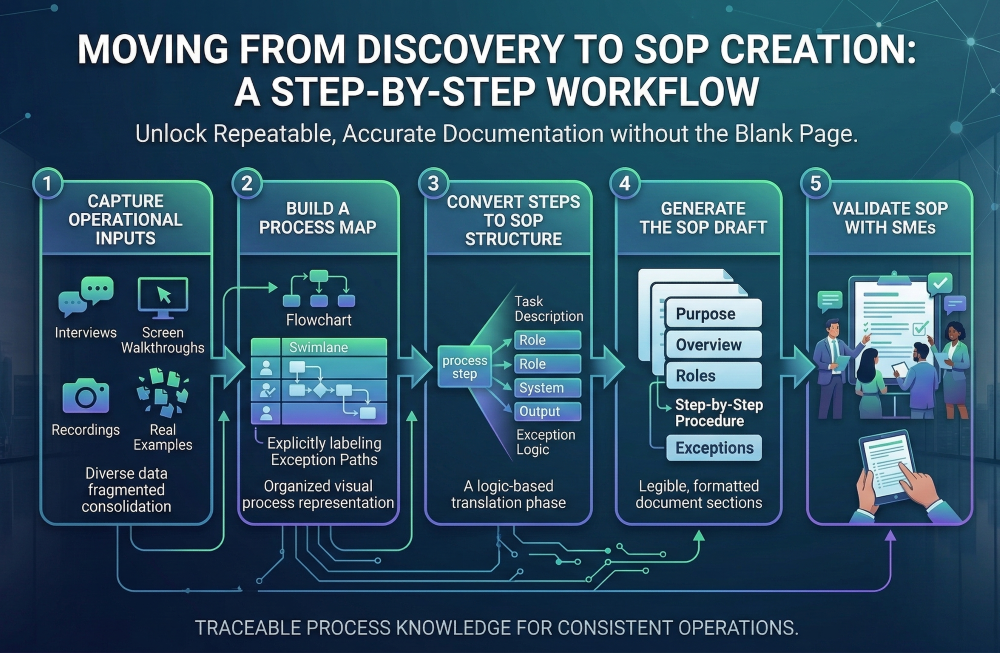
If you want the full “create SOPs from real work (not guesswork)” workflow, this post covers that end-to-end:
https://www.clearwork.io/blog-posts/ai-sop-generator-process-documentation-software-2026-how-to-create-sops-from-real-work-not-guesswork
This post focuses on one thing: how to keep SOPs current.
SOP drift is not random. It’s predictable.
1) System changes
New fields, new screens, new required steps, new integrations. Even small changes can invalidate step-by-step guidance instantly.
2) Policy changes
Pricing rules, compliance requirements, approval policies, vendor terms, customer segmentation. Policies shift faster than documentation.
3) Org changes
Roles change. Teams reorganize. Responsibilities move. Handoffs that used to be clear become unclear.
4) Exception growth
That “rare case” becomes common because volumes change, new customer types appear, or upstream quality slips.
5) Informal workarounds
People adjust to keep work moving: spreadsheets, side channels, “just do it this way.” The process evolves quietly while documentation stays frozen.
The first time a teammate follows the SOP and it’s wrong, they stop using it.
And once trust is gone, your documentation becomes actively harmful—because it creates false confidence.
Most teams swing between two extremes:
The answer is a lightweight model with clear roles.
1) Process Owner (Accountable)
Owns the accuracy of the SOP and the outcomes of the process. They make judgment calls when there’s disagreement.
2) Documentation Steward (Operational)
Runs the system: schedules reviews, collects feedback, updates content, manages versioning, publishes changes.
3) SME Reviewers (Consulted)
People who actually do the work. They confirm/correct reality, update exceptions, and flag drift signals.
That’s it. You don’t need a committee.
Process Owner
Documentation Steward
SME Reviewers
Not every process needs formal sign-off for every change.
The goal is speed and trust—not ceremony.
Calendar-based review cycles fail because they rely on discipline—exactly when people are busiest.
The fix is simple: use cadence + triggers.
A micro-review is short and targeted (more on that below).
Trigger a review when:
Triggers catch “sudden drift.” Cadence catches “slow drift.”
Use both, and your SOPs stop decaying.
One of the fastest ways to kill trust is letting multiple versions float around.
You need a simple publishing system that makes the “current” version unmistakable.
Every SOP should display:
You can keep this lean:
This is how you prevent the “which version is real?” problem.
SMEs are always busy. If your SOP maintenance plan assumes they’ll write documentation, it will fail.
The goal is to shift SME work from authoring to confirming.
Instead of “please rewrite this SOP,” ask:
This makes review fast and specific.
For volatile processes, make review lightweight:
Micro-reviews are short enough that they actually happen—and they prevent major drift.
Create one simple channel for drift signals:
The steward triages and batches these into the next review cycle.
This turns SOP maintenance into a flow, not a scramble.
“Living documentation” is not magic.
It’s what happens when:
When you get here, SOPs stop being “documentation work.”
They become a reliability system for operations.
A modern approach can detect when work patterns shift:
Instead of waiting for someone to complain, your governance can be prompted by real change—so documentation stays current as the business evolves.
If you want SOP governance to stick, start small and prove it works.
The goal isn’t to “govern everything.” It’s to build a repeatable system that scales.
If you want this to last, avoid these traps:
If you fix just two things—ownership and triggers—you’ll prevent most drift.
It depends on volatility. Stable processes can be reviewed quarterly, medium-change processes monthly, and high-change processes benefit from short biweekly micro-reviews. The best approach combines a cadence with triggers for sudden changes.
Use three roles: a process owner (accountable), a documentation steward (operational), and SME reviewers (consulted). This keeps ownership clear without creating a committee.
Common triggers include system releases, policy changes, KPI drift (cycle time/rework), recurring escalations, audit findings, and role/approval changes. Triggers prevent drift when the calendar review inevitably gets delayed.
Don’t ask SMEs to write SOPs—ask them to confirm/correct drafts and focus review on what changed. Micro-reviews (10–15 minutes) plus a simple “SOP drift inbox” make participation realistic.
Version control is the mechanism (versions, change logs, publishing rules) that prevents confusion. Governance is the operating system (owners, cadence, triggers, review workflow) that keeps SOPs accurate over time.
To learn how ClearWork can enable this governance & collaboration, click here!
Keeping SOPs current isn’t about more discipline—it’s about building a lightweight system that makes updates inevitable: clear owners, review triggers, and fast SME validation. ClearWork helps you generate SOPs and process documentation from real work, manage versions and approvals, and keep everything current as processes change. Book a demo to see how ClearWork keeps documentation alive
Enjoy our newsletter!