Transformation Risk: What Actually Surfaces Late (And How to Surface It Early)
Avery Brooks
May 21, 2026
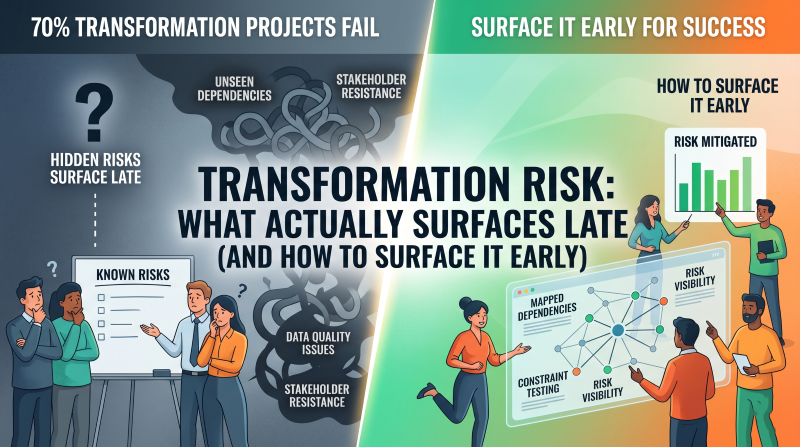
Seventy percent of transformation projects fail. But here’s what makes that statistic even worse: most of those failures aren’t caused by the risks that were planned for. They’re caused by the risks that weren’t visible until it was too late to do anything about them. This is one manifestation of the broader “Transformation Knowledge Gap” - when organizations don’t understand what’s really happening until it’s too late to adjust.
A transformation team enters discovery with a risk register - a tidy list of technical, organizational, and stakeholder risks. But three months into delivery, a hidden dependency surfaces. A workaround that three teams rely on, invisible in the formal process maps, suddenly becomes a blocker. A system integration point that nobody mentioned turns out to require six months of custom development. An organizational dynamic that nobody flagged emerges as the actual reason adoption is stalling.
Sixty-four percent of organizations cite data quality as their top barrier to transformation success. More than 40% lack full visibility into their operational dependencies. And when late-stage risks do surface, projects rarely have the organizational flexibility to address them - budgets are committed, timelines are locked, and rework becomes the only option.
The question isn’t how to eliminate transformation risk. The question is how to surface the real risks early enough to actually do something about them.
Traditional risk management in transformations starts with a risk workshop. Executives, PMO representatives, and delivery leads gather, and based on organizational experience, they build a risk register. The register is comprehensive - it captures what they learned from the last project, what they heard from peers, what they know from reading case studies.
But that register is built on what’s known. It doesn’t capture what’s invisible.
Here are the five core reasons transformation risks surface late:
The process documentation says one thing. The actual workflow says another. A team follows a formal approval process, but there are three informal coordination steps that happen before anyone starts the formal process. A system integration is defined as a scheduled batch job, but teams call a custom API every hour because the batch window is too slow. A handoff is documented as “pass to next team,” but three teams are actually involved, and nobody documented it because it seemed obvious to people who work there.
These dependencies don’t show up in process maps because they’re embedded in how work actually gets done. They surface only when a transformation either removes the workaround or changes the timing.
A new system is selected based on vendor demos and reference sites. Expectations are set: “This platform handles our transaction volume, integrates with our core systems, and supports our data model.” Then discovery begins. The data audit reveals that 30% of your data doesn’t fit the model. The integration testing shows that the platform API doesn’t actually support the response times you need. The environment cloning reveals that your legacy system has custom fields, custom tables, and workarounds that the new system can’t replicate without custom development.
By the time these constraints surface, the vendor is selected, the design is locked, and the budget is committed. The transformation either accepts the constraints or pivots - both options are expensive.
A transformation needs buy-in from five teams. During planning, all five teams signal support. During discovery, they participate in interviews and workshops. But when delivery demands sustained effort - when teams are asked to release people for testing, when new processes require people to change how they work daily, when adoption requires real behavioral change - hidden organizational dynamics emerge. A team doesn’t have capacity to participate because of an undisclosed business initiative. A leader’s support was conditional on not disrupting a specific workflow, which the transformation must disrupt. A team is skeptical because the last transformation “didn’t work,” and that experience (which the transformation project didn’t know about) makes them resistant.
These risks don’t surface in a kickoff workshop. They surface when the work gets real, and by then there’s momentum and commitment that makes addressing them painful.
A transformation is approved with a defined scope. But as teams dig into the current state, they discover requirements that weren’t obvious initially. “We thought you were just replacing the system, but you’re also changing the process, and that requires training.” “We didn’t know you were changing the organizational structure; that changes the access model.” “We didn’t realize this system talks to seventeen other systems; we thought it was three.”
Each discovery triggers scope expansion. Budgets don’t expand. Timelines don’t expand. The difference becomes rework, or scope gets cut, or quality suffers.
A transformation team communicates regularly with the executive sponsor and the core delivery teams. But there are stakeholders one or two layers removed from the core group - regional teams, support teams, teams that touch the system tangentially. They don’t hear about changes until those changes affect them. By then, the transformation is in motion. Adjusting for their needs becomes a late addition to the scope, or their concerns are dismissed as out of scope.
The risk wasn’t that they existed. The risk was that they were invisible until after planning was done.
The economics of late risk discovery are brutal.
When a risk surfaces during discovery (weeks one through eight), the project has options. Scale the scope. Adjust the design. Shift resources. Extend the timeline. The cost of addressing the risk is real, but the cost of not addressing it is still negotiable.
When a risk surfaces during design (weeks nine through 20), the options narrow. The approach is partially locked. Changing direction requires rework. The cost starts to escalate.
When a risk surfaces during delivery (week 21+), the project is committed. Money is spent. People are allocated. Timelines are public. The transformation cannot absorb a major shift without visible failure. Late-stage risks become forced choices: accept the risk, cut scope, go live with a workaround, or admit the project is behind.
Thirty to fifty percent of transformation delivery costs are rework. A significant portion of that rework is driven by risks that surfaced too late to plan for. A risk that costs $50,000 to address during discovery costs $250,000 to address during delivery.
Organizations that run transformations effectively have moved away from a “risk register built once, updated quarterly” model. They run continuous risk emergence - building organizational mechanisms to surface hidden dependencies, constraints, and stakeholder concerns as they emerge, and then adjusting the roadmap to address them before they become blockers.
This requires three core practices:
Operational Reality Mapping: Document not just what teams say their process is, but what they actually do. Interview front-line staff about workarounds, informal steps, and dependencies that don’t appear in formal documentation.
Constraint Testing: Early in discovery, stress-test your assumptions about system capacity, data fit, and integration feasibility. Surface constraint violations early, not during testing.
Expanding Stakeholder Visibility: Map the full span of who the transformation touches. Run early communications to adjacent teams. Ask them what they depend on and what concerns they have.
Conduct structured interviews with front-line staff. Map system dependencies through API audits and data flow analysis. Document exceptions and edge cases.
Run data migration pilots. Stress-test the target system with real data and real-world transaction patterns. Test API integrations under load.
Conduct design reviews with the full stakeholder map. Walk through the new process and ask “What would break if we did it this way?”
Build a lightweight mechanism to capture emerging risks. Weekly team huddles where teams flag emerging issues. Monthly stakeholder touchpoints where people can surface concerns.
Organizations that run continuous risk emergence see dramatic improvements:
40-50% reduction in late-stage scope changes. When risks surface early, scope adjustments can be planned and budgeted.
30-40% reduction in post-go-live rework. Many post-go-live issues are driven by risks that should have been visible during discovery.
50%+ improvement in stakeholder alignment. When stakeholders are engaged early and their concerns are addressed, adoption improves and resistance decreases.
Risk emergence activities aren’t additions to discovery; they’re core discovery activities. Allocate time and resources accordingly.
Interview frontline staff directly. Ask them to walk you through their day. Frontline staff will surface dependencies that managers don’t know about.
Run constraint testing early, in parallel with design. Early constraint validation allows you to adjust the design while there’s still flexibility.
Give organizational risks equal weight to technical and operational risks. If a stakeholder doesn’t have the capacity to engage, that’s a risk that can block the transformation just as effectively as a technical constraint.
Keep risk emergence active throughout the transformation. Run weekly risk meetings. Maintain a feedback channel for teams to report emerging issues.
Effective risk emergence requires visibility into how work actually gets done, what dependencies exist, and what constraints shape operational decisions. But capturing this information through workshops and formal interviews is slow and incomplete. Teams rarely surface the hidden dependencies and constraints in group settings because they seem obvious to them or because they’re hesitant to reveal that the formal process doesn’t work the way it’s documented.
ClearWork enables risk emergence at scale through AI-driven asynchronous interviews. Rather than relying on risk workshops where only vocal participants contribute, ClearWork interviews frontline staff directly about how they actually do work. The platform identifies undocumented dependencies that design needs to account for, reveals constraints and workarounds that formal documentation misses, surfaces organizational dynamics that might block adoption, and captures the contextual variations that might affect implementation success.
This intelligence becomes the continuous risk emergence system. Risk visibility isn’t limited to a quarterly review meeting. Instead, hidden dependencies surface early when there’s time to design around them. Constraints are identified before design is locked. Stakeholder concerns emerge before resistance hardens. The result: risks surface when they’re planning problems, not crises.
A: Risk management identifies and mitigates known categories of risk (technical, organizational, financial). Risk emergence surfaces the specific, hidden dependencies and constraints that only exist in your operational context. Risk management builds a risk register from experience and case studies. Risk emergence discovers what’s actually true in your environment. Both are necessary - risk management provides a framework, risk emergence fills in the specifics that matter.
A: Risk emergence should start in week one of discovery and continue throughout the transformation. Early risk emergence surfaces foundational constraints that shape design. Mid-project risk emergence surfaces organizational dynamics and scope issues. Late-stage risk emergence (during delivery) captures changes in stakeholder commitment and emerging operational problems. Continuous risk emergence catches issues before they become blockers.
A: Start with frontline staff interviews. Ask them to walk you through a typical day, documenting undocumented dependencies and informal steps. Conduct API audits and data flow analysis to map system dependencies. Identify edge cases and exceptions through current-state workshops. Early dependency discovery shapes the entire transformation roadmap, so invest heavily here before design begins.
A: No. Some surprises are unavoidable - external business changes, unexpected system constraints discovered during testing, organizational dynamics that only emerge under real operational stress. But continuous risk emergence can prevent 70-80% of late-stage surprises by surfacing the dependencies, constraints, and stakeholder concerns that do exist in your organization.
A: Create psychological safety. Make it clear that surfacing risks early is valued, not punished. Celebrate when risks surface early and are planned for. Don’t blame people for discovering late-stage surprises - blame the system for not surfacing them earlier. Build risk emergence into governance as a required activity, not an optional practice. When surfacing risks becomes part of how the organization operates, people will do it naturally.
The organizations that deliver transformations successfully aren’t smarter about risk management. They’re smarter about risk visibility.
Seventy percent of transformation risks surface late because they’re hidden in the gaps between what organizations think happens and what actually happens. Organizations that run continuous risk emergence - interviewing frontline staff, stress-testing assumptions, engaging the full stakeholder map, and maintaining ongoing feedback channels - surface hidden dependencies, constraints, and organizational dynamics early enough to address them. When risks surface while they’re still planning problems rather than crises, transformation success rates improve dramatically.