AI SOP Generation: What Actually Works vs Hype
Avery Brooks
April 21, 2026
Your process documentation team has just spent 40 hours writing an SOP for a customer onboarding workflow. It's detailed. It's clean. It's in a template. And within 90 days, it's wrong—operations have adapted, the template feels burdensome to update, and no one uses it anymore.
That's where AI SOP generation enters the conversation. The promise is seductive: describe a process in natural language, let the AI write the SOP, and suddenly you have evidence-backed documentation. No more blank page problem. No more weeks of interviews synthesizing into a three-page guide.
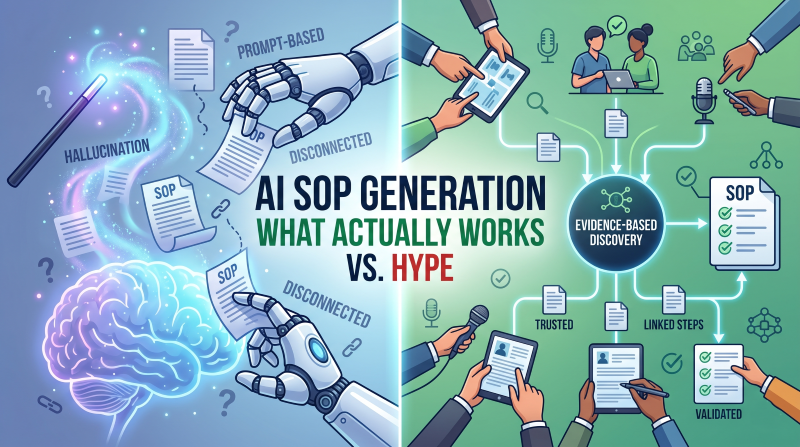
But here's the trap: not all AI generation is equal. A prompt-based system will hallucinate. It will invent steps that don't exist, flatten complex decision trees, and miss the exceptions that make operations actually work. You get something that looks like an SOP but isn't grounded in operational reality.
The smarter approach separates evidence-based generation from prompt-based generation. One discovers what actually happens; the other merely synthesizes plausible-sounding text. This guide walks you through the difference, the risks of hallucination, and how to build SOP generation that teams will actually trust.
For deeper context on how process discovery feeds SOP creation, this guide explains the four-layer framework that separates lived operations from idealized documentation.
Writing an SOP from scratch is cognitively expensive. You need to:
Most teams solve this by scheduling interviews, synthesizing notes, and writing manually. That takes days. So when an AI tool says "give me a prompt and I'll write your SOP in minutes," it feels like a force multiplier.
Prompt-based generation works beautifully when accuracy is optional. It's great for brainstorming, drafting outlines, or generating creative copy. But SOPs are operational truth—if the AI invents a step or misses a critical handoff, the person following the SOP will fail.
Research from 2025 shows that even state-of-the-art language models hallucinate at scale, especially when generating longer documents. A prompt like "write an SOP for order processing" can produce outputs that sound coherent but describe workflows that never existed at your company. The AI doesn't know your process. It's interpolating from patterns in its training data.
Even if a team knows hallucination is a risk, most lack a systematic way to validate AI outputs. The result: someone skims an AI-generated SOP, misses an invented step, and assumes it's correct. The SOP gets deployed, a frontline operator gets confused, and trust in the documentation system collapses.
The governance gap is real: without evidence linking each step back to how work actually happens, you can't systematically catch and fix errors.
Evidence-based SOP generation flips the workflow: instead of starting with prompts, it starts with discovery of actual operations, then synthesizes that evidence into SOPs.
What it is: Interviewing frontline operators, capturing workflows in their own words, identifying exceptions and edge cases, then using that evidence as the foundation for SOP generation. Each step is traceable back to "person X told us this is how they handle Y situation."
What it is NOT: Prompt-based generation where you describe a process to an AI in natural language and hope it captures your operational reality. That approach can supplement this one, but it shouldn't be the foundation.
When it applies: Any process where accuracy matters—compliance-heavy workflows, high-stakes operational procedures, or processes that other teams depend on. If a mistake in the SOP causes a customer impact or regulatory risk, evidence-based generation is non-negotiable.
Evidence-based generation moves through four distinct phases:
Step 1: Evidence Capture Interview the people who actually do the work. Async interviews are more scalable than synchronous workshops; the operator can explain their workflow on their own schedule without meeting-room time. Capture specific examples: "Walk me through the last time you processed a refund." This grounds the interview in lived reality, not idealized process.
Step 2: Exception Mapping Every real process has branches: "Usually we do X, but if Y happens, we do Z." These exceptions are where most SOP failures occur. Explicitly catalog them. If the SOP doesn't mention that exception, someone will eventually run into it blind.
Step 3: Evidence-Linked Synthesis Generate the SOP using the evidence as input, not just a prompt. Each step should be traceable back to "operator A described this step" or "we observed this in three separate interviews." Use a tool or process that maintains that link. If the SOP says "escalate to management if processing time exceeds 2 hours," there should be evidence that this rule actually exists in practice.
Step 4: Validation and Iteration Share the draft SOP with the operators who provided evidence. Let them mark what's wrong, what's missing, and what's confusing. Iterate until it reflects their reality. This closing loop is what separates SOPs that get used from SOPs that gather dust.
Day 1–2: Setup and Planning Define the scope of the process. Identify 4–6 operators who perform the core workflow at different levels of seniority or frequency. Prepare interview questions that ask for concrete examples ("Tell me about the last time you...") rather than abstract process descriptions.
Day 2–4: Evidence Capture Conduct async interviews. Use video or audio recording if possible; it's easier to miss nuance in transcripts. Capture edge cases and exceptions explicitly. If an operator mentions "but usually we skip that step," dig into when and why they skip it.
Day 5: Exception Mapping and Synthesis Review all interviews. Build a map of the workflow with all branches and exceptions called out. Identify areas of ambiguity or disagreement—these are red flags for processes that need clearer ownership.
Day 6–7: Draft and Validate Use your evidence to write the SOP (or feed it into a tool that supports evidence-linked generation). Share the draft with operators for feedback. Plan to make 2–3 rounds of edits, but most errors will surface in the first pass.
This approach works best when embedded in a recurring cycle. Don't treat SOP generation as a one-time project. Instead:
Teams using this approach report that SOPs stay current longer and gain broader adoption because operators helped shape them.
Evidence-based generation doesn't slow you down. Research by the Aberdeen Group found that organizations using automated but evidence-grounded processes reduce documentation time by 67% compared to fully manual approaches. The AI handles the synthesis; humans handle the validation. You get speed without sacrificing accuracy.
If an auditor asks "why does your SOP say to escalate after 2 hours," you can point to specific interviews where multiple operators confirmed that practice. That evidence-linked SOP becomes a compliance asset, not a liability.
New operators onboard 30–40% faster when the SOP they're reading was validated by the people they're replacing. Trust builds immediately. Confusion drops.
When SOPs accurately describe reality, operators follow them. When they're hallucinated or disconnected from practice, people work around them, and your efficiency gains disappear.
Platforms like ClearWork support this workflow by systematizing the evidence-capture phase. Instead of scheduling interviews, transcribing them manually, and synthesizing notes in a spreadsheet, async AI-powered interviews compress that work. Operators answer structured discovery questions; the platform surfaces patterns and exceptions automatically.
That evidence then flows directly into SOP generation, maintaining the link between what the SOP says and why it says it. This removes the hallucination risk—the SOP is grounded in your actual operations, not in training-data patterns.
Learn more about how evidence-linked process documentation works.
No. The evidence-gathering phase (interviews) is the expensive part. You do that regardless of whether you're writing SOPs manually or using AI. The AI multiplier kicks in during synthesis. You still get 67% faster documentation, but now it's also accurate.
Best practice: share the draft with the operators who provided evidence, and ask three specific questions: (1) What's wrong? (2) What's missing? (3) What's confusing? They'll spot errors quickly because they're reading something close to their reality. You're not asking them to verify every detail; you're asking them to flag what stands out.
That's not an AI problem. That's a governance problem. Evidence-based discovery will surface the disagreement immediately—different operators will describe the same step differently. That's actually valuable. It means you need an owner to decide which method is standard, then update the SOP. The alternative (hallucinated consensus from a prompt) is worse.
Yes, but with caution. If you feed your SOP to an AI and it invents three new steps, catching those is harder than if you started with evidence. Validation can catch errors, but it's easier to validate something close to truth than to validate something close to fiction.
Trigger updates when: (1) operators report the SOP doesn't match reality, (2) the process changes materially, or (3) you onboard new operators and they flag confusion. Don't update on a calendar. Update when the evidence changes.
AI SOP generation is powerful, but only if it's evidence-based. Prompt-based systems will hallucinate. Evidence-based systems ground each step in how work actually happens, making them faster to write, easier to validate, and more likely to get used. The modern approach captures evidence from your operators, synthesizes it into a draft SOP, validates that draft with the people who do the work, and maintains links between the SOP and the evidence it came from. It's systematic, scalable, and accurate. The bottleneck isn't writing anymore. It's knowing what to write about. Evidence-based discovery solves that problem.
Fourteen days, full access, no card required.
No credit card required.