The Transformation Knowledge Gap: Why Each Phase Reinvents Context
Avery Brooks
April 30, 2026
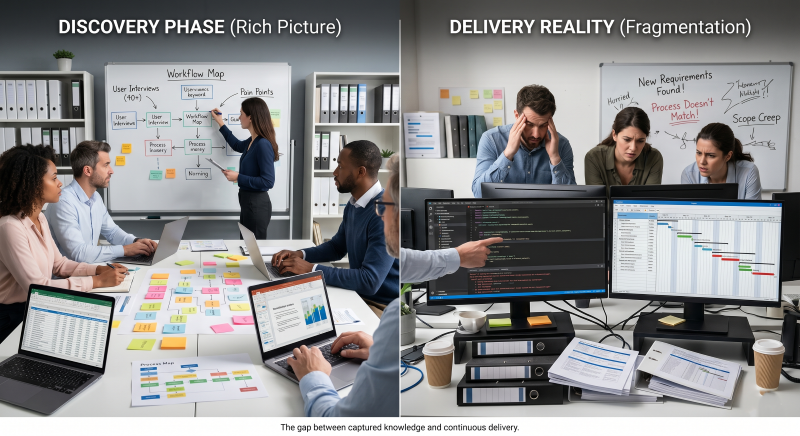
Your transformation team spends three months in discovery. They interview 40 people, map workflows, document current pain points, identify requirements, and build a rich picture of what needs to change. The discovery phase is complete.
Then delivery begins.
Six weeks into implementation, your team surfaces requirements they've never seen. Workflows operate differently than documented. Exception handling wasn't captured. Informal processes turn out to be critical. Stakeholders who seemed aligned early now raise objections because nobody mentioned this. Scope expands. Timeline stretches. Budget overruns begin.
This isn't a discovery problem. Everyone did the work. The real problem is that what was learned in discovery exists as artifacts disconnected from delivery. It lives in spreadsheets, presentation decks, and the heads of three people who were in every meeting. When delivery begins, context is rebuilt from scratch. Requirements are reinterpreted. Assumptions get tested against reality. Knowledge that was captured doesn't reach the team that needs it.
The transformation knowledge gap isn't about phase-specific failure. It's about the transformation knowledge that should flow from one phase to the next instead disappearing at phase boundaries.
Each transformation phase has a different objective, different team, different timeline, different focus. Discovery's job is to understand current state. Design's job is to create future state. Delivery's job is to build and implement. Adoption's job is to transition to the new way.
These different objectives create knowledge silos. A discovery team learns the operational reality. But discovery is done. The team moves on. The knowledge stays in documents that design doesn't read, or in the heads of discovery team members who aren't part of design. Design proceeds without that knowledge.
Design creates a solution. But design is done. The team moves on. The design exists in specifications that delivery teams might not fully understand. Delivery proceeds without understanding the intent behind design decisions. When something needs to be adjusted, delivery doesn't know why it was designed that way and makes decisions that conflict with design intent.
Delivery executes the implementation. But delivery is done. The team moves on. The learning from delivery—what worked, what didn't, what constraints were real, what workarounds were necessary—stays with the delivery team. Adoption teams don't know what delivery learned. Each transition loses knowledge. By the time you realize that transformation knowledge is being lost, the failure is already baked in.
Discovery's job is to understand current state. Not the documented current state. The actual current state. How work actually gets done. What informal processes are critical. What constraints are real. What workarounds are necessary. What dependencies exist.
If discovery does its job well, it creates a comprehensive picture of operational reality. But that picture needs to flow to design. If it doesn't, design makes assumptions based on incomplete information.
Design's job is to create the future state based on current state. If design understands what discovery found, it can design with intent we understand this constraint, and here's how we're addressing it. But design creates assumptions. This manual process will become automated. This informal coordination will disappear when we implement the new system. This constraint isn't real; it's just how they've always done it.
These assumptions need to flow to delivery so delivery knows what design was assuming. When delivery discovers an assumption was wrong, it needs to know it was an assumption that design made, not a requirement the business set.
Delivery's job is to build and implement the designed solution. But implementation always reveals things that discovery and design didn't account for. A constraint assumed away in design turns out to be real. A dependency that wasn't documented becomes critical. A workflow that was supposed to be simple turns out to have five informal steps.
Delivery learns what actually works. Delivery learns what constraints are real. Delivery learns what informal processes are necessary. This knowledge is gold. But if it doesn't flow to go-live, go-live will encounter the same surprises delivery encountered.
Adoption's job is to transition the organization from the old way to the new way. If adoption knows what delivery learned, it can plan with confidence. It knows which workarounds are necessary. It knows which constraints are real. It knows which informal processes need to be maintained.
But if adoption doesn't know what delivery learned, adoption teams will encounter surprises. They'll think something should work because design says it should. But delivery learned it doesn't work. Adoption teams will have to figure it out in real-time while the organization is depending on the system working.
The antidote to transformation knowledge fragmentation is intentional knowledge continuity. Three mechanisms make this work:
When a phase completes, the phase gate shouldn't just ask "Are deliverables done?" It should ask "Does the next phase understand what this phase learned?" The discovery gate holds until design can demonstrate they understand current state. The design gate holds until delivery can demonstrate they understand design intent. The delivery gate holds until adoption can demonstrate they understand what delivery learned.
Phase gates become knowledge transfer mechanisms. Understanding gets validated before work begins. If understanding hasn't happened, the gate holds.
Knowledge should live somewhere accessible. Not scattered across emails and documents. Containers where knowledge is organized:
Discovery Container: Current state findings, constraints, dependencies, workarounds, risks
Design Container: Design intent, assumptions, rationale for decisions, trade-offs made
Delivery Container: What worked, what didn't, constraints that were real, informal processes that were necessary
Adoption Container: What went well, what surprised us, what teams needed help with, what adoption barriers emerged
At every phase boundary, structured handoff meetings happen. The outgoing phase presents what they learned. The incoming phase asks questions until they understand. This isn't optional. This is governance.
The handoff meeting is how transformation knowledge moves. The outgoing phase shares context. The incoming phase builds understanding. Both leave the meeting with shared understanding of what happened and what the incoming phase needs to know.
Effective knowledge continuity requires visibility into what each transformation phase is learning and what the next phase needs to understand. But capturing this information across phases without systematic support is slow and incomplete.
ClearWork enables continuous transformation knowledge capture and flow across all phases through AI-driven asynchronous interviews and intelligence synthesis.
In discovery, ClearWork captures operational reality through structured interviews with frontline staff, surfacing informal processes, constraints, dependencies, and workarounds that documentation misses. During design, ClearWork ensures design teams understand discovery findings and documents design assumptions so delivery knows what design was assuming. During delivery, ClearWork captures what delivery learns about what works, what constraints are real, and what informal processes are necessary. At go-live, ClearWork surfaces what go-live teams need to understand from delivery so adoption planning is grounded in execution reality rather than design assumptions. In post-implementation, ClearWork ensures institutional knowledge from all previous phases is accessible so optimization decisions are informed by what's been learned.
The result: transformation knowledge flows continuously across phases. Each phase understands what the previous phase learned. Each phase builds on that understanding rather than rediscovering it.
The knowledge gap shows up when each phase operates with incomplete context from the previous phase. Discovery learns that a critical dependency exists; design doesn't know it. Design makes an assumption about whether a workaround will disappear; delivery discovers it won't. Delivery learns that a constraint is harder to manage than expected; adoption doesn't know and plans for the designed constraint instead of the actual constraint. The organization pays the cost through rework, scope creep, and extended timelines.
Seventy percent of transformations fail or significantly underperform. Most failures aren't caused by phase-specific incompetence. They're caused by transformation knowledge not flowing between phases. That knowledge loss becomes evident during execution when it's expensive to fix. A project that surfaces requirements gaps during delivery has to rebuild scope, extend timelines, and increase budgets. A project that builds knowledge continuity surfaces those gaps during design when there's time and budget to address them.
Phase gates create bureaucracy when they become checkboxes. "Are deliverables done? Check. Moving to next phase." Phase gates create value when they validate understanding. "Does design understand what discovery found? Show us. Ask questions until you understand. Then we're good to go." The gate isn't about compliance; it's about ensuring the next phase proceeds with actual understanding rather than assumptions.
That's exactly why transformation knowledge should live in containers and be transferred through handoff meetings, not stored in people's heads. If knowledge is being actively documented, transferred at phase boundaries, and captured in a knowledge system, departure of key people is disruptive but not catastrophic. If knowledge lives in people's heads and isn't being transferred, departures are crises. Build transformation knowledge continuity so knowledge is institutional, not personal.
Running structured handoff meetings and maintaining knowledge containers doesn't take significant additional time. Handoff meetings replace informal knowledge transfer that happens anyway you're just making it structured and documented. Knowledge containers are populated by the work teams are already doing; you're just organizing that knowledge so it's accessible. The time investment pays back many times over through reduced rework and faster execution.
Transformations move through phases. Transformation knowledge dies at phase boundaries. Organizations that manage knowledge continuity across phases move from 30% success rates to 70%+ success rates. The difference isn't smarter people or better tools. It's whether transformation knowledge flows continuously, or whether each phase has to rediscover what the previous phase already learned.
Information lives in people's heads, but even when it is documented it sprawls across documents, decks, recordings and more. ClearWork presents and opportunity not to centralize, but to make it all usable, and understanding of the full context.
Fourteen days, full access, no card required.
No credit card required.