AI in Consulting Delivery: Closing the Gap Between Discovery and Execution
Avery Brooks
April 15, 2026
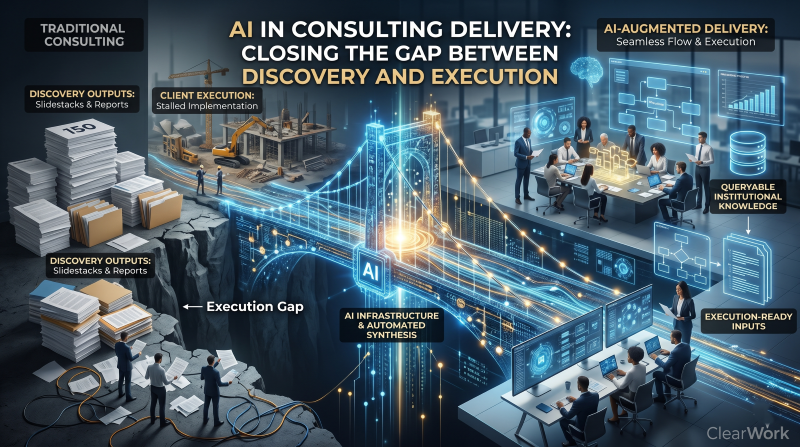
The engagement ends with a polished deliverable. The client receives a process map, a requirements document, a transformation roadmap. Then six months pass, and the firm gets a call: the implementation has stalled. No one knows what the process actually looks like in practice. The documentation doesn't match reality. The insights from discovery are locked in a 150-slide deck that nobody is reading.
This is the consulting execution gap — and it's structural, not accidental.
Most consulting firms invest heavily in the discovery phase and the final deliverable, but nearly nothing in the connective tissue between them. The middle of the engagement — where insights get translated into executable outputs — is where most of the value evaporates. The problem isn't that consultants are doing bad work. It's that the tools and workflows supporting that translation are still largely manual, unstructured, and person-dependent.
AI is now changing this in concrete, measurable ways. Not by replacing consultants, but by rebuilding the infrastructure that sits between discovery and execution. The full picture of how this reshapes the consulting delivery model can be explored on our Automated Discovery for Consulting page, including the specific phase where most firms continue to leak time and margin.
Traditional consulting delivery was designed around three assumptions: that discovery would be human-led through workshops and interviews, that synthesis would be done by analysts working overnight in spreadsheets and Word docs, and that execution would be handed off to the client with supporting materials. None of those assumptions hold in the same way in 2026.
Clients move faster. Implementation teams need structured inputs, not slide decks. And the volume of operational detail that needs to be captured, reconciled, and translated has grown significantly as organizations run more complex, cross-functional processes.
The delivery model hasn't kept pace. Most firms are still running the same engagement structure they used a decade ago — just with better-looking slides.
This is the core structural failure. Discovery produces insights — patterns, root causes, stakeholder perspectives, process flows. Execution requires specifications — detailed, structured, traceable inputs that implementation teams can act on without constant clarification.
The gap between those two things is filled by consultants doing manual synthesis work: reviewing interview notes, reconciling conflicting accounts, translating qualitative observations into structured requirements. That work is expensive, slow, error-prone, and completely dependent on individual analyst judgment.
When McKinsey's 2025 survey found that 88% of organizations use AI in at least one function but only 6% report meaningful enterprise-wide financial impact, the execution gap is part of the explanation. Technology is being deployed, but the upstream process that produces execution inputs hasn't changed.
Consulting engagements generate enormous amounts of institutional knowledge about how a client's operations actually work — the informal coordination, the exceptions, the workarounds, the unwritten rules that govern daily decisions. That knowledge lives in interview notes, analyst heads, and synthesized documents.
When the engagement closes, most of that knowledge walks out the door. The client has the deliverable. The firm has a billing record. Neither has a structured, queryable record of what was learned and why the recommendations were made.
The next engagement, whether with the same client or a new one facing similar challenges, starts from scratch.
Many consulting firms have responded to the AI moment by adding AI services to their service catalog: AI readiness assessments, generative AI strategy engagements, machine learning implementation projects. This is commercially rational. It is not the same thing as transforming the delivery model.
Offering AI strategy as a service and operating delivery with AI-augmented infrastructure are entirely different capabilities. Bain's research found that the gap between AI strategy and AI reality in organizations is primarily an execution problem — firms know what they want to build, but the operational infrastructure to build it doesn't exist. The same is true inside many consulting firms.
The traditional consulting pyramid depended on junior analysts handling structured, high-volume work: interview transcription, data synthesis, document drafting, research compilation. Those tasks are now the exact work that AI tools perform well.
As junior analyst work is automated, the leverage model changes. Smaller teams can execute larger scopes — which sounds like a win but creates its own pressure: senior consultants must take on more execution-layer work unless the firm actively rebuilds how delivery is structured.
AI-augmented consulting delivery is not the same as using AI tools inside an existing workflow. It means rebuilding the workflow so that AI handles the repeatable, high-volume middle layer — capture, synthesis, structuring — while consultants focus on judgment, relationship management, and strategic framing.
It is not about having analysts use ChatGPT to draft slide copy faster. That is AI as a word processor. The firms capturing real delivery advantage are rebuilding the connective tissue: how discovery inputs get captured, structured, reconciled, and translated into execution-ready outputs.
This applies most clearly to three phases: discovery capture, synthesis, and handoff documentation.
The first intervention point is the discovery phase itself. Instead of relying on live workshops, manual note-taking, and post-interview synthesis, leading firms are moving to structured async capture: AI-guided interviews or structured intake processes that produce machine-readable outputs from the start.
This is not about removing the human conversation — it is about removing the unreliable transcription and synthesis layer that sits between the conversation and the usable output. When a stakeholder's responses are captured in a structured format from the beginning, the analyst work shifts from transcription to interpretation.
Most firms synthesize each engagement from zero: review notes, identify patterns, reconcile conflicts, structure outputs. When that process is manual, it is slow and expensive. When it is AI-assisted, it can be fast and consistent — but only if the capture layer fed it structured inputs.
The synthesis layer should produce two things: a reconciled picture of how the process works (the operational truth, including exceptions and informal coordination), and a traceable link from that picture back to the source evidence. Without traceability, the outputs can't be challenged, validated, or updated without re-running the discovery.
The handoff from consulting delivery to client implementation is where the most value evaporates. Slide decks summarize findings. They do not give implementation teams the structured inputs they need to build, configure, or change systems.
Execution-ready outputs — requirements documents, process maps with decision logic, structured SOPs with owner assignments and exception handling — need to be produced as first-class deliverables, not as appendices to the main deck. AI can generate these outputs from structured synthesis data, reducing the analyst time required by 50–70% on well-scoped engagements.
The final step is keeping the evidence chain alive through the execution phase. When implementation teams ask "why was this designed this way?", the answer should be traceable to specific stakeholder inputs from discovery, not to a consultant's memory or a buried slide.
AI-assisted platforms that link requirements to source evidence allow implementation teams to self-serve on context, reduce re-discovery requests, and adapt specifications as conditions change without losing the original rationale. This is what turns a one-time engagement into a reusable asset.
Map where your current engagement workflow produces unstructured outputs. Identify the handoff points: where does discovery output get synthesized? By whom? In what format? How long does that synthesis take?
Most firms will find two or three points where the workflow bottlenecks on individual analyst judgment and manual documentation. Those are the intervention points.
Select one active or upcoming engagement to pilot structured async discovery. Replace or supplement at least two stakeholder interviews with a structured async format that produces machine-readable outputs. Measure: time to synthesis, output quality, number of follow-up clarifications required.
Don't try to transform the full delivery model at once. Prove the capture layer first.
Using the structured capture data from the pilot, build a template for translating synthesis outputs into execution-ready deliverables. This does not require sophisticated technology — it can start as a structured prompt workflow or a templated output format. The goal is repeatability: the same quality of execution-ready output regardless of which analyst runs the synthesis.
Standardize the new workflow, train senior consultants on oversight rather than execution, and begin building a knowledge base from completed engagements. The compounding value of AI-augmented delivery comes from reuse: discovery patterns, process templates, and synthesis heuristics that improve over time and across clients.
The business case for AI-augmented consulting delivery is not primarily about cutting costs. It is about margin recovery and delivery quality.
Discovery and synthesis work is expensive when done manually — typically 30–40% of total engagement hours on complex transformations. When that work is structured and AI-assisted, those hours compress significantly. The savings can be reinvested in higher-value senior consultant time, passed to clients through better pricing, or captured as margin improvement.
Quality improves because synthesis is no longer person-dependent. The same structured process produces consistent outputs regardless of which analyst is working the engagement. Junior analysts can contribute at a higher level earlier, because they're working within a structured workflow rather than improvising.
The handoff problem also improves materially. When execution-ready outputs are a first-class deliverable, implementation teams have what they need. Re-engagement rates decline. Client satisfaction scores go up. The firm's reputation shifts from "great strategy, hard to implement" to "gave us what we needed to actually execute."
The hardest part of AI-augmented delivery is not the technology — it is the capture layer. If discovery still depends on manual workshops and note-taking, every downstream benefit is constrained by the quality and consistency of those upstream inputs.
Platforms like ClearWork support this by replacing manual discovery interviews with structured async AI-guided intake. Stakeholders respond on their own schedule. The platform captures responses in a structured format, surfaces conflicts and gaps automatically, and produces synthesis-ready outputs that downstream tools can actually work with. The result is a discovery phase that produces consistent, traceable, execution-ready inputs — without the consultant-hours overhead that manual workshops require.
More detail on how this fits into a modern consulting delivery model is covered in [Automated Discovery for Consulting (2026)](https://www.clearwork.io/clearwork-for-consultants---automated-discovery).
-Treating AI as a writing accelerator, not a workflow change. Using AI to draft slides faster is not delivery transformation. The intervention needs to happen at the capture and synthesis layer, not the presentation layer.
-Piloting on low-stakes engagements and judging it unfair. Structured async discovery works best on mid-complexity, multi-stakeholder engagements. A single-stakeholder scoping call is not a useful test.
Skipping traceability. Synthesis outputs without source evidence links create exactly the same handoff problem as manual documentation — just faster. Build traceability into the workflow from the start.
- Automating the wrong layer. Many firms automate the formatting and presentation layer (slide production, report templating) while leaving the synthesis layer completely manual. This saves junior analyst hours on low-value work while leaving the expensive bottleneck untouched.
- Not involving implementation teams in the output design. The point of execution-ready outputs is that implementation teams can use them without constant clarification. Design those outputs in partnership with the people who will actually use them, not in isolation.
The consulting execution gap is the disconnect between discovery insights (what was learned) and execution inputs (what implementation teams need to act). AI adoption in consulting has largely focused on service offerings rather than closing this gap — which explains why AI strategy engagements are proliferating while delivery efficiency improvements remain limited.
Not necessarily. It means differently structured teams. Senior consultants focus on judgment, client relationship, and strategic framing. AI handles repeatable synthesis and documentation work. Firms that manage this transition well can take on more engagements or more complex scope with the same headcount.
Structured async discovery captures the same stakeholder knowledge through AI-guided intake rather than live interviews. It produces structured, machine-readable outputs from the start, eliminates the manual transcription and synthesis layer, and scales across more stakeholders without adding proportional consultant time. It works best for operational discovery where the goal is capturing how work actually happens, not facilitated co-creation.
Execution-ready outputs contain specific, structured, traceable information that implementation teams can act on without clarification. This includes decision logic, owner assignments, exception handling, system dependencies, and links to source evidence. A summary slide is not execution-ready. A structured requirements document with traceability to discovery sources is.
Firms report meaningful margin improvement within two to three engagements when the capture and synthesis layers are restructured. The compounding benefit — reusable knowledge assets, reduced re-discovery, better implementation handoffs — builds over time and is harder to measure but significant over a 12-month horizon.
Closing the consulting execution gap requires rebuilding the delivery infrastructure, not just adding AI tools to existing workflows. The firms capturing real advantage in 2026 are those treating discovery capture and synthesis as engineered systems — structured, repeatable, and traceable — rather than as craft work that varies by engagement and analyst. When discovery produces execution-ready outputs consistently, the rest of the delivery model improves downstream: better handoffs, faster implementation, fewer re-engagements, and stronger client outcomes. That is the actual transformation available — not in the deck, but in what happens between the discovery call and the client going live.
Closing the consulting execution gap requires rebuilding the delivery infrastructure, not just adding AI tools to existing workflows. The firms capturing real advantage in 2026 are those treating discovery capture and synthesis as engineered systems — structured, repeatable, and traceable — rather than as craft work that varies by engagement and analyst. When discovery produces execution-ready outputs consistently, the rest of the delivery model improves downstream: better handoffs, faster implementation, fewer re-engagements, and stronger client outcomes. That is the actual transformation available — not in the deck, but in what happens between the discovery call and the client going live.
Fourteen days, full access, no card required.
No credit card required.