Process Intelligence Software in 2026: Process Mining, Task Mining or Automated Discovery?
Avery Brooks
October 7, 2026
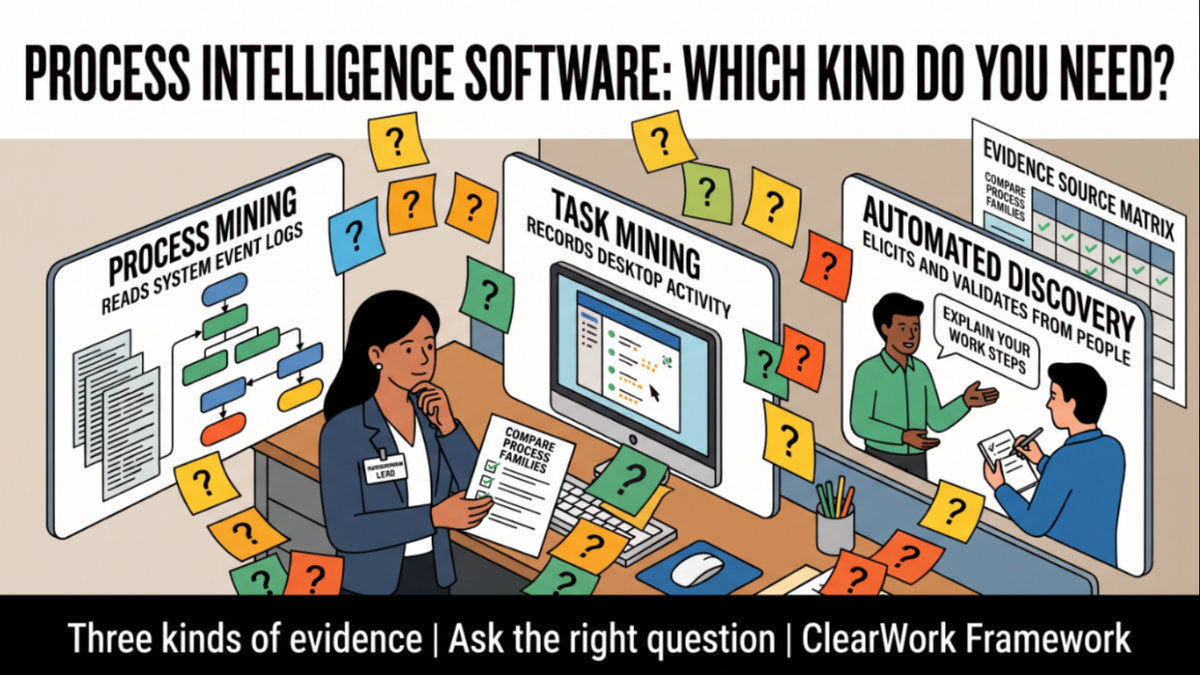
Process intelligence software shows how work actually runs so you can improve, automate or redesign it. It comes in three families: process mining reads system event logs, task mining records desktop activity, and automated process discovery elicits and validates how work is done from the people doing it. Each sees a different slice; most programs need two.
The mistake buyers make is treating the three as competitors and picking one. They answer different questions. Mining tells you what the systems recorded; task mining tells you what happened on the screen; discovery tells you what people did, why, and what never touched a system at all. This guide maps the families, gives you an evidence-source matrix to test your own questions against, and links to the deeper guide for each part of the category.
Three readers, mostly. Operational excellence and transformation leads choosing a process intelligence platform for an improvement or automation program. Program and project leads on ERP, CRM or service management implementations who need a reliable current state before design starts. And consultants who run client discovery and want evidence they can defend in a steering meeting.
If you already know the family you need, jump to its section. If you are not sure, start with the matrix: it takes ten minutes and usually settles the argument.
The three overlap less than vendor pages suggest. A mining tool and a discovery tool on the same process will usually produce two maps that disagree, and the disagreement is the most useful output either produces: it marks where the system's view of the process and the people's view part ways.
Write down the three questions your program actually needs answered, find the closest rows below, and read across. "Yes" means the family answers it from its own evidence; "Partly" means it gives a signal you will still need to explain; "No" means it cannot see the answer.
Answer yes or no.
Yes to 1 and 2 and no to 4: start with process mining. Yes to 3 and no to 4: task mining is a reasonable first step. Yes to any two of 4, 5 and 6: start with automated discovery, then add mining once you know which paths to measure. Most transformation programs land in the last group, which is why discovery-first is the common pattern for ERP and CRM projects and mining-first is common for mature, high-volume operations already running on one platform.
Process intelligence is the umbrella term for software that turns evidence about work into an accurate, current picture of how processes run. Our 2026 guide to what process intelligence is covers the definition and the components; this pillar focuses on choosing software within it.
Two boundaries matter. Process intelligence is not business intelligence: BI reports outcomes (revenue, volumes, SLAs), while process intelligence explains the sequence of work that produced them. And it is not documentation software: a process repository stores maps, while process intelligence produces or checks them against evidence.
A third distinction is newer. Data processing automation, which extracts and transforms the information flowing through a process, is often sold alongside process intelligence and sometimes confused with it. Our primer on automated data processing for enterprise leaders explains where the line sits. In short, data processing moves information through the work; process intelligence tells you how the work itself runs.
The practical test for any product calling itself process intelligence: ask what its evidence is and who confirmed it. A map with no stated evidence source is a drawing, however good the interface.
The three terms get used interchangeably in vendor marketing, and the confusion costs buyers months. Process mining reconstructs processes from timestamps in system logs. Task mining reconstructs desktop routines from recorded user activity. Process discovery, in the sense used across this cluster, establishes how a process actually works from the people who do it and the artifacts they use, and validates it with them.
Each has a characteristic failure. Mining shows you a perfect map of the part of the process the systems can see and nothing of the rest; teams then optimize the visible part and move the delay somewhere invisible. Task mining shows you clicks without intent, which produces automation candidates that break on the first exception. Discovery done badly, through a handful of workshops, produces the process as managers describe it rather than as it is done.
Our detailed comparison, process discovery vs process mining vs task mining, sets out the differences with examples and is the page to send a stakeholder who keeps using the terms as synonyms.
The short rule: mining is for measurement, task mining is for desktop automation candidates, discovery is for understanding and redesign. When a program needs all three, the order is usually discovery to establish the process and its exceptions, mining to measure it at volume, and task mining only for the specific desktop steps chosen for automation.
Traditional discovery means interviews and workshops run by an analyst or consultant: slow, expensive, and dependent on who is in the room. Automated process discovery keeps the source (the people doing the work) and changes the method. An AI agent runs structured interviews asynchronously, each person contributes recordings and documents they already use, and the software assembles a current-state picture, flags conflicts between accounts and lists what is still unknown. A human confirms each finding before it counts.
That last step is what separates it from generic AI summarization. A summary of interviews is a draft; a validated, source-linked current state is evidence. The difference shows up when someone in a steering meeting asks "who says so?" and the answer is a link rather than a shrug.
We explained why this step was missing from most project toolchains in automated process discovery: the missing link in the modern project management stack. The case is simple: project tools manage the work of the project, design tools draw the target state, and nothing in the stack was responsible for establishing the current state reliably.
Automated discovery does not replace analysts or consultants. It removes the scheduling and transcription load, so they spend their time on the judgment calls: which variation matters, what the target state should be, and what to tell the sponsor.
Buying in this category goes wrong in a predictable way: a team searches for "process discovery tools," gets a list that mixes mining, task mining, documentation recorders and discovery platforms, and compares them on features rather than evidence. Start from the matrix above, then compare tools within the family your questions point to.
For a side-by-side, our comparison of the best process discovery tools for 2026 groups tools by family and says where each fits. The process discovery software comparison for 2026 goes further on evaluation criteria.
Four criteria separate tools that produce usable evidence from tools that produce pictures. Traceability: can every step in the output be traced to a source? Validation: does a human confirm findings, and is that recorded? Coverage: does the evidence reach work outside systems? And time to first insight: how much setup (log extraction, agents, consent processes) stands between purchase and a first current-state map? None of these criteria favors one family outright; they make the trade-offs visible.
Task mining is the most misunderstood member of the family. It records what users do on their desktops (applications opened, fields filled, clicks) and finds repeated routines. For identifying automation candidates in high-volume back-office work, it is useful. For understanding a process, it is narrow: it sees the screen, not the reason, and nothing that happens off it.
Our explainer on what task mining is and its common use cases covers where it earns its place. If you are already a UiPath shop weighing its capture tooling, UiPath Task Capture alternatives for 2026 compares the options, including approaches that capture the work rather than only the clicks.
A related category is documentation recorders, which turn a single recorded session into a step-by-step guide. They are often shortlisted for discovery and are not discovery tools: they document one person's path once. Our comparison of Scribe alternatives against process intelligence platforms explains the difference.
Two practical cautions. Desktop recording raises privacy and employee-consent questions that can take longer to resolve than the technical rollout, so start that conversation early. And treat task mining output as a list of hypotheses: confirm each candidate routine with the people who perform it before anyone builds a bot.
Platform programs are where weak discovery costs the most, because design decisions get locked into configuration. Each major platform has its own discovery problem. SAP S/4HANA programs fight custom code and years of workarounds; Oracle Fusion programs need to separate what the old system forced from what the business needs; ServiceNow programs depend on how work really flows between teams, not the org chart; Salesforce programs need to capture how revenue and service teams actually sell and support, which rarely matches the configured stages.
We wrote platform-specific guides for each: process discovery tools for SAP transformations, for Oracle ERP transformations, for ServiceNow transformations and for Salesforce transformations.
The common thread is that mining the legacy system shows how the old configuration constrained the work, which is precisely what the program is trying to change. Discovery with the people doing the work shows what they need, including the steps the old system never supported. Our guide to AI-led stakeholder interviews for ERP and CRM discovery covers how to get those inputs from dozens of people without a month of workshops.
Discovery that ends in a map is half finished. Programs need requirements that trace back to the evidence, and delivery teams need them in the tools they use.
For the end-to-end path, start with process discovery for project delivery: from current state to build-ready requirements, then how process excellence teams convert discovery into Jira epics, stories and test coverage. If your inputs are mostly documents, auto-generating requirements, flows and stories from documents covers that route.
Traceability is what keeps requirements stable. Evidence-linked requirements explains how linking each requirement to its source reduces scope churn, and managing change and requirements traceability after discovery covers governance once build starts.
For the fundamentals of eliciting requirements, three guides go deeper: mastering requirements gathering techniques and tools, techniques and tools for effective requirements elicitation, and requirements gathering 2.0 in the discovery phase.
The thread through all of them: a requirement nobody can trace to how the work is done is an opinion with a ticket number.
Before any of the tooling, discovery is a project phase with its own deliverables, risks and stakeholders. Our ultimate guide to the project discovery phase is the most-read page in this cluster and covers the phase end to end: scope, deliverables, roles and how long it should take.
Two parts deserve their own attention. Stakeholders: discovery fails quietly when the people who do the work are consulted late or not at all, which is the theme of stakeholder engagement in the discovery phase. And risk: discovery is where feasibility is tested before money is committed, covered in managing risks and feasibility studies in software projects.
Process intelligence software changes the economics of this phase rather than its purpose. The deliverables are the same: a validated current state, a list of risks and unknowns, and requirements that trace to evidence. What changes is how many people you can hear from and how quickly the evidence comes back.
The last shift in the category is from discovery as a one-off project to process intelligence as an ongoing capability. Lean and process improvement programs used to map a process, fix it and move on; the map went stale within months. Continuous process intelligence keeps the current state current, so improvements can be measured and drift can be spotted.
Our pieces on how process intelligence is reshaping continuous improvement and moving from one-time lean projects to continuous process intelligence cover the operating model, and top process excellence trends for 2026 puts it in the context of AI-native operations.
The practical implication for buyers: ask how each tool keeps its picture current after the first project. Mining refreshes as logs refresh. Task mining refreshes as long as agents keep recording. Discovery refreshes when people are asked again, which is cheap once it is asynchronous and the previous answers are on record to compare against.
ClearWork is an automated discovery platform, the third family in the table above. ClearWork's automated discovery elicits how work actually happens from the people who do it, through AI-guided asynchronous interviews, screen recordings they choose to share, meeting capture and the documents they already use. Its agent, Clarity, assembles the current state, flags where two accounts of the same step disagree and lists open questions. Every finding is validated by a person before it enters the record, and every step in the resulting process maps, SOPs and requirements traceability matrix links back to its source.
Its distinguishing feature is active elicitation: it goes and gets knowledge that is not written down anywhere, rather than retrieving what already exists in systems or documents. That is also why it pairs well with mining rather than replacing it. Discovery establishes the process, its exceptions and its rules; mining measures how often each path occurs once you know what you are looking for.
ClearWork augments the analysts, consultants and process owners doing the work. It does not decide the target state or run the engagement; it gives the people who do a validated, traceable starting point.
ClearWork is the wrong choice if your question is purely quantitative and the process lives inside systems with good logs: if you need variant frequencies and cycle times across millions of transactions, buy a process mining tool. It is the wrong choice if you need a continuous record of desktop activity to find automation candidates at volume: that is task mining's job. It is the wrong choice if you need a quick click-by-click guide to one software task: a documentation recorder is faster. And it is the wrong choice if the people who do the work cannot be asked to take part, because its evidence comes from them.
It is the right choice when the process crosses systems and people, when exceptions and undocumented rules decide the outcome, when you are about to redesign, replace or automate, or when you need requirements and documentation that trace to evidence someone has confirmed.
Only if you can't vouch for the maps. If they were validated with the people doing the work recently and the process hasn't changed, you may only need mining to measure it. If the maps are more than a year old, came from workshops, or nobody can say who confirmed them, process intelligence software is how you find out whether they still describe the work.
No. Process mining is one family within process intelligence, the one that reads system event logs. It is strong on measurement inside systems and blind to work outside them, which is why it is usually combined with discovery or task mining.
Process mining reconstructs processes from timestamps in system logs. Process discovery establishes how work is done from the people who do it and the documents they use, including decisions, exceptions and offline steps no log records. Mining measures; discovery explains.
Start from the questions you need answered, not the tool. If you need volumes and cycle times inside one or two systems, start with mining. If the process involves judgment, exceptions or work outside systems, or you are about to redesign it, start with discovery and add mining once you know which paths to measure.
It depends on the family. Mining needs log extraction and modeling, which commonly takes weeks before a first map. Task mining needs desktop agents and consent processes. Automated discovery needs access to the people doing the work, so the first result depends mostly on how quickly they respond and confirm the findings, not on data engineering.
Run your top three process questions through the evidence matrix before you shortlist any process intelligence vendor.
Most process intelligence software measures what systems recorded; the decisions, exceptions and unwritten rules that decide how work really runs sit outside that view. If your matrix pointed to discovery, see how ClearWork's automated discovery elicits and validates how work actually happens and links every step back to its source. Book a walkthrough and bring the one process your systems data cannot explain.
Process mining, task mining and automated discovery each see a different slice of how work runs. A 12-question matrix shows which one your question needs.
Fourteen days, full access, no card required.
No credit card required.