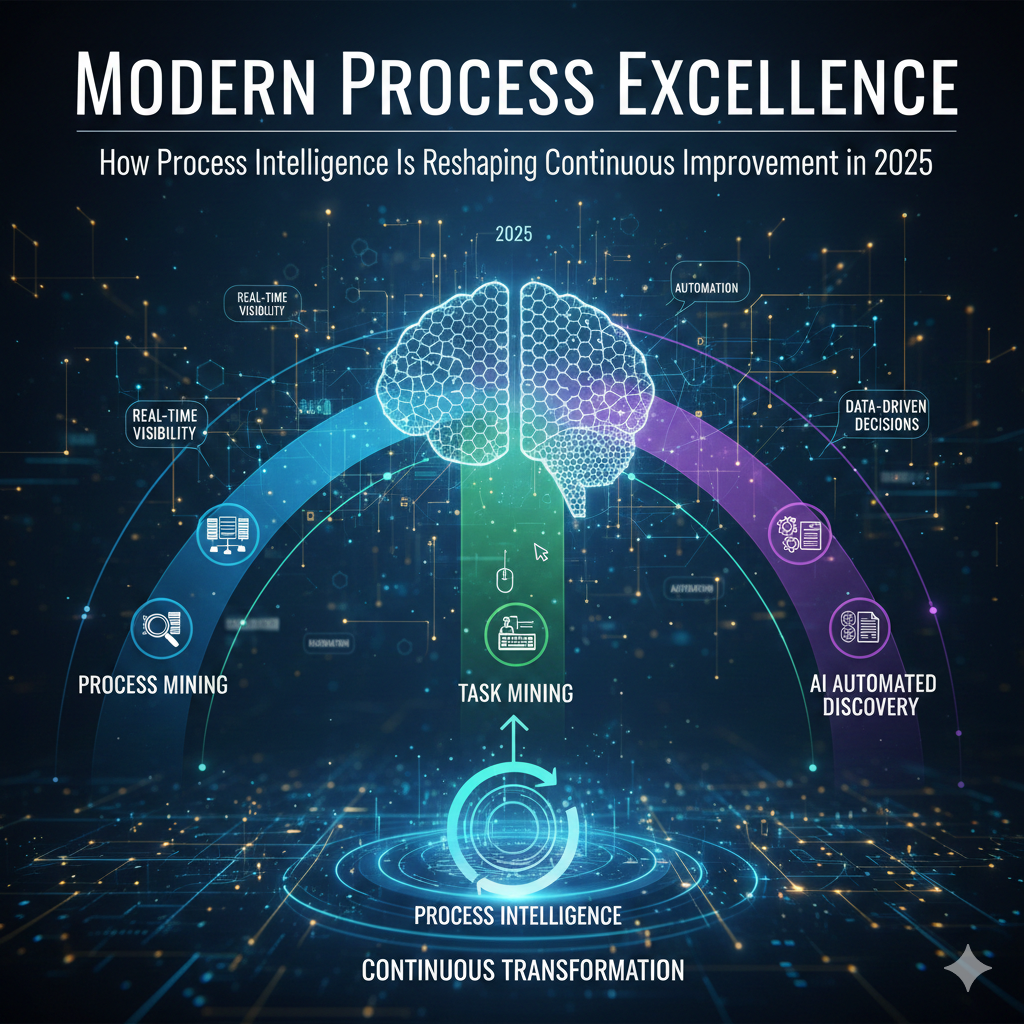
Modern Process Excellence: How Process Intelligence Is Reshaping Continuous Improvement in 2026
Avery Brooks
December 2, 2025
Process Excellence has always been about one thing: ensuring work gets done as efficiently, reliably, and intelligently as possible. But as organizations face unprecedented complexity—from ERP upgrades to AI-driven automation to globally distributed teams—the traditional tools of Process Excellence can no longer keep up.
In 2025, Modern Process Excellence looks different. It’s faster. It’s more data-driven. It’s more connected. And it is increasingly powered by a new category of technology called Process Intelligence.
This article explores how Process Excellence is evolving, the trends shaping the discipline, and why Process Intelligence is quickly becoming the foundation for high-performing, transformation-ready organizations.
For decades, Process Excellence was built on the backbone of Lean, Six Sigma, Kaizen, and traditional business process management. These frameworks remain invaluable—but they were built for a world where:
That world is gone.
Today’s PEX teams operate inside environments defined by:
Modern Process Excellence is not a project. It is an always-on capability.
And this shift—from episodic improvement to continuous transformation—is powered by Process Intelligence.
Most organizations still rely on interviews, workshops, shadowing sessions, and manual documentation to understand and improve processes.
But these approaches suffer from serious limitations:
Weeks of interviews and manual mapping can’t keep pace with rapidly changing environments.
SMEs explain what should happen—not what actually happens.
Workflows differ by region, user, application, or team structure.
Hybrid work and system changes cause processes to drift constantly.
You can’t interview your way to a global transformation.
This is where Process Intelligence fundamentally changes what’s possible.
Process Intelligence is the practice of understanding how work actually gets done by analyzing real user interactions, system data, and AI-generated insights.
Unlike traditional methods, Process Intelligence provides evidence-based clarity, not assumptions.
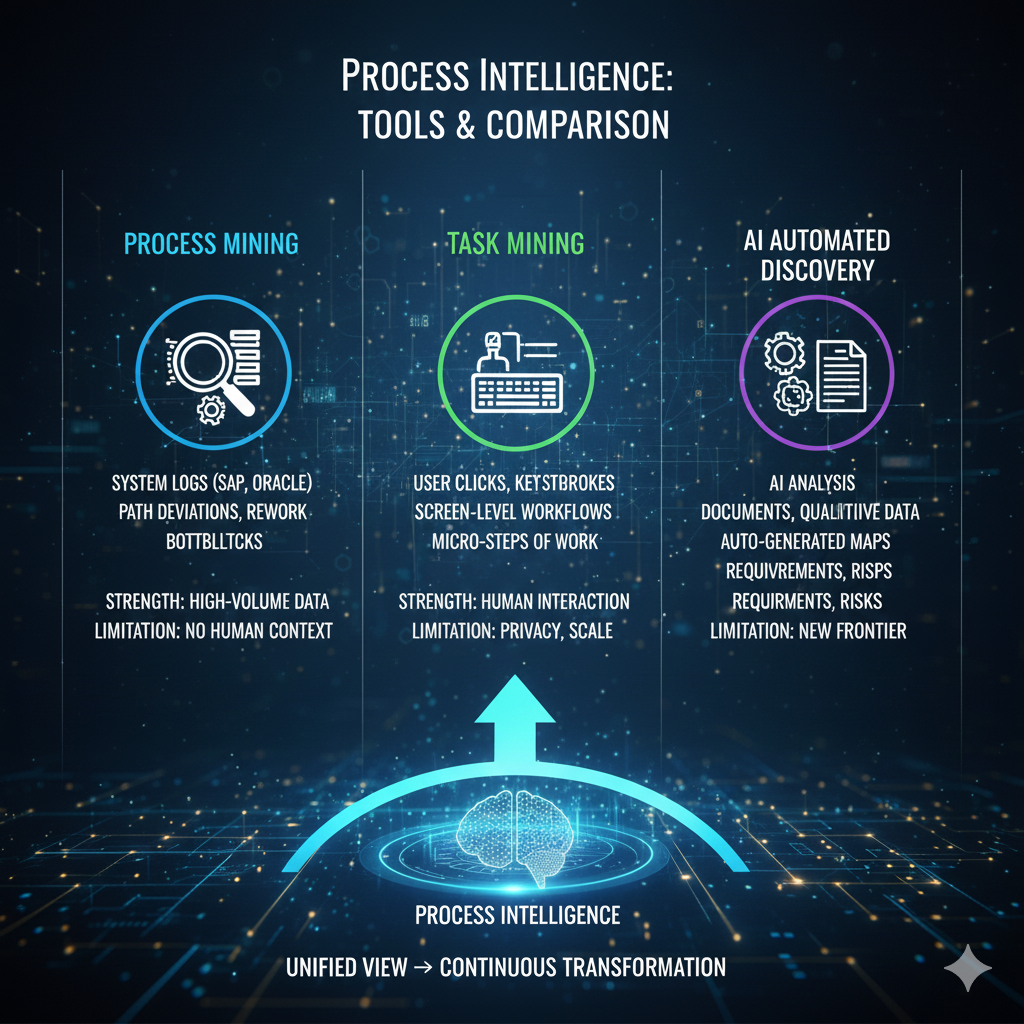
It combines three complementary components:
Uses system event logs from applications like SAP, Oracle, Salesforce, or custom tools to show:
Strength: Excellent for high-volume workflows with structured system logs.
Limitation: Cannot see human-level steps taken outside those systems.
Captures user actions inside applications:
Strength: Shows the micro steps of work.
Limitation: Difficult to scale and can raise privacy/user adoption concerns.
Uses AI to automatically:
Strength: Fills the gaps left by mining alone—adding context, intent, decisions, and rationale.
Together, these three layers enable true Process Intelligence: real-time, end-to-end visibility into work.
Organizations no longer accept month-long discovery cycles.
Automated discovery reduces the effort from weeks to hours, providing:
This changes the job of analysts from "documenting" to strategic interpreting.
Legacy tools give partial insight—only system logs or human interactions.
Process Intelligence blends:
PEX teams finally see the entire workflow, not pieces of it.
Modern organizations need continuous process oversight—not annual reviews.
Process Intelligence enables:
PEX becomes proactive, not reactive.
AI no longer just analyzes data—it creates process artifacts:
This accelerates transformation and increases quality.
Executives expect process improvement to deliver:
Process Intelligence equips PEX teams with the evidence and insights needed to deliver quantifiable outcomes.
No more marathon workshops.
Process Intelligence shows what users really do—accurately, quickly, and objectively.
Leaders can see:
Insight replaces guesswork.
Automation fails when based on inaccurate workflows.
Process Intelligence provides the factual foundation needed for:
Most ERP projects fail due to bad discovery and unclear requirements.
Process Intelligence reduces rework and accelerates configuration.
Process Intelligence finally operationalizes continuous improvement—not in months, but daily.
Builds global standards, ensures governance, and drives transformation using always-on data.
Shifts from manual mapping to delivering strategy, insights, and redesign.
Cuts discovery cycles by 70%+ and reduces implementation risk by seeing real workflows early.
Identifies the right opportunities, prioritizes them, and accelerates design.
These metrics build executive trust—and Process Intelligence provides them with precision.
Modern PEX is moving toward:
Process Intelligence is the bridge between today’s challenges and tomorrow’s AI-native operations.
ClearWork brings Process Excellence into the modern era through two integrated capabilities:
Together, they form a modern Process Intelligence layer built for PEX, PMO, transformation, and automation teams that need speed, accuracy, and evidence-driven decisions.
Process Excellence isn’t disappearing—it’s evolving.
And organizations that embrace Process Intelligence will deliver transformation faster, reduce risk, and create operational excellence that compounds over time.
Process Excellence focuses on designing, optimizing, and governing workflows, while Process Intelligence provides the real-time data and insights needed to improve processes continuously and accurately.
They are slow, subjective, and unable to capture the true variations and exceptions that define modern work, especially across distributed teams and complex systems.
It accelerates discovery, improves requirements quality, reduces rework, and ensures the transformation reflects real-world workflows.
Yes—by pinpointing repetitive, high-volume tasks with measurable inefficiencies, it helps automation teams prioritize the highest-ROI cases.
No—it augments them. Analysts spend less time documenting and more time designing, optimizing, and leading strategic improvement initiatives.
Process Excellence is being redefined by the complexity of modern operations and the speed required to meet customer and executive expectations. Traditional methods can’t keep up, but Process Intelligence provides the real-time visibility and AI-driven insights needed to improve faster and more accurately. Organizations that adopt Process Intelligence today will build the transformation capabilities that competitors won’t match for years.
Fourteen days, full access, no card required.
No credit card required.