Carve-Out Readiness: Document Standalone Processes Before the TSA Ends
Avery Brooks
November 17, 2026
Updated: November 16, 2026
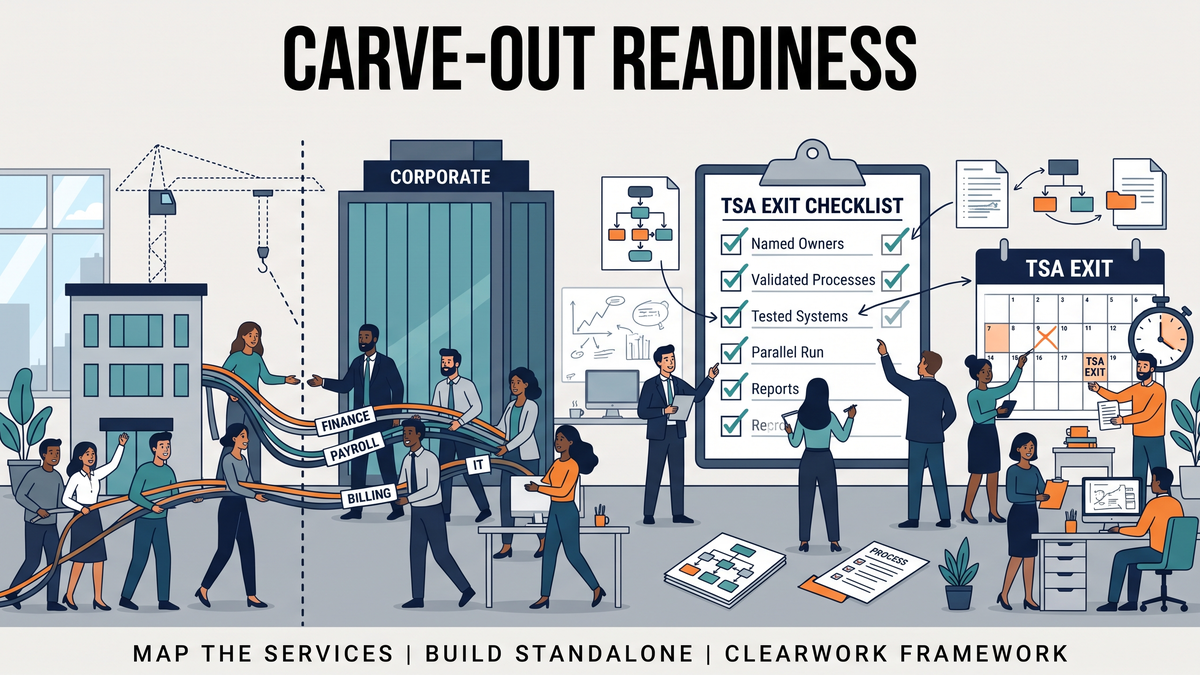
A carve-out is ready to exit its transition services agreement when every service the parent provides has a named owner, a documented standalone process that the new team has validated and tested, and a date. Map what the parent did for the business, process by process, then build and test the replacements well before the TSA ends.
A carve-out is the sale of a division, business unit or product line by a larger company, often to a private equity buyer. The business has customers, people and products of its own, but it has usually relied on the parent for much of how it runs: finance, payroll, IT, procurement, logistics, customer billing and more.
A transition services agreement (TSA) is the contract that keeps those parent services running after the deal closes. The seller agrees to provide named services, for a fee, for a fixed period, while the buyer builds its own. Most TSAs list the services in schedules, with a duration and an exit date for each one, and some allow extensions at a higher price.
The TSA solves Day 1. On the morning after close, payroll still runs, invoices still go out and systems still work. What it does not do is teach the carved-out business how any of that work is done. A TSA buys time, not knowledge. For operators, that means the TSA period is a project with a deadline, a budget and a list of deliverables, and it deserves the same discipline as any other program in the first year of ownership. The work that matters is using that time to document, build and test standalone processes before each service switches off.
Carve-outs rarely fail at Day 1. They struggle later, when services end and the business finds out what the parent was really doing.
FTI Consulting's analysis of hidden costs in carve-outs (2025) notes that standard diligence relies on seller-provided cost bases and business-as-usual assumptions, and tends to miss true standalone costs, transitional needs, system dependencies and people complexity. It also warns that leaning too heavily on seller TSAs can give a false sense of security.
The common patterns are:
Each of these turns into an extension request, a cost overrun or a service gap.
Reverse services add another layer. Some carve-outs provide services back to the parent for a period, such as manufacturing for a product line the parent kept or shared warehouse space. Those need the same inventory, owners and end dates, and the people who deliver them need to know when the obligation stops.
Start with a service inventory: every service the parent provides under the TSA, and every one it provides that the TSA does not mention. For each, find out who does the work today, what the process looks like step by step, which systems and data it uses, and who will own it after exit.
The table shows the minimum to track for each service.
The hardest part is the process column. The schedules say what the service is; they rarely say how the work is done. That knowledge sits with the people doing it today, on both sides of the deal, and in documents scattered across the parent's systems.
A current-state assessment of each TSA service is the fastest way to fill that gap. ClearWork is an AI discovery platform for processes and requirements. Its AI agent, Clarity, runs short async interviews (voice or chat, about 20 minutes) with the people who do the work, people can add screen recordings of how a task is done on screen, and ClearWork ingests existing documents such as desk procedures and system guides. It flags where sources conflict or leave gaps, process owners validate each round, and every step traces back to who said it.
With the current process documented, design what replaces it. For each service, decide whether the carved-out business will run the same process on its own systems, change it, or buy it from a third party. Then build it, staff it and test it while the TSA is still a safety net.
Work in this order:
Plan the people side alongside the process work. The carve-out may need to hire a controller, a payroll specialist or an IT lead it never had, and those people need time to learn the process before the service ends. Where parent employees hold knowledge the business will need, capture it early and with their manager's support, and make clear that the goal is a clean handover, not an evaluation of anyone's work. The tribal knowledge and key-person risk guide covers how to do this without unsettling people.
Keep one tracker for all services rather than a separate plan per function. Exit dates interact: an ERP cutover can move the date for accounts payable, invoicing and the close at the same time, so the steering group needs to see every service and its dependencies in one place.
Agree the readiness criteria with the seller early. As FTI notes, "operationally ready" means different things to buyers and sellers unless someone writes it down.
Use this checklist for each service before it ends.
For sponsors, TSA exit is part of the value creation plan: extension fees and dual running costs come straight out of the first year's numbers, and standalone readiness is often the first milestone the board tracks.
The free template turns this article into a working tracker for every TSA service. Download the TSA exit readiness checklist (Excel).
Update the inventory weekly during the TSA period and review the readiness tab at each steering meeting. For more on how sponsors and operators use discovery after a deal, see ClearWork's page for private equity operating teams.
It depends on the deal and the services. Many TSAs run for several months to a year or more, often with different end dates for different services and an option to extend at a higher cost. Plan the exit from the day the agreement is signed, not when it is close to ending.
Typical TSA services include finance and accounting, payroll and HR administration, IT hosting and support, procurement, logistics and customer billing. The schedules should list each service, its scope, its price and its exit date. Anything the parent does for the business that is missing from the schedules is a risk to find early.
Before signing if possible, and no later than Day 1. The service inventory and current-state documentation take time, and replacements need to be built, staffed and run in parallel before each exit date.
A separation or TSA exit lead usually coordinates the program, reporting to the CFO or COO. Each service needs a named owner in the new company who will run the standalone process and sign off that it is ready.
The business either negotiates an extension, usually at a higher price, or runs the process without proven support, which risks errors in billing, payroll or financial reporting. Both are avoidable with an early inventory, documented processes and a parallel run.
Interview the people who do the work today, on both sides, and collect the parent's existing procedures and system guides. Validate what you capture with the process owner, and record exceptions as well as the standard path.
See how ClearWork documents standalone processes before the TSA ends. Book a demo.
How to exit a transition services agreement on time: map what the parent did, document and test standalone processes, and run a TSA exit checklist.