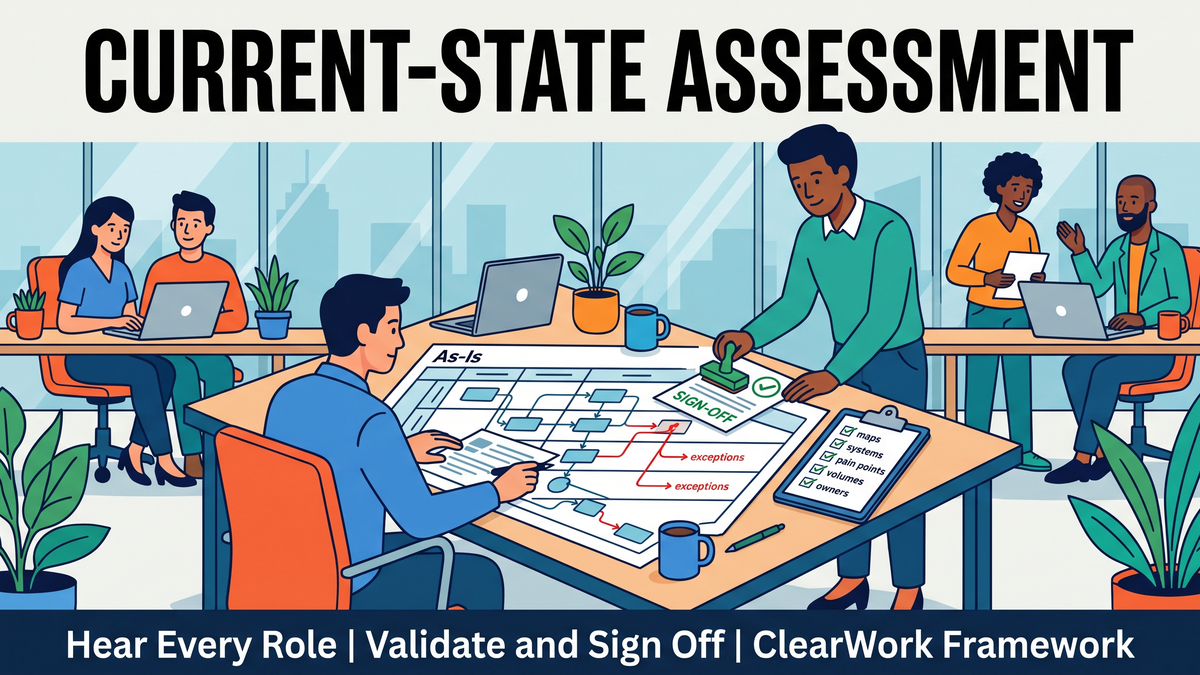
Current-State Assessment: What It Includes, How Long It Takes, and a Template
Avery Borooks
October 26, 2026
Updated: October 26, 2026
A current-state assessment is a documented, validated picture of how a part of the business runs today: the process maps, exceptions, systems, pain points by role, volumes and owners. Done well, it hears from everyone who does the work, gets process owners to sign it off, and takes one to four weeks, depending on scope and complexity.
A current-state assessment (also called an as-is assessment or current state analysis) answers one question: how does this area of the business actually work right now? It is the baseline every later decision rests on, whether that decision is a new system, an operating-model change, a cost program or an AI rollout.
It is broader than a process map. A map shows the steps. An assessment also shows who does each step, which systems and spreadsheets they use, where the work breaks, how often each path happens, and who owns the result. It is also narrower than a strategy review: it describes what is true today and leaves the target design for later.
The most common failure is a current state that describes the process as designed rather than the process as run. Policies, SOPs and leadership briefings tell you the intended version. The people who do the work know the real one, including the workarounds that keep things moving. If you only need the map itself, our guide to current state process mapping covers the six-step method in detail.
A complete assessment covers six things for each process in scope. If any one is missing, the gap usually shows up later as rework, a scope argument or a surprise during build.
Keep the scope tight enough to finish. One end-to-end process done completely is more useful than ten processes mapped at the happy-path level, because the exceptions are where cost, risk and rework sit.
Each item should carry its source: the person who described it or the document it came from. That trace is what lets you defend the assessment when someone later says "that's not how we do it."
Duration depends on scope, the number of roles involved and how the information is collected. For reference, Umbrex, a marketplace for independent consultants, lists typical durations on its current-state process assessment page of 1–3 weeks for a rapid diagnostic and 4–8 weeks for a fuller analysis engagement. The bigger difference between approaches is usually coverage: how many of the people who do the work are actually heard.
No approach is wrong in every case. Workshops are good for agreeing a future state. A consultant diagnostic brings outside judgment. The question for a current-state assessment is whether you heard enough people to trust the result.
Time also has a cost of its own. While the assessment runs, decisions wait: a system selection, a value creation initiative, a reorganization. That is why operators and program leads increasingly scope the assessment around a few focus areas that carry the most value or risk, and aim to have a validated picture of each before the first big decision is due, rather than mapping the whole business at once.
Interview everyone who does the work in the processes you scoped, not a sample. That includes each site and shift, the people who handle exceptions, and the teams on either side of each handoff. Managers explain how the process is designed. Frontline staff explain how it runs. Both views matter, and the gaps between them are findings.
Ask people to walk through the last real case they handled rather than a typical one. Real cases surface the exceptions.
Frontline staff (the people doing each step)
Team leads and supervisors
Process owners and managers
Adjacent teams (upstream and downstream)
A current state nobody has confirmed is still a draft. Validation has two steps, and both should be recorded.
First, each participant reviews what they contributed and confirms, corrects or adds to it. This catches misunderstandings early and shows people their input was used as they meant it. Where two people describe the same step differently, keep both versions and flag the conflict. A disagreement between sites or roles is a finding, not an error to smooth over.
Second, the process owner reviews the full picture, decides each open conflict, and signs off the current state as the baseline. Record who signed off and when. That sign-off is what lets a program team, a board or an implementation partner rely on the assessment without re-running it.
Validation matters most when requirements will be built on the current state. In PMI's Pulse of the Profession (2014), 37% of organizations reported inaccurate requirements as the primary reason their projects failed. Requirements drawn from an unvalidated current state inherit its gaps.
Use this structure for each process in scope. It works in a spreadsheet or a document, and the step-level detail can follow the step record in the current state process mapping guide.
The example column is illustrative, not taken from a real company. Replace it with your own process.
ClearWork is an AI discovery platform for processes and requirements. Its agent, Clarity, runs async AI interviews, by voice or chat and about 20 minutes each, with the people who do the work. It also ingests the documents you already have, such as SOPs, policies and system exports. Findings are validated by participants and signed off by process owners, and every line traces back to its source.
The outputs map to the template above: process maps, SOPs, requirements, traceability matrices, fit-gap, and improvement and AI opportunities by role. Because interviews run in parallel on each person's own time, discovery typically takes one to four weeks, depending on scope and complexity. Most teams start with a 30-day sprint on one focus area. You can see how the interviews, validation and outputs work, or how transformation and operational excellence teams use it before a system or operating-model change.
On data: all data is hosted in the US, encrypted in transit and at rest, and no data is used to train AI models.
It depends on scope, the number of roles and the approach. Consultant engagements are often scoped in weeks per area. With interviews running in parallel and validation built in, discovery typically takes one to four weeks, depending on scope and complexity.
Everyone who does the work in the processes you've scoped, including each site and shift and the people who handle exceptions. Sampling a few people per team is where most missing exceptions come from. Add managers and process owners for the designed view and for sign-off.
The current-state assessment describes how work runs today. A gap analysis compares that with the target state and lists what must change, each gap with an owner. A gap analysis is only as reliable as the current state underneath it.
No. As-is process mapping produces the map. A current-state assessment adds the systems, pain points by role, volumes, owners and sign-off around it, so the map can be used for decisions.
Treat the signed-off assessment as a baseline, not a one-off deliverable. Name an owner for each process, re-validate when a system, team or policy changes, and record what changed and when.
Want to see a current-state assessment built from interviews with every role? Book a demo.
A current state assessment shows how work really runs: maps, exceptions, systems, pain points by role. What to include, how long it takes, and a template.