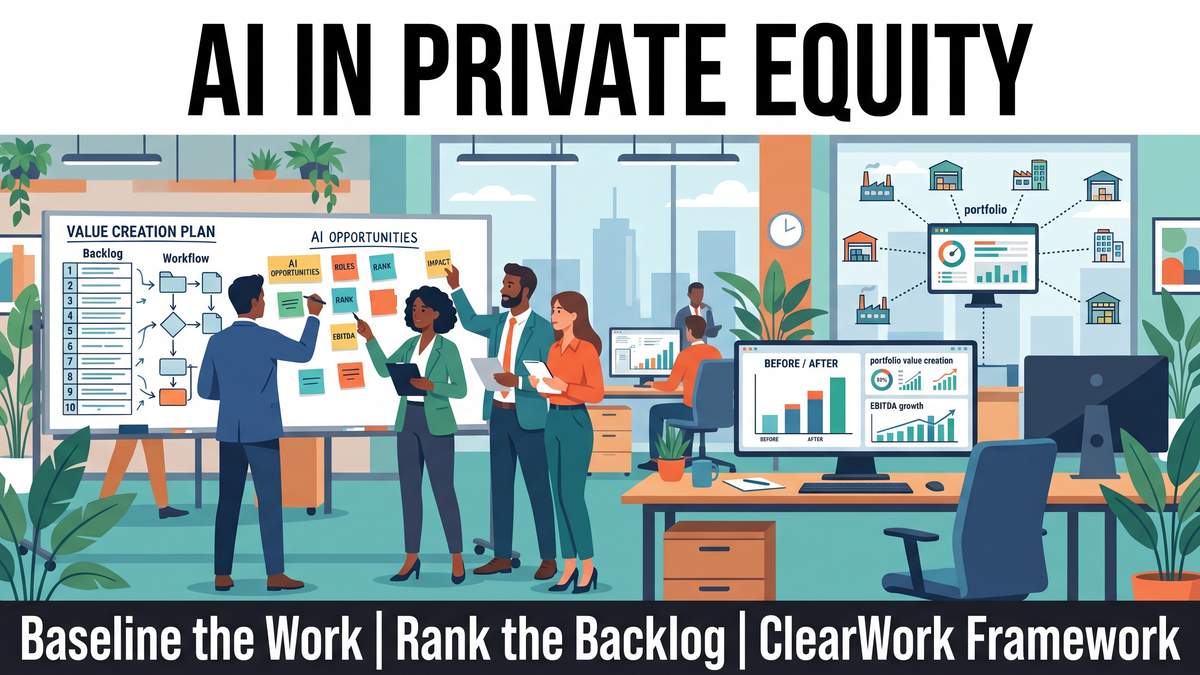
AI in Private Equity: Where AI Value Comes From in Portfolio Companies
Avery Brooks
November 16, 2026
Updated: November 16, 2026
AI in private equity creates value when a portfolio company applies it to specific, high-volume work it understands in detail. Start with a role-level baseline of how the work runs today, build a ranked backlog of AI opportunities, measure each one before and after, then repeat the method across the portfolio rather than running one-off pilots.
Most sponsors now expect every portfolio company to show progress on AI. Accordion's survey of PE sponsors and portfolio CFOs (2025) found that 98% of sponsors have directed their CFOs to prioritize AI adoption. The same survey found that most CFOs had not acted, and 68% of them said the main reason was not knowing where to begin or who to turn to for help.
The request usually arrives in three forms. The board wants an AI section in the value creation plan with named initiatives and owners. The operating partner wants a short list of use cases that will move EBITDA inside the hold period. And at exit, buyers will want to see AI that is running in the business with measured results, not a list of experiments.
For a portfolio company CEO or COO, that adds up to a practical question: which parts of our operation would AI actually improve, by how much, and how will we prove it? Answering it starts with the work, not with the tools.
The results so far are thin. PwC's analysis of PE-backed CEOs in its 2026 Global CEO Survey found that only 14% say AI has contributed to both higher revenues and lower costs, and more than half report no upside at all.
Pilots tend to stall for the same few reasons:
BCG's work on AI-first portfolio companies (2026) attributes about 70% of AI value to people, organizations and processes, with 20% from technology and 10% from algorithms. The tool is the smaller part of the problem.
A role-level baseline describes, for each role in a focus area, what the work is, how often it happens and where it goes wrong. It is the map an AI backlog is built on.
For each role, capture:
The fastest way to get this is to hear from everyone who does the work, not a sample. ClearWork is an AI discovery platform for processes and requirements: its AI agent, Clarity, runs short async interviews (voice or chat, about 20 minutes) with the people in each role, people can add screen recordings of how a task is done, and ClearWork ingests existing documents. Process owners validate each round, every line traces back to its source, and the outputs include improvement and AI opportunities by role. If a focus area needs more detail, run another round on it.
If you have already run an AI readiness assessment for operations, the current-state work there is the starting point for this baseline.
With the baseline in hand, list every place AI could change the work. Most opportunities fall into a few patterns: reading and keying documents, answering repeat questions, drafting routine outputs, checking work against rules, and routing work to the right person. The baseline tells you where each pattern shows up and at what volume.
Then rank the list. Score each opportunity on value, effort and risk, using the evidence from the baseline rather than opinion. The table shows the columns to keep for every line.
Score effort with the people who own the systems and data, and score risk with the process owner. For a fuller scoring method, the AI use case prioritization framework sets out impact and feasibility criteria you can reuse. Keep the value column in the units the board tracks, and enter your own estimates; the baseline gives you the volumes to support them.
A good backlog has 10 to 30 lines per portfolio company. The top five become the AI section of the value creation plan.
Every opportunity that moves into delivery needs a measured before. Pick two or three metrics per opportunity, record the baseline value, the date and where the number came from, then measure the same thing after the change has run for long enough to be fair.
Useful metrics are usually operational:
Agree the metrics with the CFO before work starts, so that results feed the KPI tracker the board already reviews. If a metric can't be measured today, that is a finding in itself: either add the measurement first or pick a different metric.
Measurement is also what makes AI credible at exit. A short record for each initiative, showing the baseline, the change, the result and the owner, is far stronger evidence than a list of tools in use.
Sponsors get the most from AI when what works in one portfolio company is reused in the next. That depends on doing the work the same way each time.
The operating partner's job here is to set the method and the format, not to pick every use case. Each portfolio company still owns its own backlog, because the people who do the work know where the real volume and pain sit. For more on how operators work with portfolio companies, see ClearWork's page for private equity operating teams.
The free template puts the method in this article into one workbook. Download the portfolio AI opportunity backlog (Excel).
Start with the Backlog tab during baseline work, score in a working session with process owners, and update the roll-up before each quarterly board meeting.
Start with one or two focus areas where volume is high and the work is well understood by the people who do it, such as accounts payable or order entry. Build a role-level baseline there first. The baseline shows where AI would remove real work and gives you the numbers to measure against.
It depends on scope. The discovery that produces the baseline typically takes one to four weeks, depending on how many processes and people are involved. Scoring and ranking the backlog usually takes a few working sessions with process owners once the baseline exists.
Each opportunity needs a business owner, usually the leader of the process it changes, not only the IT or data team. The CFO or COO typically owns the overall backlog and reports progress to the board. The operating partner sets the method and compares results across the portfolio.
Record a baseline for each opportunity before work starts, using operational metrics such as cycle time, volume per person or error rate. Measure the same metrics after the change has run for a fair period, and report the difference in the units the board already tracks.
It can if it feels like an audit. Explain that the goal is to find work that is slow, repetitive or error-prone and make it easier, and share what you learn with the people involved. Process owners validate the findings, so people see their own work described accurately.
A strategy sets direction and principles. A backlog is a ranked list of specific changes to specific work, each with an owner, a value estimate and a baseline. Boards and buyers give more weight to a measured backlog than to a strategy document.
See how ClearWork builds the role-level baseline your AI backlog starts from. Book a demo.
Where AI value comes from in PE portfolio companies: start from a role-level baseline, rank an AI backlog, measure before and after. Free Excel template.