AI Readiness Assessment for Operations: Start With How Work Actually Gets Done
Avery Brooks
November 2, 2026
Updated: November 2, 2026
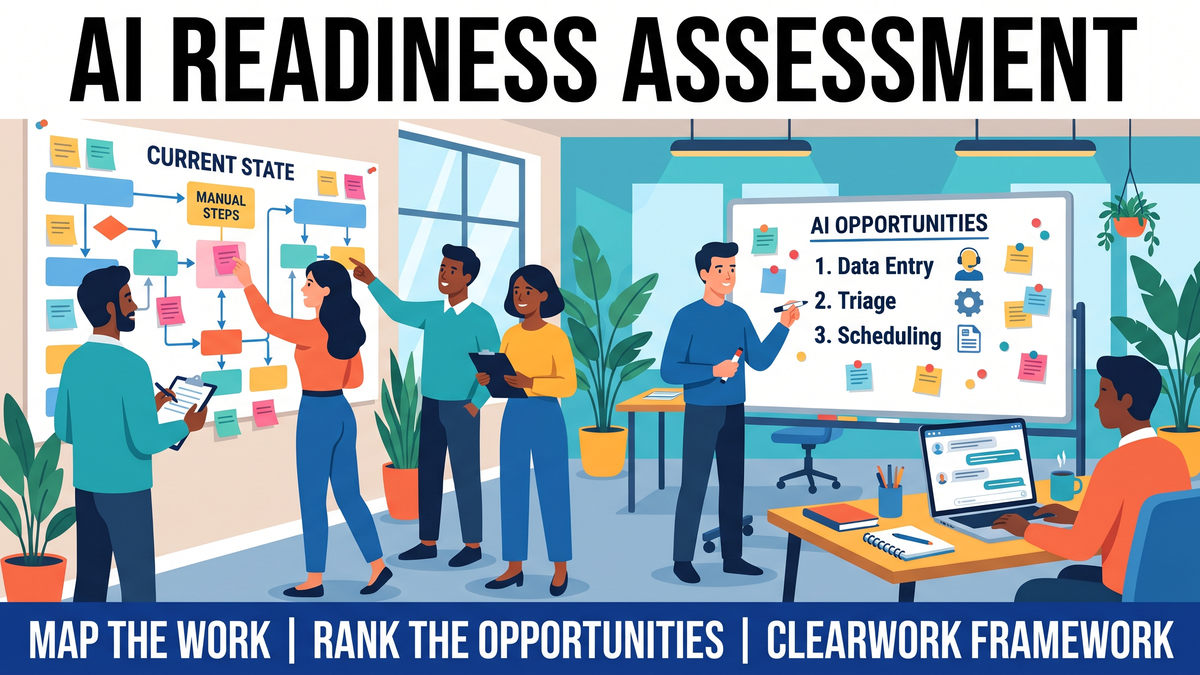
An AI readiness assessment for operations should tell you which processes are ready for AI, which need fixing first, and where AI would save the most time. Start with how work actually gets done: map the real current state from the people who do the work, find the manual steps and volumes, then rank AI opportunities by role.
Most leaders ask for an AI readiness assessment because they are under pressure to show progress on AI and aren't sure where to start. A useful assessment answers practical questions, not abstract ones:
If an assessment can't answer those questions, it hasn't measured readiness. It has measured enthusiasm. The output should be a short, ranked list of opportunities tied to specific processes and roles, with the evidence behind each one, that an operations leader can fund or reject with confidence.
That applies whether you lead a transformation program inside a large company or you are a private equity operator asked to show AI value across a portfolio. Transformation teams use the same groundwork to get a signed-off current state before implementation starts; operators use it to compare how each portfolio company really runs before deciding where AI fits, as described on our private equity page.
Search for "AI readiness assessment" and most results are maturity quizzes: rate your strategy, culture, data and skills from one to five, and receive a score. A score can start a useful conversation, but it rarely tells anyone what to do next week.
Surveys measure opinions about the organization. They ask a leader how mature the data is, not which fields in the order system are filled in by hand. They ask whether processes are standardized, not how three warehouses actually handle a damaged delivery. The people answering are usually the furthest from the work.
The bigger problem is that AI projects succeed or fail on specifics. Gartner predicted in 2025 that over 40% of agentic AI projects will be canceled by the end of 2027 because of escalating costs, unclear business value or inadequate risk controls (Gartner, 2025). Unclear business value often means nobody knew, in detail, how the target process worked, who did it or how often it ran. A maturity score doesn't fix that. A validated picture of the work does.
You can't automate a process nobody has written down, and you shouldn't automate one that is written down wrong. The first step is a validated current state for the focus areas you care about: what happens, in what order, who does it, which systems they touch, and where the exceptions are.
Policy documents and old process maps are a starting point, not the answer. They describe how work was designed to run. The people who do the work know how it really runs: the extra approval for one customer, the spreadsheet that bridges two systems, the check someone added because a report was wrong once.
Capture that from everyone involved, not a sample. Short interviews with each person, run in parallel, cover more ground than a series of workshops, and people describe their own steps more accurately than a manager describing them second-hand. Then ask the process owner to review and sign off the result, so the current state is something the business agrees with rather than one analyst's interpretation. Our guide to a current-state assessment and what it should include covers scope, timing and a template.
This is the step ClearWork is built for. ClearWork is an AI discovery platform for processes and requirements. Its agent, Clarity, runs async AI interviews (voice or chat, about 20 minutes) with the people who do the work, ingests existing documents, gets findings validated and signed off by process owners, and traces every line to its source. Outputs include process maps, SOPs, requirements, and improvement and AI opportunities by role.
With a validated current state in hand, look for the work AI could realistically change. For each process step, record:
Workarounds deserve special attention. A step people added because the system doesn't handle a case is often a strong candidate for AI. It is also the step most likely to break an automation designed from the official process. If the workaround isn't in your current state, it won't be in your AI design, and the project will discover it in testing or after go-live.
Ask about exceptions directly. "What happens when the invoice doesn't match the purchase order?" produces better answers than "Walk me through your process," because exceptions are where time goes and where AI needs a clear rule or a clear handoff to a person.
Now turn the findings into a ranked list. Score each opportunity on value (volume multiplied by time saved, plus fewer errors) against effort and risk. Keep the logic simple enough that the process owners can follow and challenge it.
The examples below are illustrative, not benchmarks. Yours will come from your own current state.
High-volume steps with clear rules and low risk usually go first. Opportunities that depend on data nobody trusts move down the list until the data is fixed. Group the final list by role, so each team leader can see what changes for their people: the aim is to take repetitive steps off people's plates so they spend more time on the judgment work only they can do.
For deeper scoring, use our AI use case assessment criteria to test each candidate, and the AI use case prioritization framework to order the shortlist.
Before any opportunity moves into a build, settle the questions that stop projects late. Data is the most common one. Gartner reported in 2025 that 63% of organizations either do not have, or are unsure if they have, the right data management practices for AI, and predicted that through 2026 organizations will abandon 60% of AI projects unsupported by AI-ready data (Gartner, 2025).
Use this checklist for each opportunity on the shortlist:
Hold discovery tools to the same standard. With ClearWork, all data is hosted in the US, encrypted in transit and at rest, and no data is used to train AI models.
Readiness also isn't a one-time result. Processes change when people move roles, systems are upgraded or a business is acquired, and an AI tool built on last year's process will quietly drift out of step with the work. Name an owner for each automated process, re-validate the current state when something material changes, and review the ranked list at least once a year so new opportunities and new risks are both visible.
It depends on scope and complexity. With interviews running in parallel, discovery for a focus area typically takes one to four weeks, including validation and sign-off. ClearWork usually starts with a 30-day focus-area sprint, so you see ranked opportunities for one area before widening the scope.
The people who do the work in each focus area, the process owners who sign off the current state, and someone from IT or data who can answer questions about systems and data access. A sponsor should agree the success measures up front. Keep the interviews short so they don't pull people away from their work.
Less than most teams expect. Existing process documents, system lists and org charts help, but the main input is what people say about their own work. Transaction volumes from your systems make the ranking sharper, and can be added once the current state shows which volumes matter.
A workshop collects ideas from the people in the room, usually managers. A readiness assessment starts from evidence: how the work runs today, who does it and how often. Use cases that come out of it are tied to real steps and volumes, so they are easier to score and less likely to stall later.
Start with one or two focus areas where volume is high and leaders already feel the pain, such as order-to-cash or accounts payable. A validated result in one area builds the case for the next, and the method stays the same as you widen the scope.
Want to see how Clarity maps how work actually gets done and ranks AI opportunities by role? Book a demo.
An AI readiness assessment should start with how work gets done: map the current state, find manual steps and volumes, then rank AI opportunities by role.