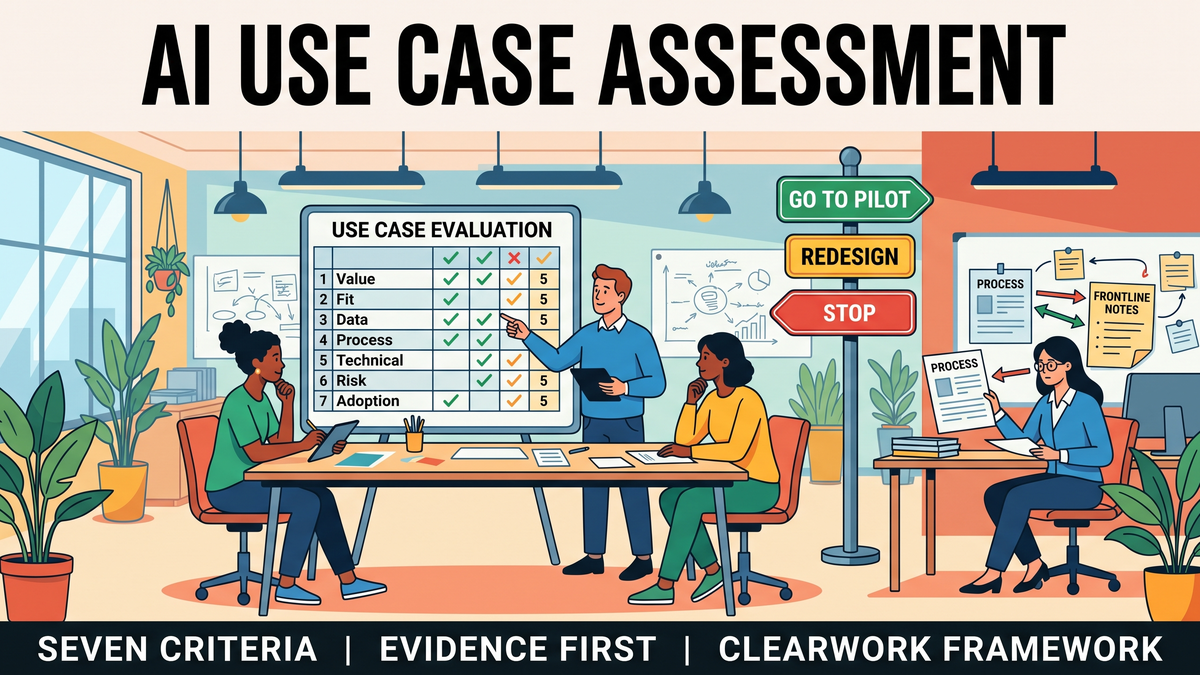
AI Use Case Assessment: Scoring Criteria, Evidence and a Go/No-Go Rule
Avery Brooks
October 19, 2026
An AI use case assessment is a structured check of one AI idea before you fund a pilot. You score it on seven criteria (business value, strategic fit, data readiness, process clarity, technical fit, risk and adoption), record the evidence behind each score, and reach one of three decisions: go to pilot, redesign the use case, or stop.
It sits between ranking and building. The AI use case identification process runs from discovering candidates to framing them on a canvas and scoring them as a portfolio. The AI use case prioritization framework ranks that portfolio. An assessment takes the use case at the top of the list and asks a harder question: is the evidence good enough to spend money on this one?
Teams use these three words loosely. They are different jobs with different outputs.
The assessment is where most bad pilots could be stopped cheaply, because it is the first step that demands evidence rather than opinion.
These are the same seven criteria the prioritization framework uses, so a use case's assessment and its ranking stay consistent. The difference is depth: for each criterion, the assessment names the evidence that justifies the score and the person who can give it.
What measurable outcome improves, by how much, and from what baseline? Score 5 only if the baseline has been measured, not estimated in a workshop. A use case with no baseline cannot be judged after the pilot either.
Is the problem named in a plan someone senior owns, and is there a sponsor who will defend the pilot when it hits a snag? Strategic fit rarely sinks a use case on its own, but low fit plus high cost is a reliable stop.
Does the data the use case needs exist, can you get to it, and is there enough labeled history to test against? Ask the data owner directly. "We have it in the ERP" is not the same as "we can extract it with the fields we need."
Can someone describe how the work is done today, end to end, including the exceptions? This is the criterion assessments most often score on hope. The documented process and the real one are rarely the same; the gap is usually in exception handling, workarounds and judgment calls that live with the people doing the work. Our AI agent readiness guide explains why those unwritten rules are what automated systems trip on.
Can the capability be delivered with tools and platforms you already run, and how many integrations does it need? Score lower for new platforms, custom models and integrations that depend on a system being replaced.
What happens when the AI is wrong, how quickly would someone notice, and who can override it? Bring in risk, compliance and (where relevant) the works council early; a blocking objection found after the pilot is the most expensive kind.
Were the users asked, does it fit how they work today, and who will change their routine because of it? A use case the users did not ask for needs a stronger value case to survive.
Copy this worksheet into your own template. For every criterion, record the score (1–5), the evidence behind it and where that evidence came from. The red flags are the patterns that should lower a score even when the room is optimistic.
Two rules make the worksheet honest. First, a score of 4 or 5 needs evidence in the third column; without it, cap the score at 3. Second, record the source. A process clarity score from the process owner alone is an estimate; one confirmed by the people who do the work is evidence.
After scoring, apply one rule so the decision does not depend on who argues hardest.
"Redesign" is the most common and most useful result. It turns a vague "not yet" into a short list of things to find out.
This is an illustrative example, not a benchmark. A finance operations team ranked "route AP invoice exceptions to the right resolver with AI" near the top of its list, with an estimated value score. Here is the assessment.
The first pass would have sent this straight to a pilot. The assessment returns Redesign: process clarity is 2 and the data lacks reason codes. The conditions to reassess are a validated routing map that reconciles the two teams' rules, and a decision on how to capture reason codes. Once the routing rules are agreed and validated, process clarity can move to 4 and the use case meets the go rule.
Notice what changed the outcome. It was not the model or the platform. It was finding out how the work is actually done.
An assessment for one use case is a small piece of work, but it needs the right inputs.
Seven criteria cover most cases: business value, strategic fit, data readiness, process clarity, technical fit, risk and controls, and adoption readiness. Add a regulatory criterion if you work in a heavily regulated industry. What matters more than the list is recording the evidence behind each score.
For one use case, expect a few working sessions spread over one to three weeks, mostly spent waiting for data samples and talking to the people who do the work. If an assessment drags past that, the use case is usually too broad and should be split.
The business owner of the process should own the decision, with a transformation, operational excellence or PMO lead running the assessment. The AI or data team advises on data readiness and technical fit but should not score business value or process clarity alone.
Process clarity. The use case was framed against the documented process, and the people doing the work describe something different, especially for exceptions. That is usually a reason to redesign rather than stop.
You can assess it, but data readiness will score low and the result will usually be redesign. A short data-collection period, or a narrower scope that uses data you already have, is often enough to reach the go rule.
Validate how the work is actually done before you fund your next AI pilot.
ClearWork's AI agent, Clarity, interviews the people who do the work and turns it into process maps, SOPs and requirements, every line traced to source. That gives your assessment validated evidence for process clarity instead of a best guess from the official SOP. See how ClearWork's automated discovery works, or book a 30-minute call to walk through one of your use cases.
Assess one AI use case before you fund a pilot: seven scoring criteria, the evidence each score needs, red flags, and a go/redesign/stop rule with example.
Fourteen days, full access, no card required.
No credit card required.