AI Use Case Prioritization Framework: Gates, Scores and an Evidence Check
Avery Brooks
October 9, 2026
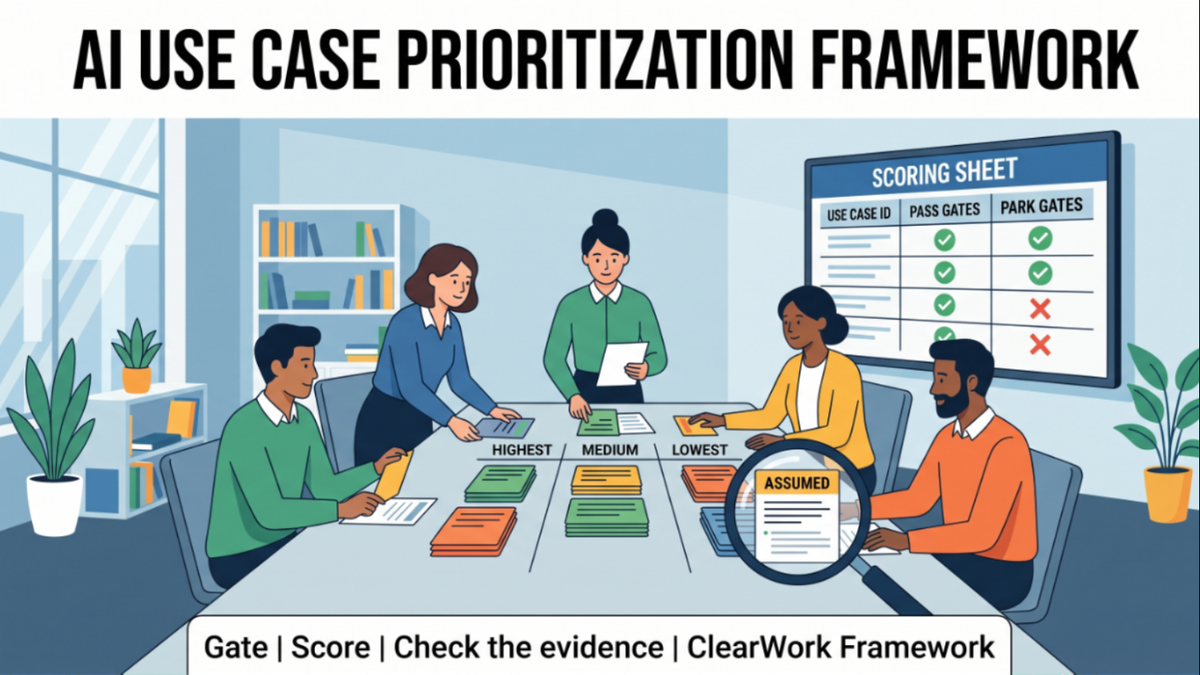
An AI use case prioritization framework is a fixed set of gates and weighted criteria that ranks AI ideas on the same terms. This one uses four pass/fail gates, seven criteria scored 1 to 5, and an evidence check that discounts scores nobody has verified. It turns a shortlist of framed use cases into an ordered pilot list.
It is the third step of the AI use case identification process: discover candidates, frame each on a canvas, then prioritize. The hub article introduces the impact–feasibility matrix; this article gives you the weighted version that sits behind it, plus a free Excel scoring sheet (no email required) with a worked example of six use cases.
A two-axis impact–feasibility matrix is the right picture for a steering meeting. It is a poor scoring method on its own, for three reasons.
It collapses too much into one axis. "Feasibility" mixes data, process clarity, technical difficulty and adoption, which fail in different ways and need different fixes. A use case can be technically simple and still impossible because nobody can describe the process it is meant to support.
It has no floor. A use case with no owner, no baseline or no legal basis can still land in the top-right box if the room likes it.
And it treats every score as equally reliable. A value estimate from a process owner who has measured the baseline and one from a workshop guess get the same dot on the chart. That last problem is the one this framework is built to fix.
Gates stop the scoring session from spending an hour on ideas that cannot go ahead. Any "no" parks the use case with a note on what would unpark it.
G1, owner and baseline. A named business owner, and a measured baseline for the thing the AI is meant to improve. No baseline, no way to judge the pilot.
G2, permissible. Legal, compliance and works council (where relevant) have no blocking objection to the AI making or drafting this decision.
G3, data exists. The data the use case needs exists somewhere you can get to. Not clean, not labeled; it just exists.
G4, process described. Someone can describe how the work is done today, end to end. This is where most parked ideas fail, and it is the easiest gate to unblock: it needs discovery, not budget. The AI use case discovery playbook covers how to get that description from the people who do the work.
Score each criterion from 1 to 5, where 5 is always better. The anchors below keep two scorers from meaning different things by "3." The default weights are a starting point; change them on the "Criteria & weights" tab and keep the total at 100%.
Process clarity gets its own row on purpose. In many failed pilots, the model worked and the process didn't: the AI was built against the documented process, and the real one had exceptions and unwritten rules nobody mentioned. The AI agent readiness framework explains why those unwritten rules are what agents trip on.
For each use case, record where the scores came from:
The adjusted score is the weighted score times the multiplier. It does not punish ambitious ideas; it stops unverified ones from outranking verified ones. And it creates a cheap way up the list: validate the evidence and rescore.
This is the "Worked example" tab in the download: an illustrative mid-sized operations team with six candidates, each framed on an AI use case canvas first. The scores are illustrative, not benchmarks.
Three things happen that a matrix alone would hide.
The sales forecast assistant has the highest business value score in the set (5) and ranks second on the weighted score. Every score behind it is assumed, so it drops to fifth. That is not a verdict that it is a bad idea; it is a verdict that nobody knows yet.
AP invoice exception routing has the same top value score but a process clarity of 2: the routing rules that decide a third of cases are not written down. The sheet's next-action rule sends it to discovery rather than to a pilot. If discovery confirms the process and the score for process clarity rises to 4, its weighted score becomes 3.80 and, validated, it ranks second.
The onboarding assistant never reaches the ranking. It has no owner and no baseline, so it is parked with a note, which saves the steering group an argument.
Score in one 90-minute session with the business owners, someone from IT or data, and someone from risk or compliance. Score independently first, then discuss only the criteria where scores differ by two points or more; that is where the useful disagreement is. Set the evidence column honestly: "Estimated" is not a criticism. Agree the top three by adjusted score as the pilot shortlist, and turn every "Run discovery, then rescore" into a dated action with an owner.
Rescore the list each quarter or whenever a pilot reports. If you are working from a long ideas list rather than framed canvases, start with the step-by-step guide to identifying generative AI use cases and come back when you have eight to fifteen candidates.
The fastest way up this list is better evidence, and the evidence that matters most is how the work is actually done today. That usually means interviewing the people who do it, which is the step teams skip because it takes facilitator time.
ClearWork's automated discovery handles that step. Clarity, its discovery agent, interviews the people doing the work asynchronously, reads the documents and recordings they already use, flags where accounts disagree and lists what is still unknown. A person validates each finding before it enters the record, and the output is a source-linked current-state map and requirements set, which is what moves the evidence column from Assumed to Validated and the process clarity score from a guess to a fact. ClearWork does not score or choose your use cases; your team does that with the sheet.
A good framework has three parts: gates that remove ideas that cannot proceed, weighted criteria scored on anchored scales, and a way to account for how reliable each score is. The impact–feasibility matrix is the right summary picture, but the weighted scores behind it are what make the ranking defensible.
Five to eight. Fewer than five forces unrelated risks into one score; more than eight makes scoring sessions long and the weights arbitrary. This framework uses seven, with feasibility split into data readiness, process clarity and technical simplicity because they fail for different reasons.
The business owner of each process, someone from IT or data, and someone from risk or compliance, scoring independently before discussing differences. The AI team should advise on technical simplicity but should not score business value alone.
Score data readiness honestly, mark the evidence as Estimated or Assumed, and let the adjusted score reflect it. Gate G3 only asks whether the data exists; if it exists but is messy, the use case can still be ranked, and the gap becomes part of the pilot plan.
Quarterly, and whenever a pilot reports results or a parked use case clears its gate. Rescoring is quick once the sheet exists, and the evidence column shows exactly which scores are worth revisiting first.
Download the scoring sheet and rank your AI use case shortlist before the next steering meeting.
A prioritization framework is only as good as the evidence behind its scores, and the weakest evidence is usually how the work is done today. Download the free scoring sheet, score your shortlist, and look at which high-value ideas are still marked Assumed. Then see how ClearWork's automated discovery validates the current state for those use cases, and start a free 14-day trial on the first one.
A four-gate, seven-criterion AI use case prioritization framework with an evidence check that discounts guesses. Free Excel scoring sheet + worked example.
Fourteen days, full access, no card required.
No credit card required.