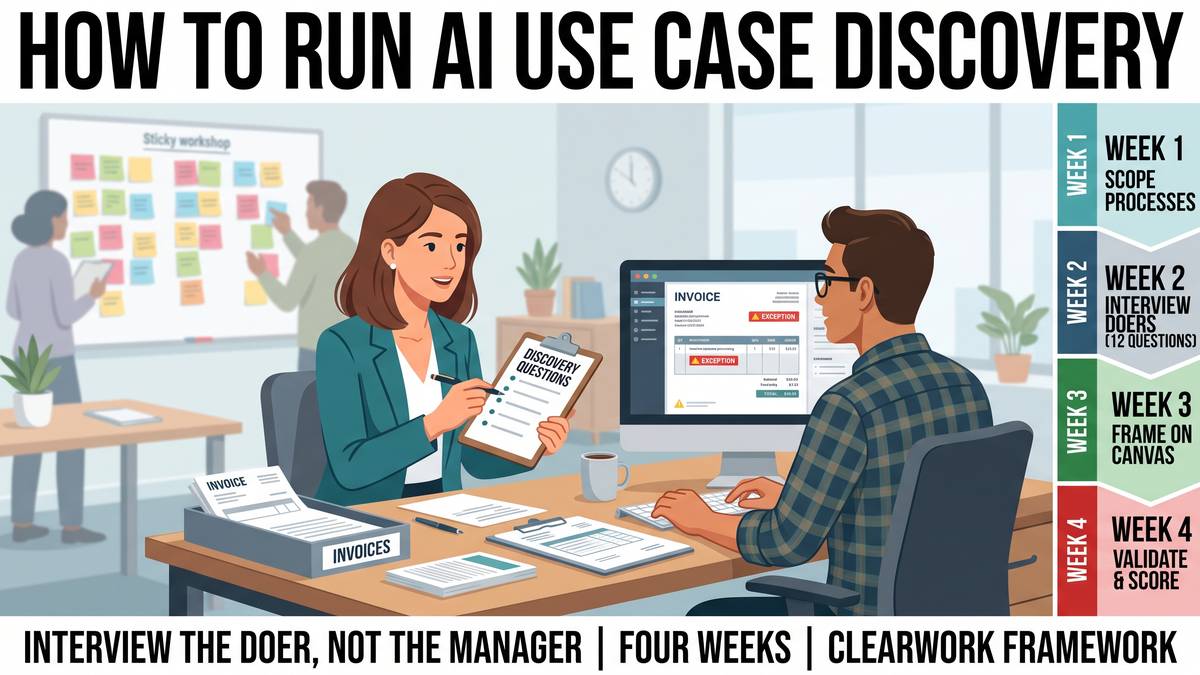
AI use case discovery is the structured work of finding where AI could create measurable value by examining how work actually happens, not by brainstorming what AI could do. It produces a shortlist of framed, evidence-backed candidate use cases, each tied to a real process, its data, and a baseline. It comes before prioritization and long before a pilot.
It is the first stage of the AI use case identification process: discover, frame on a canvas, test with a framework, score on an impact–feasibility matrix. This article covers the discovery stage only, because it is the one most teams skip and the one that decides whether the later stages rank anything real.
Discovery borrows from process discovery and feeds the canvas. If you already have validated current-state maps, discovery is mostly done; if you only have an ideas list, it has not started.
Week 2 is where discovery is won or lost. Most teams compress it to a single workshop; the step-by-step guide to generative AI use cases puts current-state mapping at step five, after framing, which is fine when maps exist and fatal when they do not. Interview first.
Ask these of the person who does the work, not their manager, in this order. The first six find the use case; the last six find the reasons it will fail.
Question 4 produces more good use cases than any brainstorm. Question 7 produces the blocker list: the undocumented rules an AI would need and cannot get from a system export. Question 10 writes the human-in-the-loop box on the AI use case canvas for you.
Run discovery when the AI programme is at the "which use cases" stage; when an ideas list exists but nobody can size the ideas; when a pilot stalled because the process turned out to be different from the diagram; or when a COO or AI strategy lead has been asked for a portfolio rather than a project.
Skip it, or shorten it to week 1 only, when the use case is already fixed by an external requirement (a regulator, a contract, a platform migration), when the process is fully instrumented and a current-state map exists and was validated in the last six months, or when you are evaluating a single vendor product for a single team and the decision is buy or don't.
Discovery does not replace an AI readiness assessment; it tells you what to be ready for. And it is not process mining. Mining reads event logs from systems and shows you paths and frequencies; discovery elicits the parts of the work that never hit a log, which is where most of the answers to questions 4 through 7 live. The AI agent readiness framework explains why those undocumented parts are what agents trip on.
The honest constraint is facilitator time. Three to five processes, three people each, an hour per interview, plus write-up: two to three weeks of one person's time, which is why it gets cut to a workshop. ClearWork's automated discovery exists for that week. Clarity, its discovery agent, runs the interviews asynchronously with each person, ingests the documents and recordings they already have, spots where two people describe the same step differently, and lists what is still unknown. Every finding waits for a human to confirm it before it enters the record, and the output is a source-linked current-state map and requirements set that fill the canvas's "how the work happens today" and "data and knowledge" boxes. It does not choose your use cases; it makes sure the ones you choose are built on how the work is actually done.
Four weeks for three to five processes with one facilitator, most of it in week 2. With asynchronous interviews and document ingestion the elicitation week compresses; the framing and validation weeks should not, because they are where the people doing the work correct the record.
Someone who owns operations or transformation, not the AI team alone. The AI team knows what is buildable; discovery is about what is worth building, and that requires access to the people doing the work and enough credibility that they answer question 5 truthfully.
A register of eight to fifteen framed canvases, each with a baseline, a validated description of how the work happens today, a list of undocumented rules the AI would depend on, and a first-pass impact and feasibility score. Not a roadmap; that comes after prioritization.
Process discovery produces a validated current-state map of a process. AI use case discovery uses that kind of evidence to find where AI fits and writes it up as candidate use cases. If you have recent validated maps, most of week 2 is already done.
Surveys find complaints; interviews find decisions. A survey can scope week 1 (where is the pain), but questions 4 through 7 need a conversation, because the answers are things people do not know they know until they walk through the last case.
Run the four-week discovery plan and bring validated use cases to your next AI steering meeting.
Discovery is the stage that decides whether the matrix ranks anything real. If week 2 is the bottleneck, see how ClearWork's automated discovery runs the interviews and document review and holds every finding for human validation. Start a free 14-day trial and run it on the first process in your scope list.
What AI use case discovery is, how it differs from ideation and process discovery, a four-week plan, and the 12 interview questions that surface real use cases.
Fourteen days, full access, no card required.
No credit card required.