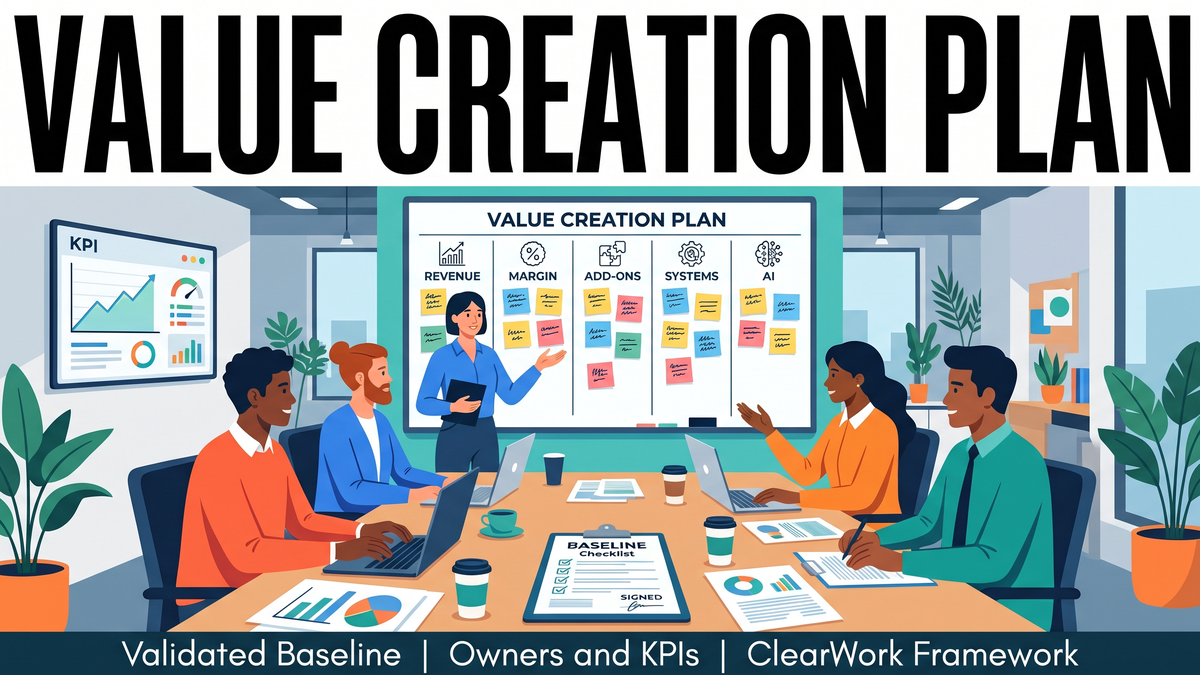
Private Equity Value Creation Plan: An Operator's Guide (With Template)
Avery Brooks
November 10, 2026
Updated: November 9, 2026
A private equity value creation plan is the document that turns an investment thesis into named initiatives, owners, KPIs and dates for the hold period. The plans that deliver are built on a validated baseline of how the portfolio company really runs, not on management presentations, and they are reviewed against measured results every quarter.
A value creation plan (VCP) is the operating version of the deal thesis. The thesis says why the business will be worth more at exit. The plan says what will change, who owns each change, how much it is expected to be worth, how progress will be measured and when. It usually covers the full hold period, with the first year planned in detail and later years at the level of themes and targets.
The pressure on these plans has grown. Bain's Global Private Equity Report 2026 announcement estimates that a deal which needed about 5% annual EBITDA growth in the 2010s to reach its target return now needs roughly 10% to 12%, and that buyout holding periods at exit average about seven years. With less help from leverage and multiple expansion, more of the return has to come from operating improvement, which is exactly what a value creation plan describes.
For operators, the VCP is also the contract with the sponsor. It sets what the board will ask about every quarter, which initiatives get funding and people, and what the business needs to show buyers at exit.
A good plan is short enough to manage from. Most operators end up with five to ten initiatives that carry most of the value, each one specific enough that someone could tell, at any quarterly review, whether it is on track.
Most plans are assembled from three inputs, and each has a blind spot.
Diligence. Commercial, financial and operational diligence build the thesis and size the opportunities. Diligence teams work fast, with limited access, from the data room and a handful of management sessions. They are good at markets, customers and the numbers. They rarely see how an order actually moves through the business, where the rework sits, or which steps depend on one person.
The 100-day plan. The first 100 days after close are when the new owner and the management team turn the thesis into a working plan. This is where operators set priorities, pick focus areas and commission deep dives into the parts of the business the plan depends on. It is the best window to replace assumptions with facts, but the window is short and deep dives often take weeks each.
Management. The leadership team knows the business better than anyone outside it. Their view is also shaped by how things are meant to work, by what has been reported upward, and, early in the hold, by the presentation they gave during the sale.
Alvarez & Marsal's North America Value Creation Report 2026 found that fewer than one-quarter of respondents embed value creation planning in diligence before the letter of intent, even though most say doing it earlier would improve outcomes. In practice, that means most plans are finished after close, and the quality of the first year depends on how quickly the team learns how the business really runs.
The practical answer is to treat each input as a hypothesis and reconcile them. Where diligence, management and the first weeks of operating experience agree, the plan can move quickly. Where they disagree, for example management describes a single order process while the data shows three different cycle times by site, that disagreement becomes a question for the baseline work rather than a footnote. Keep a short list of these open questions and close each one with evidence from the people who do the work before an initiative depending on it is sized.
Every plan draws on the same handful of levers. What differs is how much each is worth for this company, and how much the team really knows about the operations underneath it. The table below lists the common levers, typical initiatives, what you need to know about current operations before you commit to a number, and the evidence that answers it.
The right-hand two columns are where plans most often run thin. A margin initiative sized from a benchmark, with no view of the actual steps, is a hypothesis. The same initiative sized from a process map with volumes and time per step is a plan.
Treat the levers as a portfolio rather than a menu. Revenue initiatives usually take longest to show up in EBITDA; margin work shows up sooner but depends on processes changing; systems and AI initiatives are often enablers for the other three. Most plans need at least one early win the board can see, alongside the larger initiatives that carry the value.
Plans miss more often than they hit. In the same Alvarez & Marsal report, 41% of respondents said they realized below 75% of planned value creation over the previous 12 months. The reasons operators give tend to cluster.
The baseline was wrong. Targets were set against how the business was described, not how it runs. When the team starts the work, it finds more manual steps, more exceptions and more variation between sites than anyone assumed, and the number moves.
The initiative was never broken down. "Improve working capital" stays a line on a slide instead of becoming specific process changes with owners and dates.
Ownership was unclear. Initiatives owned by "the leadership team" are owned by nobody. Each one needs a single accountable person inside the company and a sponsor on the board.
Dependencies were missed. A pricing initiative that depends on clean customer data, or a shared-services move that depends on an ERP change, slips as soon as the dependency does.
Knowledge walked out. Leadership change is common after a deal, and key people in finance and operations leave or get stretched. When the know-how behind a process lives with one person, initiatives built on that process stall. Our guide to capturing tribal knowledge after an acquisition covers how to reduce that risk early.
Progress was measured in activity. Boards hear about workstreams launched and consultants engaged rather than KPIs moving against a baseline.
Most of these failures trace back to the same gap: the plan was written before anyone had a validated picture of the operations it set out to change.
The fix is to build the baseline first and the initiatives second. These steps work for a new plan in the first 100 days and for a reset in the middle of a hold.
Steps 3 and 4 are where most of the time goes. A consultant diagnostic typically interviews a sample of people over several weeks per focus area. ClearWork, an AI discovery platform for processes and requirements, is built to shorten that. Its agent, Clarity, runs async AI interviews, by voice or chat and about 20 minutes each, with everyone who does the work, in parallel, and ingests existing documents. Process owners validate and sign off the findings, and every line of the resulting process maps, SOPs, requirements, fit-gap and improvement and AI opportunities by role is traced to its source. Discovery takes one to four weeks depending on scope and complexity. All data is hosted in the US, encrypted in transit and at rest, and no data is used to train AI models. See how ClearWork works.
Value creation plan readiness checklist
Before the plan goes to the board, check that:
Whatever method you use, the output of step 4 should look like a current-state assessment: process maps, exceptions, systems, pain points by role, volumes and named owners, signed off.
The free value creation plan template is an Excel workbook that follows the steps above. It has no formulas you need to understand and no prices: you enter your own figures. Download the value creation plan template (Excel).
The Baseline tab comes first on purpose. If a focus area's source is "management presentation" or "assumption", the initiatives that depend on it should be flagged until the baseline is validated.
A plan becomes real when every initiative has one owner, a KPI with a measured starting point, and a slot in a regular review.
Owners. Each initiative needs a single accountable owner inside the company, usually a member of the leadership team, and a sponsor from the board or the operating team. Workstream leads report to the owner; the owner reports to the board. Avoid shared ownership between two executives.
KPIs. Pick one or two measures per initiative that move when the work is done, not just when the market moves. Good ones are close to the process: days sales outstanding, order-to-invoice cycle time, first-pass yield, cost per order, hours of manual work per week in a given role. Record the baseline value, where it came from and the date, so later comparisons are like for like.
Cadence. Most portfolio companies run a monthly management review of initiative status and a quarterly board review of KPIs against target. Keep the monthly review short: status, decisions needed, risks that changed. Use the quarterly review to re-prioritize, move resources and retire initiatives that are no longer worth the effort.
Keeping the baseline current. Processes change as initiatives land, people move and add-ons arrive. Refresh the current state for each focus area when it changes materially, at least annually, so the plan, the KPIs and the exit story stay grounded in how the business runs now.
The value creation plan sits at the center of the rest of the hold-period work.
Integration. In a buy-and-build strategy, add-ons are often the largest lever. Each add-on needs its current state documented, compared with the platform, and a decision on what to harmonize. A documented platform baseline makes every later add-on faster, because the comparison starts from something already validated. See ClearWork for private equity for how integration teams use a signed-off platform baseline.
AI. Sponsors increasingly expect AI to show up in the plan. It belongs there as specific initiatives tied to roles, volumes and measured baselines, not as a pilot program. Our guide to the AI readiness assessment for operations explains how to rank AI opportunities from the real current state, so the AI line in the plan has the same evidence behind it as every other lever.
Systems. ERP and other system changes are both initiatives in their own right and dependencies for many others. Requirements gathered from every role, and traced to their source, keep a system program from becoming the reason other initiatives slip.
Exit. Buyers look for evidence that value creation is real and repeatable: KPIs measured against a baseline, documented processes that don't depend on a few people, and a credible list of further opportunities. A plan built and tracked this way produces that evidence as a by-product, instead of a scramble in the last year of the hold.
Carve-outs. When the company was carved out of a larger group, the plan also has to cover standing up the processes the parent used to run, on a timeline set by the transition services agreement.
The investment thesis restated as initiatives, a validated baseline for each focus area, an owner, value estimate, KPI and milestones for each initiative, a log of risks and dependencies, and a review cadence. Most operators manage five to ten initiatives that carry most of the value.
The portfolio company's CEO owns delivery, with each initiative owned by one member of the leadership team. The sponsor's deal and operating team co-author the plan and review it with the board. Shared ownership between two executives is a common reason initiatives drift.
Start during diligence with the thesis and the main levers, then finish it in the first 100 days after close, once the team has a validated view of current operations. Rebuild it when the baseline changes materially, such as after a large add-on or a leadership change.
Monthly by management for initiative status and risks, and quarterly by the board for KPIs against baseline and target. Refresh the baseline at least once a year, or whenever a focus area changes materially.
The 100-day plan covers the first three months after close: stabilizing the business, learning how it really runs and setting priorities. The value creation plan covers the whole hold period and turns those priorities into initiatives, owners and KPIs measured through to exit.
Measure each initiative against a baseline recorded before the work started, with the source and date of that baseline. Track one or two operational KPIs per initiative and the EBITDA effect the board agreed to attribute to it, and review both quarterly.
To see how ClearWork builds the validated baseline a value creation plan starts from, book a demo.
How to build a private equity value creation plan from a validated baseline: the levers, the steps, owners and KPIs, plus a free Excel template.