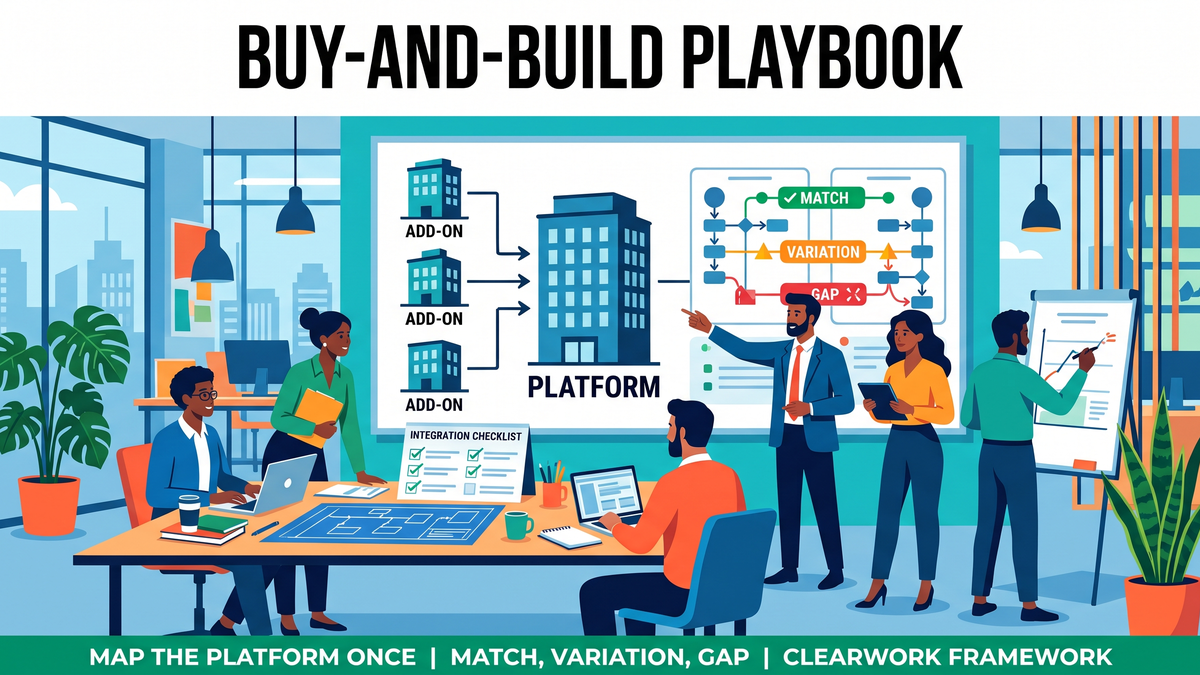
Buy-and-Build Integration Playbook: How Platform Companies Absorb Add-Ons
Avery Brooks
November 12, 2026
Updated: November 9, 2026
A buy-and-build strategy grows a platform company by acquiring smaller add-ons and integrating them. Integration decides whether the strategy pays: map how the platform runs once, assess each add-on against that baseline, decide deliberately what to harmonize, and reuse the work so each add-on integrates faster than the last.
In a buy-and-build, a private equity sponsor acquires a platform company with the management, systems and scale to absorb others, then adds smaller companies in the same or adjacent markets. The logic is familiar: buy smaller businesses at lower multiples, combine them, and sell a larger, more valuable whole.
The strategy has gone mainstream. BCG's How Private Equity Firms Fuel Next-Level Value Creation (2016) found the share of PE deals including add-ons rose from 20% in 2000 to 53% in 2012. Bain's Building a Stronger Buy-and-Build (2024) reports that add-ons which are at least a platform's fourth acquisition rose from 21% in 2003 to close to 50% today.
Multiple arbitrage alone no longer carries the returns. In the same Bain analysis of 44 buy-and-build deals made between 2010 and 2019, those that relied on multiple arbitrage averaged 1.4x multiple on invested capital, against 2.2x for those with a strategic rationale for faster organic growth or margin improvement. Organic growth and margin come from operating the combined business better, and that depends on integration.
Integration is also where the effort concentrates. Every add-on brings its own processes, systems, customer commitments and key people. A platform that treats each add-on as a fresh project spends the same weeks of discovery every time, and the integration team becomes the bottleneck on the deal pace.
The single most useful asset in a buy-and-build is a documented, validated baseline of how the platform runs. Without one, every add-on is compared with a platform nobody has written down, and integration decisions rest on what platform managers remember.
Start with the processes add-ons will most often be integrated into: order to cash, procure to pay, finance close, customer service and, where it matters, operations or fulfillment. For each, capture the steps, the systems, the approvals, the exceptions and the volumes, from the people who do the work at the platform. Have process owners review and sign off the result.
ClearWork, an AI discovery platform for processes and requirements, is built for this. Its agent, Clarity, runs async AI interviews, by voice or chat and about 20 minutes each, with everyone who does the work, and ingests the documents that already exist. Process owners validate and sign off what was captured, and every line of the resulting process maps, SOPs, requirements and fit-gap is traced to its source. Discovery takes one to four weeks depending on scope and complexity. All data is hosted in the US, encrypted in transit and at rest, and no data is used to train AI models.
Keep the baseline at a level of detail you can compare against: steps and decisions, not keystrokes. And treat it as a living record: when the platform changes a process, update the baseline, or the next add-on will be compared with how things used to work.
With the platform mapped, each add-on becomes a comparison rather than a blank page. Capture the add-on's current state for the same processes, at the same level of detail, from the people who run it, then compare step by step.
Classify each step as a match, a variation or a gap. A match works the same way in both companies. A variation reaches the same result differently, for example the same price book with local discounts. A gap is a step one company has and the other doesn't, or does in a fundamentally different way, such as manual collections calls where the platform runs automated reminders.
The rows above are illustrative. Your comparison will reflect each deal.
Pay as much attention to exceptions as to the main flow. The large customer with special terms, the product that ships differently and the approval that happens by phone are where integrations surprise people. For background on why operational knowledge is the hardest thing to carry across a merger, see our article on bridging operational knowledge across merger integration programs.
The comparison produces a list of differences. The integration plan turns each meaningful one into a decision: adopt the platform way, keep the add-on way, or redesign the process for both.
Harmonize where differences cost money or create risk without helping customers: duplicate approvals, re-keying, inconsistent controls, separate month-end calendars. Keep the add-on's way where it is part of why customers buy, or where it is simply better, and consider adopting it across the platform. Redesign where neither company's process will scale to the combined volume.
Sequence the decisions. Processes that touch customers, cash and compliance come first, along with any the value creation plan depends on. Others can stay documented and visible with a date to revisit.
Record each decision with its reason, its owner, the date and what has to be true first. A decisions log does two jobs: it keeps the integration team honest about what was decided and why, and it becomes the starting point for the next add-on, because many of the same choices will come up again.
Involve the add-on's people in these decisions. They know why their process works the way it does, and their knowledge is part of what the platform paid for. Many add-ons depend on a few people who hold most of that knowledge; our guide to capturing tribal knowledge after an acquisition covers how to protect it without unsettling them.
Consolidating every add-on onto the platform's ERP, CRM and finance systems is usually the end state. The timing is what matters.
Consolidate after the process decisions, not before. Moving an add-on onto the platform's systems forces process changes whether anyone chose them or not, and configuration built before the decisions often has to be redone.
Start from documented requirements for both companies. The platform's system was configured for the platform's processes; the add-on may depend on steps, data or reports the platform has never needed. Requirements gathered from every role, and traced to who said them, keep those from disappearing in migration. Our guide to ERP requirements gathering covers how to collect them.
Expect a period where the add-on runs on its own systems with platform controls and reporting layered on top. Make that interim state deliberate, with clear reporting, approval rights and a target date, rather than an accident that lasts years.
The real advantage of a buy-and-build comes from repetition. The first add-on teaches the platform how to integrate; by the third, integration should be a routine.
Three things make that happen. The platform baseline is the reference every add-on is measured against, so it must stay current. The decisions log carries forward: if the platform has already decided how credit checks work after an acquisition, the next add-on's comparison only has to confirm whether it fits. And the integration playbook itself, the order of work, the checklists, the owners and the timeline, gets refined after each deal.
Measure it. Track the time from close to a signed-off add-on current state, the time to harmonization decisions for core processes, customer issues since close and retention of the add-on's key people. If add-on number three isn't faster than number one on these measures, the platform is starting from zero each time.
The ClearWork for private equity page shows how platform teams keep one baseline and run a fit-gap for each new add-on against it.
Download the platform and add-on fit-gap worksheet (Excel). The free platform and add-on fit-gap worksheet is an Excel workbook built around the steps above:
Keep one copy of the Platform baseline tab as the master and copy it into a new workbook for each add-on.
A private equity strategy that acquires a platform company and grows it by adding smaller companies in the same or adjacent markets. Returns come from buying add-ons at lower multiples and, increasingly, from growing and operating the combined business better, which depends on integration.
The first, usually larger, acquisition in a buy-and-build. It has the management team, systems and scale to absorb add-ons, and its processes become the baseline each add-on is compared with.
Document the add-on's current state from the people who run it, compare it step by step with the platform baseline, classify each difference as a match, variation or gap, then decide whether to adopt the platform way, keep the add-on way or redesign. Consolidate systems after those decisions.
It depends on size and complexity. A useful target is a validated add-on current state within about 30 days of close and decisions on core processes by about day 90, with system consolidation on its own timeline. Later add-ons should be faster than the first.
Usually in the end, but not first. Decide which processes will change, gather requirements from both companies, and then migrate. If the platform's own system is due for replacement, it can be better to hold the add-on on its systems and plan one move for both.
To see how ClearWork compares each add-on with a signed-off platform baseline, book a demo.
A buy and build integration playbook: map the platform once, assess each add-on against it, decide what to harmonize, and make every add-on faster.