Merger & Integration Programs: Bridging Operational Knowledge Across Organizations
Avery Brooks
July 20, 2026
Seventy to ninety percent of mergers and acquisitions underperform expectations. Not because the strategic rationale was wrong, or because the acquirer overpaid. Most underperform because the integration fails. The acquirer doesn't understand the acquired company's operational reality. And by the time they're trying to integrate, it's too late to learn. This is one critical way the transformation knowledge gap manifests in M&A contexts—to see how this challenge appears across all transformation types, review "Transformation by Type: How Knowledge Gaps Manifest Across Different Transformation Contexts."
An organization acquires a competitor. The strategic case is clear: the combined entity will have greater market share, better products, and lower combined costs. The acquisition closes. Integration planning begins. The acquirer sends in integration teams. The teams interview the acquired company's staff. They ask: "How do you do X?" The acquired company explains the process. The teams document it. Integration planning proceeds.
But the acquired company explained the documented process, not the actual process. By the time the acquirer realizes the documented process isn't the actual process, the integration is underway. The integration plan doesn't account for the informal structures, the hidden dependencies, the constraints that make the acquired company operate the way it does.
The result: the integration is delayed. Costs rise. Customer relationships are disrupted. Employees leave. The value proposition of the acquisition erodes.
Mergers and acquisitions fail primarily because of organizational integration, not financial engineering or strategy. The acquired company operates a different way. The acquirer's systems, processes, and culture are different. Integration requires understanding both how things work at the acquirer and how they work at the acquired company. Most integration efforts fail because they don't have that understanding.
The acquirer understands how its own company works. But it doesn't understand how the acquired company works. The acquired company has different systems, different processes, different informal structures. These differences aren't documented in a way that an acquirer can quickly grasp.
An acquiring team thinks: "We have system X. They have system Y. During integration, we'll migrate them to system X." But system X works because of informal processes that support it. System Y works because of different informal processes that support it. When acquired company users are moved to system X, the informal processes that made their system work don't transfer. Productivity drops. Users get frustrated. They look for jobs at other companies.
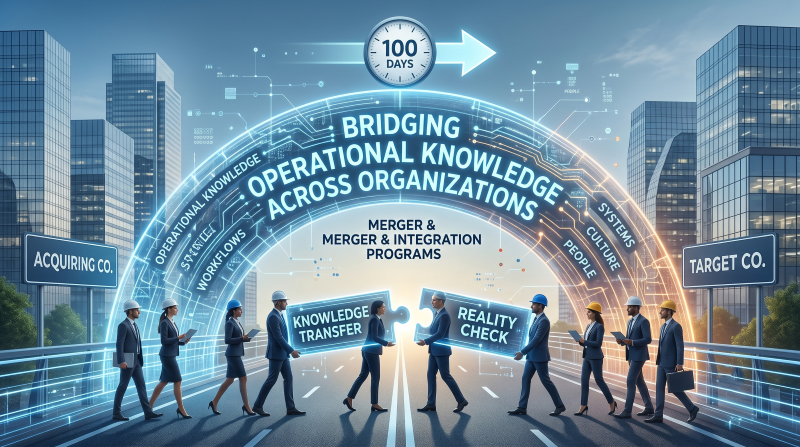
An acquisition has a critical 100-day window. In the first 100 days, the organization that's being acquired wants to know: are my jobs safe? Will the new company value my work? Will I have a future here? If the answers are unclear, people leave.
When people leave, knowledge leaves with them. The operational knowledge about how things work, why they work that way, what constraints need to be respected. This knowledge is irreplaceable.
An acquirer often realizes too late that they didn't capture the operational knowledge before people left. By then, the integration is trying to proceed with incomplete understanding.
Most integration plans assume the acquired company's processes will be fully understood and documented in the first 60-90 days. But understanding how an organization actually works takes time. The documented processes need to be stress-tested against reality. Exceptions need to be identified. Informal coordination patterns need to be mapped. Dependencies need to be traced.
If integration decisions are being made before this understanding is complete, decisions are being made on incomplete information.
Integration is disruptive. People in the acquired company are uncertain. People in the acquiring company are skeptical about integration costs and risks. If integration is being designed by people from the acquiring company who don't understand how the acquired company works, the acquired company's staff won't believe the integration will work.
Integration requires buy-in from both organizations. Buy-in requires credibility. Credibility requires that the integration team understands the acquired company's operational reality and has designed integration with that reality in mind.
Organizations that execute successful integrations follow a common pattern: they invest heavily in understanding operational reality in the critical first months, and they design integration based on that understanding.
The first 100 days after acquisition are the critical window. This is when the acquired company's staff are most engaged and most likely to participate in understanding how their organization works.
Week 1-2: Stakeholder Mapping
Week 3-8: Operational Reality Discovery
Week 9-14: Gap Analysis
Week 15-100: Integration Planning
Once operational reality is understood, integration design can proceed with confidence.
Organizations that approach M&A integration as primarily an operational discovery and knowledge transfer challenge see dramatically different outcomes:
60-70% of acquired company staff remain 2 years after acquisition. Because they understand the integration, believe in it, and see a future for themselves in the combined organization.
80-90% of synergy targets are achieved. Because integration is designed based on operational reality and is executed with buy-in from both organizations.
Customer retention improves. Because operational continuity is maintained and customer relationships are preserved.
Combined organization achieves synergies faster. Because the integration is based on understanding, not assumption.
An acquirer thinks: "Our processes are better. Let's move the acquired company to our processes." But the acquired company's processes work for their market, their customer base, their business model. The acquirer's processes work for the acquirer's market. They might not be compatible.
Integration isn't about imposing the acquirer's processes. It's about understanding both processes and designing a combined approach.
The first 100 days are critical. After that, key people have either committed to stay or decided to leave. If knowledge capture hasn't happened by then, it becomes much harder. Too many integration teams wait too long to capture knowledge.
Integration teams often focus on system integration (migrating to the same ERP, consolidating data centers). But the real challenge is organizational integration. How do people work together? How do decisions get made? How do the two organizations' cultures blend? System integration is easier. Organizational integration is harder and more important.
Acquired company staff are uncertain. They wonder: "What's going to happen to my job? Will the new company value what I do? Will I have a future here?" If leadership doesn't communicate clearly and consistently, people get nervous and start looking for other jobs.
The people who know how the acquired company actually works are invaluable during integration. If they leave, that knowledge is lost. Integration plans need to explicitly address retention of key people, at least through the integration period.
Successful M&A integration requires rapid, comprehensive understanding of how the acquired company actually operates. But the 100-day critical window is too tight for traditional discovery methods. Interviews are slow. Workshops capture what managers think happens, not what actually happens. By the time understanding is complete, key people have already left, taking operational knowledge with them.
ClearWork accelerates operational discovery in the critical first weeks and months after acquisition. Through AI-driven asynchronous interviews with acquired company staff, ClearWork surfaces operational reality quickly: how work actually gets done, what informal structures and dependencies exist, what constraints shape operations, what organizational dynamics matter, and what knowledge is critical to capture before key people leave.
The platform identifies who the knowledge keepers are (so retention can be prioritized), what undocumented dependencies and constraints will affect integration, what organizational dynamics might create resistance, and what operational capabilities of the acquired company should be preserved versus changed. This intelligence allows integration teams to design integration based on actual operational reality rather than assumptions, identify and retain key knowledge keepers before they leave, and communicate integration plans that address acquired company staff's concerns. The result: integration maintains operational continuity, staff retention improves, and synergies are achieved faster.
A: M&A success depends primarily on integration, not on financial engineering or strategy. Seventy to ninety percent of acquisitions underperform because integration fails. Integration fails when: (1) the acquirer doesn't understand the acquired company's operational reality before making integration decisions, (2) key knowledge keepers leave before their knowledge is captured (the critical 100-day window closes), (3) integration is designed on assumptions rather than understanding, (4) acquired company staff see the integration as disruptive and leave. Acquisitions succeed when integration is based on rapid operational discovery, knowledge is captured before key people leave, and integration is designed with understanding of both organizations' realities.
A: The best 100-day strategy focuses on rapid operational discovery and knowledge capture: (1) Weeks 1-2: Map organizational structure and identify knowledge keepers; (2) Weeks 3-8: Conduct comprehensive operational discovery through interviews with frontline staff, map actual processes, dependencies, constraints, and workarounds; (3) Weeks 9-14: Compare actual operations to documented processes, identify incompatibilities with acquirer's operations; (4) Weeks 15-100: Design integration based on that understanding, retain key knowledge keepers, plan knowledge transfer. The goal is to make integration decisions based on real understanding, not assumptions, before the critical window closes and key people leave.
A: That might be true. But don't assume it. Operational reality is often more sophisticated than formal documentation suggests. Even if some processes are genuinely inferior, understanding why they developed (what constraints they manage, what business logic they support) helps design integration that improves them without breaking them. Direct replacement typically fails because you're removing something that manages a constraint you didn't understand.
A: Communicate frequently and honestly. Uncertainty is normal after acquisition. The answer is clarity: "Here's what we're planning. Here's why. Here's how it affects you. Here's how decisions will be made. Here's how we'll involve you." When leadership communicates clearly and honestly, staff uncertainty decreases. When leadership goes silent, uncertainty increases and people look for new jobs.
A: That's rare, but it happens. Integration can reveal that the operational reality of the acquired company doesn't align with the strategic rationale for the acquisition. When this happens, the decision to proceed, adjust, or exit should be made based on real understanding of operational reality, not on the assumptions that drove the acquisition decision. Sometimes the best outcome is adjusting the integration plan. Sometimes it's changing the strategic direction. The key is making the decision based on actual knowledge, not assumptions.
If you're in the first 100 days of an acquisition, make operational discovery your top priority. Interview frontline staff about how the acquired company actually works. Identify the knowledge keepers. Map the dependencies and constraints. Design integration based on that understanding, not on assumptions. The difference between integration success and failure is whether you make decisions based on real understanding or guesses.
Mergers and acquisitions fail primarily because of integration failures, not strategy failures. And integration failures happen because the acquirer doesn't understand how the acquired company actually operates. Organizations that invest in operational discovery in the critical first months, and that design integration based on that understanding, have acquisition success rates that are dramatically higher than organizations that don't. The difference isn't strategy. It's the quality of understanding that goes into integration planning and execution.
Seventy to ninety percent of acquisitions underperform because integration is designed without understanding the acquired company's actual operations, and by the time understanding emerges, key staff have left with irreplaceable knowledge. Organizations that invest in rapid operational discovery in the first weeks after acquisition—before the critical 100-day window closes—design integration based on reality and retain the knowledge keepers who can make integration work. When integration is designed with understanding of acquired company operations, staff retention improves, synergies are achieved faster, and acquisition success rates more than double.
Fourteen days, full access, no card required.
No credit card required.