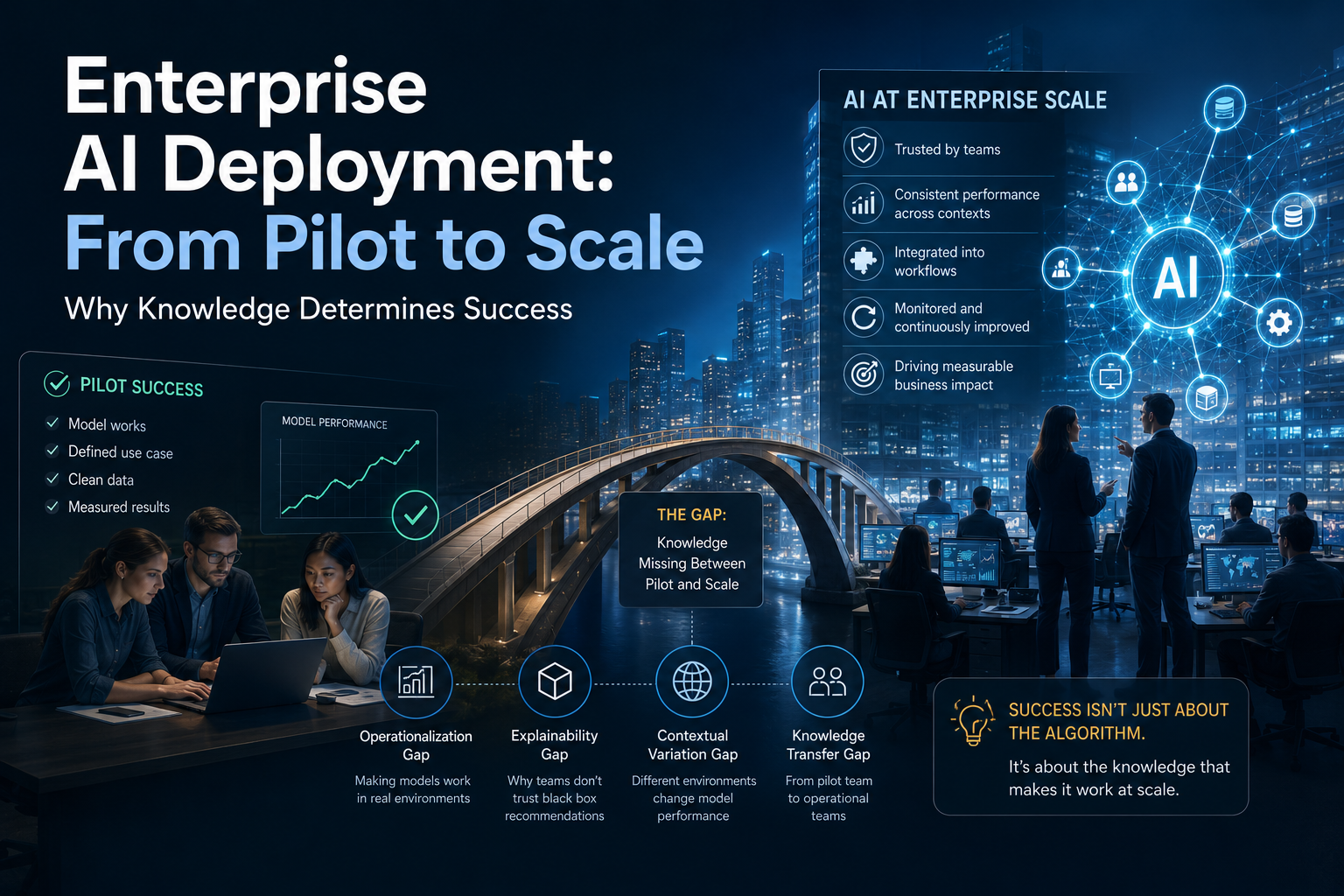
Enterprise AI Deployment: From Pilot to Scale (Why Knowledge Determines Success)
Avery Brooks
July 3, 2026
An organization runs a successful AI pilot. The AI model works. It performs the task it was designed for. The proof of concept demonstrates value. The team presents to leadership: "The pilot was successful. Now we scale to the enterprise." Scale happens. Six months into enterprise deployment, adoption stalls. The system isn't being used at scale. Teams are using workarounds. The promised ROI isn't materializing.
The AI pilot failed to scale, not because the technology was wrong, but because the pilot didn't capture the knowledge required to deploy at scale. This is one way the transformation knowledge gap manifests in AI deployments—to understand how this challenge appears across all transformation types, check out "[Transformation by Type: How Knowledge Gaps Manifest Across Different Transformation Contexts](TBD - link to be added once published)."
A pilot is perfect. The data is clean. The use case is narrow. The team understands the exact problem the AI is solving and why it matters. Pilots work because the team manages all the variables. Enterprise deployment is messy. Data quality varies by region. The use case applies differently in different contexts. Teams don't understand why the AI is doing what it's doing, or they disagree about whether the AI output should be accepted or questioned.
The organizations that scale AI successfully aren't the ones with the best algorithms. They're the ones that capture the knowledge required to make the model work in the operational context where it's deployed.
An AI pilot is a scoped experiment. A team is assembled. A narrow use case is defined. Data is sourced and cleaned. A model is built and trained. The model is tested against test data. Success metrics are defined. The pilot runs. The metrics are met. The pilot concludes with a success story.
But a pilot is a controlled environment. And operational deployment is not controlled.
A pilot demonstrates that an AI model can do something. Operationalization is making that model work every day in a real environment where conditions change and data quality varies.
A model is built on historical data from a specific context. It's trained to recognize patterns in that data. When the model is deployed in a new context—a different region, a different time period, a different data source—the patterns change. The model makes different predictions. These predictions might be accurate in the new context. They might not be.
Without understanding how the model behaves in different contexts, organizations can't trust it. And if they can't trust it, they create workarounds. A team ignores the model's recommendation and does it the old way. The model becomes another data point in the decision, not a decision-maker. Adoption stalls.
A model makes a recommendation. "This customer is high risk." The team asks: why? Why is this customer high risk? What factors led to this conclusion? The model doesn't have an answer. It's a black box. The model looks at 50 variables and outputs a score, but it can't explain why.
Without explanation, teams can't validate whether the recommendation makes sense. A credit team can't explain to the customer why they were declined if the AI model says they should be. A sales team can't calibrate their strategy if they don't understand why the AI flagged an opportunity as low probability.
In a pilot, this might be acceptable. The pilot team understands the model and can interpret the output. In enterprise deployment, thousands of people need to use the model, and most of them don't understand how it works.
A model is deployed in context A. It works well. The model is deployed in context B—a different region, a different customer segment, a different operational setup. The model doesn't work well. The patterns it learned in context A don't apply in context B.
Discovery didn't capture the contextual variation. Design didn't account for it. Deployment discovers it. And once deployment has discovered it, the model has already been deployed. Fixing it requires re-training, which requires knowing what changed. Which requires understanding the operational context in both contexts.
A pilot is managed by a specialized team. The data scientist, the business analyst, the IT person who set up the infrastructure. They understand how the model was built, what data it was trained on, what assumptions went into it, what trade-offs were made.
For enterprise deployment, this knowledge needs to transfer to operational teams who will use the model, monitor it, and maintain it. If this knowledge doesn't transfer, operational teams can't tell when the model is degrading. They can't tell when the model is wrong. They can't explain the model output to end users.
Pilot success requires specialized knowledge. Enterprise success requires that knowledge to be transferred, documented, and embedded in how the organization operates the model.
Run the pilot with the explicit goal of learning what it will take to operate the model at scale. Don't just measure: "Does the model work?" Measure: "What would it take to make this work across the organization?"
Design how the model will operate at scale.
Build the organizational capability to operate the model.
Deploy at scale with continuous monitoring.
Organizations that approach AI scaling as a knowledge problem see dramatically different outcomes:
70-80% adoption rate after 6 months. Teams use the model because they understand it, trust it, and it integrates into their workflows.
30-40% improvement in model performance at scale. Because the model has been stress-tested against operational reality, re-trained on diverse contexts, and refined based on operational feedback.
50%+ reduction in support costs. Because operational teams understand how to monitor the model and fix problems rather than creating workarounds.
Sustainable ROI. Because the model continues to perform and improve as the organization accumulates operational knowledge about how to use it.
Organizations often think: "The pilot works. Now we scale." And they treat scaling as an IT deployment: set up the infrastructure, push the code to production. Scale-up isn't just IT. It's operationalization. The organization needs knowledge about how to run the model, how to interpret it, how to monitor it, how to adjust it.
A model trained on data from one context will behave differently in a different context. Different data quality, different patterns, different operational constraints. Organizations that assume the model is portable without testing it across contexts get surprised at scale.
A pilot team trusts the model because they understand it. Enterprise users don't trust the model because they don't understand it. Organizations that skip the explanation phase and expect teams to trust a black box end up with workarounds.
Models degrade over time. Data changes. The patterns the model learned are no longer predictive. Organizations that don't monitor model performance don't know when this happens. The model keeps making poor predictions. Teams lose trust. Adoption stalls.
Once the pilot concludes, organizations often move to deployment and assume learning is done. In reality, enterprise deployment teaches you what the pilot didn't. Teams using the model in production find cases the pilot didn't cover. Data quality issues that weren't apparent in the pilot emerge at scale. Contextual variations show up. Organizations that continue learning and refining based on operational deployment end up with much better models.
Scaling AI successfully requires understanding how the model will behave in different operational contexts, what knowledge operational teams need to trust and use it, and what changes in data, business logic, or constraints will affect model performance. But this knowledge is typically locked in the pilot team's experience and isn't systematically captured for enterprise deployment.
ClearWork enables comprehensive operational knowledge capture that makes AI scaling successful. Through AI-driven interviews with frontline staff in pilot and target operational contexts, ClearWork surfaces how work actually gets done, what variations exist across regions or customer segments, what constraints shape decisions, and what information operational teams need to understand and validate AI recommendations.
The platform identifies where the model will work well (contexts where patterns the model learned apply), where it will struggle (contexts with different patterns or constraints), what operational procedures need to support model use, what explainability operational teams need, and what monitoring and governance structures will keep the model performing. This intelligence becomes the operational knowledge base that enables successful scaling. Pilot teams understand what operational challenges await. Design teams build systems that account for real-world variations. Operational teams receive training based on actual context. The result: models scale because they work in the operational contexts where they're deployed, and teams use them because they understand them.
Learn more about ClearWork
A: Pilots succeed because they're controlled environments. The pilot team understands the model, manages the data, and controls all variables. Enterprise deployment is uncontrolled: data quality varies, operational context changes, teams don't understand the model. AI scaling fails when: (1) the model's operationalization requirements aren't captured in the pilot, (2) context variation isn't discovered until deployment, (3) teams lack the knowledge to trust and maintain the model, (4) monitoring and governance structures aren't built. Success requires capturing these knowledge requirements during the pilot phase.
A: That's expected. Models trained on data from one region will behave differently in another region with different business logic, customer types, or data quality. The answer isn't to force the same model everywhere. The answer is to understand why it performs differently, determine whether those differences matter, and either adjust how you use the model in different regions or retrain it on regional data. Discovery should surface these differences before scaling.
A: The main AI deployment challenges are: (1) Operationalization—making the model work in uncontrolled real environments with varying data quality; (2) Explainability—teams don't trust black-box recommendations without understanding why; (3) Context variation—models trained in one context behave differently in other regions or segments; (4) Knowledge transfer—operational teams lack the knowledge to use and maintain the model; (5) Monitoring and governance—without continuous monitoring, models degrade and teams lose trust. Addressing these challenges during the pilot phase enables successful enterprise deployment.
A: Best practices for AI model governance include: (1) Designate a model owner accountable for performance and governance; (2) Set up continuous monitoring of model performance, adoption rates, and user feedback; (3) Define retraining triggers (performance degradation, context changes, data quality shifts) rather than fixed schedules; (4) Build clear escalation procedures for when the model is uncertain or users disagree with it; (5) Document and communicate model limitations to operational teams; (6) Run monthly reviews of model performance and operational issues; (7) Maintain version history and rollback procedures. Clear governance prevents models from degrading into poor performance.
A: Clear model governance prevents models from drifting into poor performance. Designate a model owner who is accountable for monitoring performance, approving retraining, managing versions, and communicating changes to operational teams. The owner doesn't need to be a data scientist—they need to understand business impact, operational constraints, and governance. They're the bridge between the data science team and the operational teams using the model.
If you're planning to scale an AI model from pilot to enterprise, invest the pilot phase in understanding operational context variation. Where does the model perform well? Where does it struggle? Why? What would operational teams need to understand and trust the model? Use those answers to design scaling that accounts for real-world complexity, not idealized contexts.
Scaling AI successfully isn't about better algorithms. It's about capturing the knowledge required to operationalize the model. Organizations that understand how the model behaves across contexts, that can explain the model output, that have procedures to monitor and maintain the model, that train teams to use it effectively—those organizations scale AI successfully. Organizations that treat scaling as a technology problem end up with deployed models that aren't used because teams don't understand them and don't trust them.
Organizations that scale AI successfully treat scaling as a knowledge problem, not a technology problem. Before scaling, they understand how the model will perform across different operational contexts, what explanations and confidence levels operational teams need, what procedures are required to monitor and maintain the model, and what capabilities teams need to operate it effectively. When this knowledge is captured in the pilot phase and embedded in scaling design, deployment, and governance, adoption rates reach 70-80% and models continue performing well over time.
Fourteen days, full access, no card required.
No credit card required.