Technology Platform Migrations: The Hidden Workflow Knowledge That Breaks Migrations
Avery Brooks
July 27, 2026
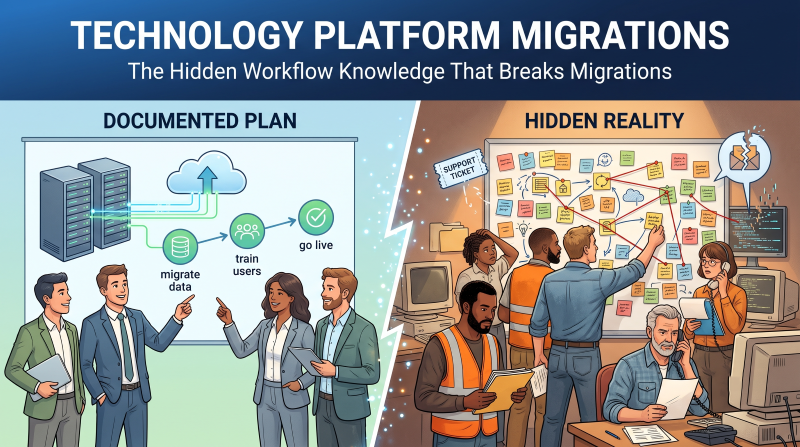
The business case for the migration was airtight. The old platform was expensive to maintain, limited in capability, and falling behind the organization's needs. The new platform was modern, scalable, and well-supported. The project plan was clear: migrate data, migrate configurations, train users, go live.
What nobody planned for was the workflows.
Not the documented workflows - those were mapped, reviewed, and accounted for in the design. The hidden workflows: the ones that only existed because the old platform had gaps. The ones frontline teams had built over years to compensate for what the old system couldn't do. The manual steps, the workarounds, the informal coordination routines that had become so embedded in daily operations that the people doing them didn't think to mention them when the migration team came to ask.
When those workflows broke - and they broke, every one of them - the migration team discovered them one by one. Support tickets accumulated. Workarounds were rebuilt on the new platform, at a fraction of the speed and significantly higher cost than if they had been discovered and planned for before migration began.
This pattern repeats across organizations at remarkable consistency. As the broader discussion of "Transformation by Type" makes clear, platform migrations and technology transformations of all kinds fail for the same root reason: the operational reality of how work gets done is not captured before the transformation is designed. Platform migrations just have a particularly acute version of this problem, because their hidden workflows are literally invisible - they are compensations for platform limitations that disappear entirely when the platform is removed.
The failure isn't random. It follows a predictable pattern rooted in how migration discovery is typically structured.
Migration discovery teams typically start with inventory: What data exists in the current system? What configurations are active? What integrations are running? What reports are in use? This is the right set of questions for understanding what the technical migration needs to move. It is the wrong set of questions for understanding how people actually use the system.
The question that surfaces hidden workflows is different: "What do you do when the system can't do what you need it to do?" Or more directly: "Walk me through what happens in a typical day when you're working with this platform." That conversation surfaces the compensatory workflows. The data export to spreadsheet that fills a reporting gap. The manual handoff that happens because two systems don't talk to each other. The approval step that happens outside the system because the system's approval workflow is too slow. These are the workflows that break at migration.
Every legacy platform accumulates what can be called workflow debt: workarounds, compensations, and informal processes that teams develop over years to address gaps in the platform's capability. Organizations with 50 or more legacy workflows typically discover that 30-40% of those workflows are no longer actively maintained - they exist in technical configurations but may serve different purposes in practice than originally designed.
The workflow debt problem is compounded by staff turnover. The people who built the original workarounds often aren't the people using them today. The current users know the workaround as the process - they don't know it's a workaround. They don't know why it exists or what gap it compensates for. This means that standard discovery interviews often fail to surface the historical context that explains what these workflows are doing.
When migration teams complete a technical inventory - all systems catalogued, all integrations mapped, all data volumes measured - there is a natural sense that the complexity is understood. The technical complexity is understood. The operational complexity is not.
Technical inventory captures what the system contains. It does not capture what people do around the system's limitations. A platform might have a built-in reporting module, but if teams have been exporting data to spreadsheets for five years because the reporting module doesn't produce the format their clients require, the migration plan needs to account for that. If the new platform's reporting module also doesn't produce that format, the problem re-emerges on the first day of go-live.
Migration projects operate under timeline pressure. Organizations want to reduce the cost of running parallel systems. Vendors have contractual end dates. Executives have committed go-live dates to boards. This timeline pressure means that when hidden workflows surface during testing or early delivery - as they almost always do - the instinct is to find a quick fix rather than a documented solution.
Quick fixes become new hidden workflows. The new platform inherits the same operational debt as the old one, sometimes in less than a year.
The people who know where the hidden workflows are are the people who use the platform every day. They are rarely the first people migration teams engage. Discovery typically starts with IT, business analysts, and process owners - all of whom know the formal process. The frontline staff who know the compensatory processes often aren't engaged until user acceptance testing, by which point the design is complete and the budget for changes is nearly gone.
The organizations that migrate platforms successfully - the ones that go live without the avalanche of post-migration support tickets - approach discovery differently.
They start with the gap inventory. Before asking what the current system does, they ask what the current system doesn't do well enough that teams have compensated. This surfaces the compensatory workflows before any technical mapping begins.
They engage frontline staff early and specifically. Not in workshops where a process owner presents how things should work, but in individual or small-group conversations where frontline staff walk through their actual day. "Show me what you do when X happens" surfaces the informal steps that process documentation doesn't capture.
They treat undocumented dependencies as a first-class discovery deliverable. For every integration between the old platform and another system, they ask: is there any manual coordination that happens around this integration? Is there anything that people do to compensate for timing, format, or accuracy issues with this integration? These compensatory steps are what break when the integration moves to the new platform's architecture.
They map the exception workflows, not just the happy path. For any platform, the standard workflow is documented. The question migration teams need to answer is: what happens when the standard workflow doesn't apply? Exceptions are often where the highest-value hidden workflows live, because exceptions are what the platform was never designed to handle, so they've accumulated the most workarounds.
A four-step framework for surfacing operational complexity before migration design is locked.
Step 1: Platform Limitation Audit (Weeks 1-2)
Before engaging any process owners or users, conduct a platform limitation audit with the IT and operations teams who administer the current system. The goal is to identify known gaps in the platform's capabilities: what does the platform not do, or do poorly, that teams have had to work around? This gives the discovery team a map of where to look for compensatory workflows. It doesn't tell them what those workflows are, but it identifies the operational territories where hidden workflows are most likely to exist.
Step 2: Frontline Workflow Interviews (Weeks 2-4)
Run structured interviews with frontline staff in each functional area that uses the platform. The interview framework should center on four questions: What do you do when the system can't do what you need? What do you do before or after using the system that the system itself doesn't track? What do you do differently from what the training or process documentation says? What would break in your daily work if the system was unavailable for a day?
These questions surface compensatory workflows, undocumented pre- and post-processing steps, informal deviations from process, and dependencies that aren't captured in the system's usage data. Document every workflow uncovered, regardless of whether it appears in formal process documentation.
Step 3: Dependency Mapping (Weeks 3-5)
For each hidden workflow surfaced in Step 2, map its dependencies: what systems, teams, or data does it depend on, and what depends on it? This step reveals the cascade effects of hidden workflows. A compensatory step that one team does manually may feed data to three other teams who don't know the data is coming from a manual process. When the migration replaces the manual step with an automated one, those downstream teams may receive data in a different format or at a different time - creating new failures that weren't anticipated.
Step 4: Migration Design Integration (Weeks 5-6)
Before migration design is finalized, integrate the hidden workflow inventory into the design requirements. For each compensatory workflow, the design team must decide: does the new platform's native capabilities eliminate the need for this workflow? If yes, confirm this with the frontline team. If no, how is the workflow supported on the new platform? This decision point is where most of the migration's hidden risk is addressed - either the new platform solves the problem, or the design explicitly accounts for it. Either outcome is better than discovering the problem in production.
For organizations preparing to launch a migration program, a dedicated 30-day discovery sprint before the technical design begins dramatically reduces post-migration operational disruption.
In week one, run the platform limitation audit with IT and operations administrators. Produce a documented list of known platform gaps and the operational areas most affected. This is the discovery roadmap.
In weeks two and three, run frontline workflow interviews in the highest-risk operational areas identified by the platform limitation audit. Target frontline staff with more than two years of tenure - they're most likely to know the workarounds that have accumulated over time. Document every informal step, compensatory process, and manual workaround surfaced, regardless of how minor it seems.
In week four, map dependencies for all documented hidden workflows and integrate findings into migration requirements. Present the hidden workflow inventory to the migration design team as a formal input to the design phase, with the same weight as technical inventory and data volume requirements.
This 30-day investment routinely surfaces the operational complexity that would otherwise emerge as post-migration support tickets, emergency patches, and productivity losses. Organizations that conduct systematic workflow dependency inventories before migration reduce post-migration support tickets by 45-65% compared to organizations that proceed directly to technical migration without this step.
The business case for investing in hidden workflow discovery before migration design is direct and measurable.
Significantly reduced rework costs. Failed lift-and-shift migrations that don't account for underlying process logic require 60-80% rework after go-live. Organizations that surface hidden workflows before design lock typically reduce this rework to 10-20%, because the migration design can account for operational reality rather than discovering it in production.
Faster time-to-productivity after go-live. When frontline staff encounter a new platform that handles their actual workflows - including the compensatory processes they've depended on - they reach productivity faster. When they encounter a new platform that breaks their workflows, productivity recovery takes months. The business impact of prolonged post-migration productivity loss consistently exceeds the cost of thorough pre-migration discovery.
Process improvement opportunity. Organizations that redesign processes during platform migration, rather than migrating existing processes to the new platform, see 25-35% efficiency gains. Hidden workflow discovery creates the visibility needed to identify which legacy processes should be redesigned, not replicated. Migrations that surface compensatory workflows early can choose to eliminate them by designing better processes on the new platform, rather than rebuilding the workarounds in a new technical context.
Reduced dependency on institutional knowledge after migration. When hidden workflows are documented, they become transferable organizational knowledge rather than tribal knowledge. Post-migration troubleshooting doesn't require tracking down the person who knows why a particular step happens - it's in the migration documentation. This resilience matters especially in the 12-18 months after go-live, when teams are still stabilizing on the new platform.
The hidden workflow discovery framework described above requires systematic engagement with frontline staff across every operational area that uses the platform. In large organizations, this can mean hundreds of frontline users across multiple regions, departments, and functions. Running this discovery through workshops or individual interviews by migration consultants is slow, expensive, and often incomplete - the people who know the workarounds are the hardest to reach and the most likely to be missed in time-pressured discovery programs.
ClearWork addresses this through AI-driven asynchronous interviews. Rather than scheduling discovery workshops and hoping that frontline staff attend and share the right information, ClearWork deploys structured AI interviews to frontline staff directly. The interviews are conducted at the respondent's convenience, without requiring the migration team to be present, and are designed specifically to surface the compensatory workflows, undocumented dependencies, and informal processes that standard discovery misses.
The platform aggregates and synthesizes the responses, surfacing patterns across large populations of respondents: this type of workaround appears in six of nine regional teams; this undocumented dependency is shared across three functional areas; this compensatory process is described by frontline staff but not mentioned in any process documentation. This population-level pattern recognition is what makes the hidden workflow inventory comprehensive rather than anecdotal.
For migration programs, ClearWork turns the 30-day discovery sprint described above from a resource-intensive manual process into a scalable, evidence-based discovery phase that can engage the full frontline population, not just the subset that fits into workshop schedules.
Treating technical inventory as complete discovery. Knowing what the system contains is not the same as knowing how people work around the system's limitations. Technical inventory is necessary but not sufficient. Operational discovery must accompany it.
Engaging process owners without engaging frontline staff. Process owners know how things should work. Frontline staff know how things actually work. Both are necessary. In platform migrations, the gap between the two is where hidden workflows live.
Treating user acceptance testing as the first hidden workflow discovery. UAT is not a discovery phase. It is a confirmation phase. When hidden workflows surface during UAT, the design is complete and the budget for changes is nearly gone. Discovery should be complete before design begins.
Migrating workarounds instead of eliminating them. Every workaround surfaced during discovery is an opportunity to evaluate whether the new platform's native capabilities should replace it. Migrating the workaround to the new platform perpetuates operational debt. Redesigning the process to eliminate the workaround improves it.
Underestimating the impact of staff turnover on migration discovery. Tenured staff know the history behind workarounds. Recent hires know only the workaround itself. Discovery that relies only on the most accessible staff - often recent hires who answer interview requests fastest - will miss the historical context that explains why compensatory workflows exist and whether they can be safely eliminated.
A: There is no way to guarantee completeness, but there are signals that suggest discovery is reasonably thorough. When the same compensatory workflows start appearing across multiple independent interviews in the same functional area, you've likely surfaced the significant ones. When frontline staff in different regions describe the same informal process independently, that process is structural, not individual. The practical completeness test is: are new significant hidden workflows still being surfaced at the end of the discovery sprint? If the rate of new discoveries is declining and you've interviewed staff across all functional areas and tenure levels, you've likely reached the point of diminishing returns. One or two unexpected findings will always emerge post-go-live - the goal is to reduce this to one or two, not zero.
A: This is a design decision, not a discovery failure. When the new platform cannot natively replicate a compensatory workflow, the organization has three options: configure or extend the new platform to support the workflow, redesign the business process to eliminate the need for the workflow, or accept a manual process on the new platform as an interim solution with a roadmap to automate it. The important thing is that this decision is made explicitly, during design, with the right stakeholders involved. The worst outcome is when this decision is made under pressure during delivery or after go-live, because by then there's no time for deliberate design and the solution is usually a rushed workaround that creates new technical debt.
A: The scale of discovery should match the scale of operational complexity, not the technical scale of the migration. A small technical migration that affects a high-frequency, high-complexity operational workflow needs thorough hidden workflow discovery. A large technical migration that primarily moves data and configurations for a back-office system with simple, well-documented processes may need significantly less. The right question is: how many people use this platform daily, and how much of their work is informal or compensatory? The answer determines the discovery investment, not the gigabytes of data being migrated.
A: This is one of the primary operational constraints on migration discovery programs. Structured asynchronous methods work better than live workshops for most frontline populations. Asynchronous interviews - whether through tools designed for this purpose or through structured written questionnaires - allow frontline staff to respond at their convenience without requiring coverage arrangements or participation in half-day workshops. For high-priority staff whose knowledge is critical and who are difficult to reach, targeted 20-30 minute conversations with specific questions about specific workflows are more efficient than open-ended discovery sessions. The goal is precision in what you ask, not breadth in how long you engage.
A: Migration is not the end of the hidden workflow problem. As users adapt to the new platform, they will develop new compensatory workflows to address the new platform's limitations - the same way they did on the old one. Post-go-live operational documentation should include a mechanism for frontline staff to report informal steps they're taking that aren't in the official training, so these can be evaluated: is this a training gap, a process design issue, or a platform gap that needs a long-term solution? Organizations that treat post-migration hidden workflow reporting as a continuous improvement input prevent the new platform from accumulating the same level of operational debt that made the old platform eventually unmigrateable.
The hidden workflows that break platform migrations aren't hidden because organizations are careless - they're hidden because they're compensations for platform limitations that have become invisible through years of routine. The migrations that succeed are the ones that take the time to ask frontline staff how they actually work, not just what the system is configured to do. Find the hidden workflows before the design is locked, and migration becomes a genuine improvement in how the organization operates. Find them after go-live, and migration becomes an expensive lesson in what discovery missed.
Before your migration design review, run a single test: ask five frontline users in your highest-volume operational area one question - "What do you do when the platform can't do what you need?" If more than two of them describe a process that isn't in your migration discovery documentation, your discovery is incomplete. Run the gap inventory before design is locked. You have time to fix this before go-live; you won't after.
Every legacy platform accumulates hidden workflows: compensatory processes, manual workarounds, and informal steps that frontline teams develop to fill gaps in the platform's capabilities over years of operation. When migrations are planned without surfacing these hidden workflows, teams discover them one by one in production, where fixing them costs 60-80% more than it would have cost to design for them upfront. Organizations that invest in systematic hidden workflow discovery before migration design lock consistently reduce post-migration disruption, deliver faster time-to-productivity after go-live, and - because they've surfaced compensatory processes - often use the migration as an opportunity to eliminate legacy operational debt rather than replicate it on a modern platform.
Fourteen days, full access, no card required.
No credit card required.