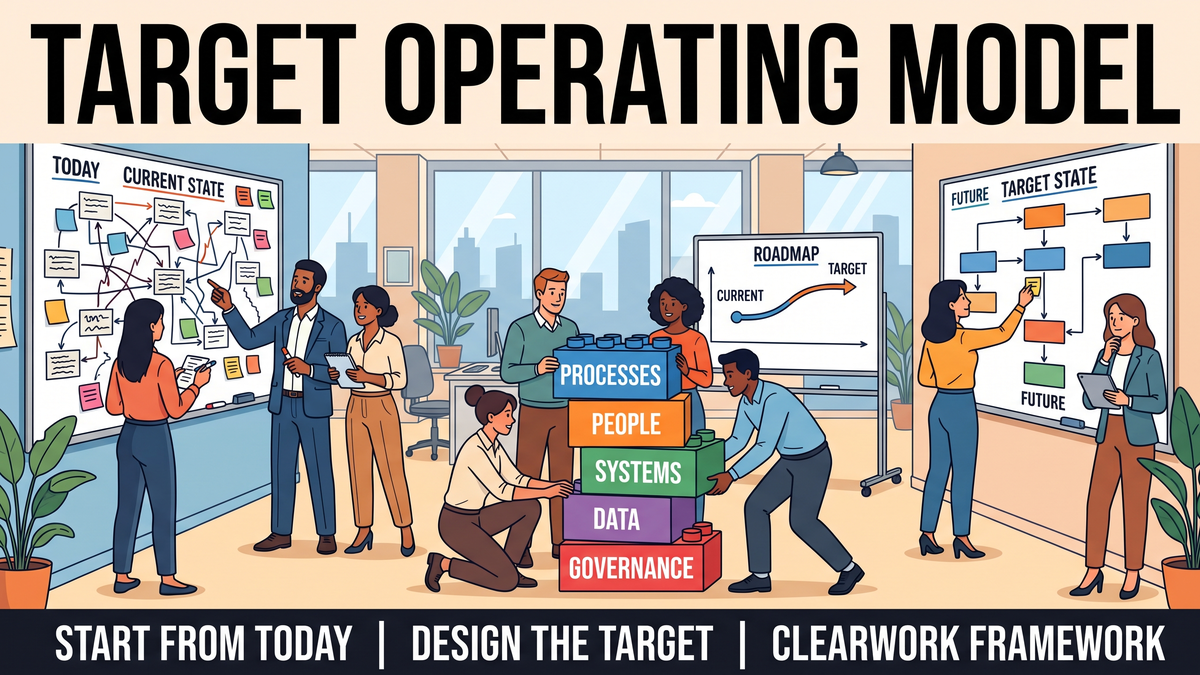
Target Operating Model: Start From How the Business Runs Today
Avery Brooks
November 19, 2026
Updated: November 16, 2026
A target operating model (TOM) describes how a business will run after a change: its processes, people and roles, systems, data and governance. The designs that hold are built from a documented current operating model, gathered from the people who run the work today, so the target, the gaps and the roadmap rest on facts rather than org charts.
An operating model is the bridge between strategy and day-to-day work. It explains how the organization delivers value: which processes it runs, who does them, which systems and data they use, and how decisions are made and controlled. A target operating model is the same description for a future state, usually after a transformation, a new system, a merger or a change of ownership.
Most TOMs cover five dimensions:
Some frameworks add customers, suppliers, locations or sourcing as separate dimensions. The exact list matters less than covering each one in enough detail that a team could act on it.
Companies usually need a new target operating model at a turning point: an ERP or CRM replacement, a merger or an add-on acquisition, a carve-out from a parent, a shift to shared services, a new owner with a value creation plan, or a push to automate and apply AI at scale. In each case the question is the same. If we change the systems, the structure or the ownership, how should work run afterward, and what has to change to get there? A clear TOM answers that question in a form that finance, IT, HR and operations can all plan against, and it gives the program a single reference for decisions that would otherwise be made one workshop at a time.
Operating model work often starts at the top. A leadership team agrees the strategy, a design team draws the future structure from the org chart, and workshops fill in the processes. The result looks complete on slides and falls apart in implementation.
The usual reasons:
The problem isn't the framework. It's the starting point. Org charts show who reports to whom, not how work flows. The difference between org charts and work charts is exactly where operating model designs go wrong.
Before designing the target, describe the operating model you have. That means capturing, for each process in scope, the steps and their variations, the decisions and business rules, the exceptions and workarounds, the handoffs between roles, and the systems and data each step touches. It also means recording who owns each process and how it is measured today.
The best source is the people who run the work, backed by existing documents. A current-state assessment gives the method: decide the scope, hear from every role involved, validate the findings with process owners and keep the result traceable.
ClearWork is an AI discovery platform for processes and requirements built for this step. Its AI agent, Clarity, runs short async interviews (voice or chat, about 20 minutes) with the people who do the work; people can add screen recordings of how a task is done; and ClearWork ingests existing documents. It goes as deep as each process area needs, flags where sources conflict, and produces process maps, SOPs, requirements and improvement opportunities by role. Process owners validate each round, every line traces back to its source, and further rounds update the outputs together.
The result is a current operating model you can design from: what the work is, who does it, where it varies and where it hurts. It also gives every later design decision a reference point. When someone proposes removing a step or merging two roles, the team can check what the step does today, who relies on it and which exceptions run through it, instead of debating from memory.
With the current state documented, design the target one dimension at a time. For each, write down what is true today, what should be true in the future, the gap between them and who owns closing it. Keep each entry specific enough to act on: "AP invoices keyed by three clerks at two sites" rather than "manual finance processes".
The table shows the structure, with illustrative entries.
Design principles help keep choices consistent: for example, standardize processes unless a variation serves a customer need, or automate high-volume steps before adding headcount. Agree five to eight principles with leadership before detailed design starts, and test each design decision against them.
Pay particular attention to variation. The current-state work will show where the same process runs differently by site, team or product line. For each variation, decide whether it serves a real need (a regulatory difference, a customer commitment, a product that works differently) and should stay, or whether it is historical and should be harmonized. Recording that decision, and the reason for it, prevents the same debate from returning during implementation.
Design roles last, once the processes, systems and data are settled. That keeps the conversation on the work rather than on boxes and titles, and it makes the people dimension of the gap easier to explain to the teams affected.
For transformation teams, ClearWork's page on operational excellence covers how this discovery supports system and process change.
A target only matters if there is a credible path to it. Turn the gaps into a roadmap:
Plan the change for people as carefully as the design. Explain what is changing and why, involve the people who described the current state in testing the target, and give process owners the documentation they need to run the new way of working. Teams accept a new operating model faster when they can see their own work described accurately in the starting point.
For private equity owners, the TOM roadmap usually feeds the value creation plan: operating model changes are often where margin improvement, system consolidation and add-on integration sit. ClearWork's page for private equity operating teams covers that use.
The free template gives you a working structure for the whole exercise. Download the target operating model canvas (Excel).
Start with the Current vs target tab once the current state is documented, then work through the gap log with process owners before building the roadmap.
The current operating model describes how the business runs today: its real processes, roles, systems, data and governance. The target operating model describes how it should run after a change. The gap between them is what the transformation has to deliver.
It depends on scope and complexity. Documenting the current state for the processes in scope typically takes one to four weeks with interview-based discovery. Target design and roadmap work then takes several more weeks of working sessions with leaders and process owners.
Leadership sets direction and design principles. Process owners and the people who do the work describe the current state and test the target. Finance, IT and HR shape the systems, data and people dimensions.
It should include the scope, design principles, the current and target state for each dimension, a gap log, and a roadmap with owners and measures. Process maps and role definitions are usually attached as supporting detail.
Assign an owner to each process and dimension, review the model at a set cadence, and update the current-state documentation when processes, systems or roles change. Treat it as a working reference, not a one-time deliverable.
See how ClearWork documents your current operating model before you design the target. Book a demo.
How to design a target operating model that holds: document the current operating model from the people who run it, then define the target, gaps and roadmap.