Consulting Discovery Playbook (2026): The 30-Day Framework Top Firms Use to Standardize Discovery Across Projects
Avery Brooks
March 9, 2026
The biggest difference between consulting firms that scale smoothly and those that struggle isn’t talent.
It’s repeatability.
Many consulting teams reinvent discovery on every project. One team runs workshops. Another team relies heavily on documentation reviews. A third team starts with process mapping. The outputs vary depending on who leads the engagement.
The result is inconsistent delivery.
Some projects move quickly and produce clear requirements. Others stall during discovery, create incomplete documentation, and experience scope churn during implementation.
The firms that deliver consistently well operate from a structured discovery playbook. Instead of improvising discovery every time, they follow a repeatable framework that captures operational insights, converts those insights into structured requirements, and produces implementation-ready deliverables.
Earlier in this consulting series we explored how modern discovery approaches are evolving. For example, relying entirely on workshops often slows projects and limits how much operational knowledge teams can capture. Many consulting teams now supplement traditional workshops with asynchronous discovery methods that allow subject matter experts to contribute without scheduling bottlenecks.
But efficient discovery inputs are only the beginning. The real goal is turning those inputs into structured knowledge that supports delivery.
A well-designed consulting discovery playbook makes that transition predictable.
Discovery sits at the beginning of most transformation projects.
It is also the phase most likely to vary across consulting teams.
There are several reasons for this.
Some consultants prefer workshops. Others prefer interviews. Others start by reviewing documentation.
All of these approaches can work, but when discovery relies entirely on individual style rather than structured methodology, outputs vary significantly.
Two teams working on similar projects may produce completely different deliverables.
Even within the same firm, discovery deliverables often differ from project to project.
One engagement might produce detailed process maps and structured requirements. Another might produce a summary presentation with limited operational detail.
Without consistent outputs, downstream implementation teams must spend time reconstructing context.
When discovery activities are loosely structured, project timelines become difficult to predict.
Scheduling challenges, incomplete stakeholder participation, and late clarification cycles can extend discovery well beyond the original plan.
This delays the start of implementation and increases delivery risk.
A consulting discovery playbook provides a consistent structure for gathering operational knowledge and converting it into implementation-ready outputs.
While the specific details vary across firms, most effective discovery playbooks include four core components.
The discovery process begins by gathering operational information from multiple sources.
These may include:
Capturing these inputs thoroughly is essential because discovery quality directly affects requirement accuracy later in the project.
Once operational inputs are collected, they are organized into a clear representation of how work actually flows through the organization.
This usually includes:
This structured view of the process becomes the foundation for all other discovery artifacts.
Once the operational workflow is understood, requirements can be derived directly from the process.
Requirements should describe the system behaviors needed to support each step in the workflow, along with any conditions, approvals, or exception scenarios.
When requirements remain connected to the operational inputs that produced them, teams can validate them more easily and avoid misunderstandings during implementation.
The final stage of discovery converts requirements and process insights into artifacts that delivery teams can immediately use.
These often include:
When discovery produces these artifacts consistently, implementation teams can move forward quickly.
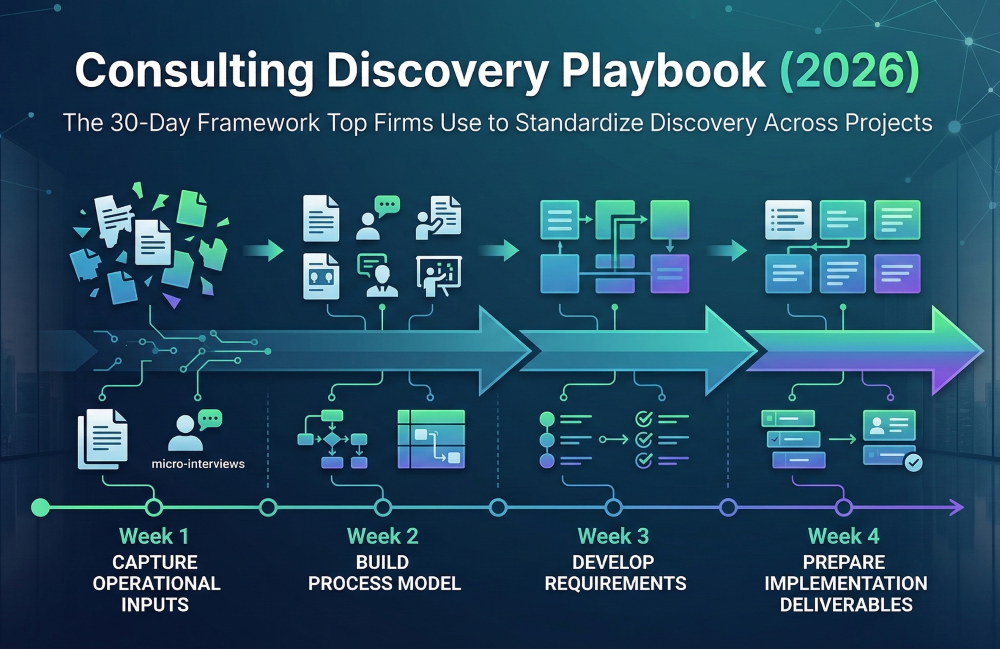
Many consulting firms structure discovery into a four-week framework that progressively builds understanding and prepares the project for delivery.
The first week focuses on gathering operational knowledge.
Consulting teams collect materials such as process documentation, transaction examples, and existing system workflows. They also begin gathering input from subject matter experts.
Many teams now collect this information asynchronously so SMEs can contribute insights without requiring multiple scheduled meetings. This approach improves participation and allows consultants to capture operational nuance earlier in the discovery process.
The asynchronous discovery approach discussed earlier illustrates how consulting teams can gather these inputs efficiently while avoiding the scheduling bottlenecks that often slow traditional discovery.
By the end of the first week, consultants should have a broad set of operational inputs describing how work actually occurs.
During the second week, operational inputs are organized into a structured view of the process.
Consultants translate SME insights and documentation into process maps that show:
Exception paths are particularly important during this stage because they often reveal the most critical system requirements.
The goal is to create a clear representation of how work flows across the organization.
Once the process model is complete, consultants begin translating operational steps into system and workflow requirements.
Each requirement should describe how the future system must behave to support the operational workflow.
Validation sessions with SMEs help confirm that the requirements reflect real operational behavior rather than simplified assumptions.
When requirements are grounded in operational inputs, they tend to remain more stable during later phases of the project.
The final stage of discovery prepares artifacts needed for delivery.
Consultants convert requirements into implementation-ready outputs such as:
At this stage, discovery transitions directly into delivery planning.
Instead of producing documentation that must be reinterpreted later, the discovery phase produces artifacts that implementation teams can immediately use.
When consulting firms adopt a consistent discovery playbook, several benefits appear across engagements.
Delivery teams receive structured artifacts quickly after discovery ends. This reduces the time required to reconstruct context before implementation begins.
Standardized discovery workflows produce similar outputs across projects, making it easier for delivery teams to understand and use the artifacts they receive.
When discovery artifacts remain connected to operational inputs, fewer requirement gaps appear during implementation.
Clients gain confidence when discovery outputs clearly reflect their operational workflows and lead directly to implementation plans.
Modern consulting teams increasingly rely on tools that support structured discovery workflows.
These platforms can help teams capture operational inputs, organize process knowledge, and generate discovery artifacts more efficiently.
Automated discovery platforms such as ClearWork are designed to support consulting teams through this process—from collecting operational insights to generating deliverables that support implementation.
https://www.clearwork.io/clearwork-for-consultants---automated-discovery
By maintaining traceability between discovery inputs and implementation artifacts, these platforms help consulting teams maintain alignment throughout the project lifecycle.
Even with a structured framework, discovery can break down if certain pitfalls are not addressed.
Without a standard playbook, consulting teams spend unnecessary time deciding how to run discovery rather than executing it effectively.
Operational knowledge must be translated into structured artifacts that delivery teams can use.
Process models, requirements, and implementation backlogs should remain closely connected to avoid interpretation gaps.
Discovery should prepare the project for delivery, not simply produce reports.
A strong discovery playbook includes operational input collection, process modeling, requirements development, and implementation-ready deliverables.
Discovery timelines vary by project complexity, but many consulting engagements structure discovery within a four-week framework.
Without standardized processes, discovery workflows depend heavily on individual consultant preferences and experience.
Using structured discovery frameworks and asynchronous SME input can significantly reduce scheduling delays.
Tools that support automated discovery, process intelligence, and artifact generation help teams maintain consistency across engagements.
Consulting discovery often becomes inconsistent when every team approaches it differently. A standardized discovery playbook creates a repeatable framework for capturing operational knowledge, developing requirements, and preparing implementation artifacts. When discovery follows a clear structure, consulting teams move from insight to delivery faster and with far fewer surprises.
Fourteen days, full access, no card required.
No credit card required.