AI Meeting Assistants vs AI Discovery Platforms: What Consultants Actually Need
Avery Brooks
June 2, 2026
Client discovery does not usually fail because consultants forget to take notes.
It fails because the knowledge captured during discovery never becomes complete, structured, source-backed, and useful enough for delivery.
A consulting team may run strong client meetings, record every call, capture transcripts, summarize action items, and still end up with the same problem weeks later: scattered notes, conflicting stakeholder input, missing context, unclear requirements, and deliverables that depend too heavily on manual interpretation.
That is why many consulting firms are starting with AI meeting assistants. Tools that summarize calls, capture action items, and create searchable transcripts are genuinely useful. They reduce administrative work and help consultants stay focused during conversations.
But an AI meeting assistant for consultants only solves one part of the discovery problem.
Consulting discovery is not just about remembering what was said in a meeting. It is about turning scattered client knowledge into defensible deliverables: process maps, requirements, SOPs, risks, decisions, user stories, implementation handoff materials, and a clear understanding of how the client actually works.
That is where the distinction matters.
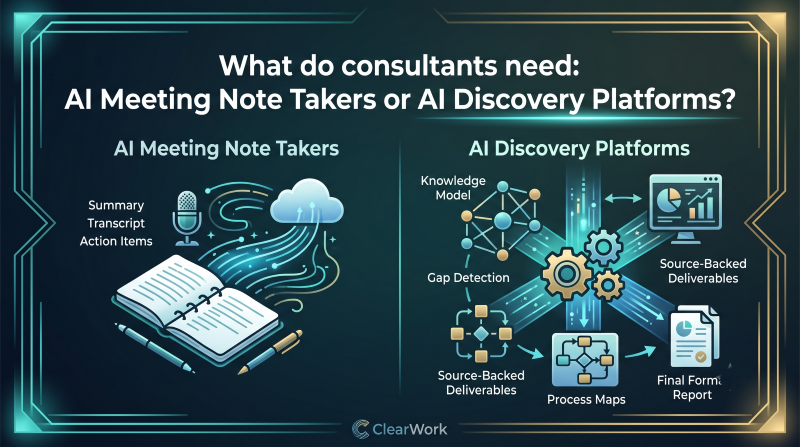
AI meeting assistants capture conversations.
AI discovery platforms structure discovery.
And for consulting firms trying to improve speed, quality, margin, and delivery confidence, that difference is significant.
For a broader breakdown of the category, see ClearWork’s guide to the best AI client discovery software for consulting firms.
AI meeting assistants are often the first AI tool consulting teams adopt because the pain is obvious.
Consultants spend a large portion of discovery in meetings. They interview executives, process owners, system administrators, frontline users, finance teams, IT leaders, operations managers, and project sponsors. Every one of those conversations contains useful context.
The challenge is that discovery conversations are messy by nature.
One stakeholder explains the official process. Another describes the workaround. Someone else remembers an exception that only happens at month-end. A manager describes how approvals should work, while the actual users explain how approvals happen when the system slows them down.
Capturing that nuance manually is difficult.
A consultant may be facilitating the conversation, watching the client’s reactions, asking follow-up questions, taking notes, identifying risks, and thinking ahead to deliverables at the same time. It is no surprise that firms look for software to reduce the note-taking burden.
AI meeting notes for consultants can help with that. They provide a record of the conversation, make it easier to revisit details, and reduce the risk that important statements disappear into someone’s notebook.
For many firms, that is a meaningful improvement.
But it is still not the same as discovery automation.
AI meeting assistants are valuable because they improve the mechanics of capturing meetings.
They can help consulting teams move faster after calls, reduce manual note cleanup, and keep better records of client conversations. In a busy project environment, that matters.
Most AI meeting assistants are especially helpful for:
For status meetings, internal planning sessions, sales calls, and lightweight client check-ins, that may be enough.
A consultant can finish a meeting, review the summary, send a follow-up, and keep moving. Compared with manual notes, that is a clear improvement.
The issue is that client discovery is not just a sequence of meetings.
Discovery is a structured effort to understand the client’s current state, future needs, constraints, gaps, risks, systems, roles, exceptions, decisions, and implementation implications.
A meeting assistant helps capture raw material.
It does not necessarily turn that raw material into the structured knowledge a consulting team needs to deliver the work.
The biggest limitation of AI meeting assistants is that they usually organize information around the meeting, not around the discovery outcome.
That creates a problem for consultants.
Client discovery does not need another folder full of call summaries. It needs a reliable understanding of the client’s business context. That context has to survive beyond the meeting where it was first discussed.
A transcript might tell you what the controller said during a finance discovery session. But it may not tell you whether that statement conflicts with what the AP manager said last week. It may not identify that no one has explained the approval process for international vendors. It may not connect a stakeholder comment to a future requirement, risk, SOP, user story, or implementation decision.
This is where meeting notes begin to break down.
They capture what happened in a conversation, but they do not automatically answer the larger discovery questions:
Did we talk to the right stakeholders?
Did we ask the right follow-up questions?
What topics are still unresolved?
Which answers conflict with each other?
Which source supports this requirement?
Which process step is based on a transcript, a document, or an assumption?
Which risks should be escalated before delivery begins?
Which pieces of knowledge need to become formal deliverables?
For consulting teams, these questions matter because discovery quality directly affects project scope, client alignment, delivery confidence, and margin.
A clean meeting summary may still leave the team with incomplete discovery.
The easiest way to understand the difference is to look at the unit of value.
An AI meeting assistant is usually organized around the meeting.
An AI discovery platform is organized around the client knowledge model.
That means the platform should not only remember what was said. It should help consultants understand what the information means, where it came from, how it connects to other inputs, and what deliverables it should produce.
A meeting assistant might summarize a call where a client explains their current procurement process.
A discovery platform should help turn that same conversation, along with related documents and stakeholder interviews, into a source-backed process map, requirements, risks, open questions, decisions, SOP content, and implementation handoff materials.
That is a very different level of support.
This does not mean meeting assistants are bad tools. It means they solve a different problem.
They help consultants capture conversations.
Discovery platforms help consultants complete discovery and turn it into usable outputs.
An AI discovery platform is built for the full discovery workflow, not just the meeting record.
For consulting firms, that matters because the hard part of discovery is rarely one individual conversation. The hard part is combining information across many people, documents, systems, workshops, and recordings until the team has a complete enough picture to make recommendations or begin implementation.
A strong AI discovery platform should help consulting teams answer questions like:
Who do we need to hear from?
What topics need to be covered?
What has already been answered?
What is missing?
Where do stakeholders disagree?
What source supports this requirement?
What deliverables can be generated from the discovery record?
What risks should the team address before moving forward?
Instead of leaving consultants to manually review transcripts and rebuild context from scratch, discovery software should create a more structured foundation.
That includes AI-led stakeholder discovery, asynchronous interviews, document analysis, transcript synthesis, discovery planning, gap detection, contradiction detection, source-backed outputs, and a living knowledge base that carries forward into delivery.
This is especially important when discovery involves multiple teams or functions.
In a typical consulting engagement, one stakeholder may understand the process, another understands the system, another owns the approval policy, and another knows the exception path. No single meeting contains the whole truth.
The platform’s job is to help assemble that truth without forcing consultants to manually connect every dot.
Consulting firms are under pressure to deliver faster without lowering quality.
Clients expect rapid discovery, clear recommendations, and implementation-ready outputs. At the same time, consulting teams are often working with incomplete documentation, busy stakeholders, competing versions of the truth, and tight project timelines.
That combination creates real delivery risk.
If discovery is shallow, the risk does not always show up immediately. It shows up later as rework, change requests, missed requirements, stakeholder frustration, unclear scope, and delivery teams asking questions the discovery team thought had already been answered.
AI meeting assistants can reduce administrative effort, but they do not fully solve that risk.
The more important question is not, “Did we capture the meeting?”
The better question is, “Can we trust the discovery record enough to build from it?”
For consulting firms, that is where AI discovery platforms become more valuable. They help standardize the way client knowledge is captured, structured, validated, and converted into deliverables.
That creates value across the engagement lifecycle.
Partners get more confidence in scope. Managers get better visibility into discovery progress. Consultants spend less time reconstructing notes. Delivery teams receive clearer handoff materials. Clients see outputs that are easier to trust because they are tied back to real source evidence.
There are many situations where a meeting assistant is the right tool.
A firm does not need a full discovery automation platform for every call. If the main goal is to capture a conversation, summarize takeaways, and send follow-up notes, an AI meeting assistant can be perfectly useful.
An AI meeting assistant may be enough when:
For example, a weekly client check-in may only need a summary, decisions, and next steps. A sales discovery call may only need account notes and follow-up tasks. An internal project meeting may only need a record of who owns what.
In those cases, a meeting assistant can save time without requiring a broader system.
The key is to avoid expecting a meeting assistant to do work it was not designed to do.
Consultants need discovery automation when the engagement depends on more than a clean meeting summary.
That usually happens when the team needs to understand how a client actually operates, document the current state, define requirements, identify risks, prepare for implementation, or create deliverables that multiple stakeholders will rely on.
Discovery automation becomes more important when:
This is where meeting notes alone become too thin.
A transcript may be useful evidence, but someone still has to interpret it, compare it against other inputs, identify gaps, and turn it into usable consulting artifacts.
That manual work is exactly where discovery automation helps.
For consulting firms looking to standardize this motion, ClearWork’s Automated Discovery helps teams move from scattered stakeholder input to structured, source-backed outputs.
The strongest argument for AI discovery platforms is not that they make discovery feel more organized.
It is that they improve the quality and defensibility of the deliverables that come out of discovery.
Most consulting deliverables depend on source knowledge. A process map is only as useful as the information behind it. A requirement is only as strong as the evidence supporting it. A risk register is only helpful if it reflects what is actually happening in the client environment.
When discovery inputs are scattered across meeting notes, transcripts, forms, emails, documents, and workshop boards, deliverables become harder to trust.
Consultants may still create a polished deck or document, but the connection between the output and the source material is often weak. That makes it harder to defend recommendations, explain decisions, or hand work to another team.
An AI discovery platform should help preserve that connection.
Instead of treating notes as isolated artifacts, it should connect stakeholder input to structured outputs:
This is the difference between documentation that looks complete and documentation that is actually grounded in discovery.
For more on this handoff problem, see ClearWork’s article on moving from discovery to deliverables.
The right tool depends on the outcome your firm needs.
If the goal is to reduce note-taking and make meetings easier to review, a meeting assistant is likely enough.
If the goal is to improve how your firm runs discovery, identifies missing context, validates client knowledge, and creates delivery-ready outputs, a discovery platform is the better fit.
Here is a simple way to think about it:
Your consulting team needs to...Better fitRecord and summarize meetingsAI meeting assistantCapture action items from callsAI meeting assistantSearch past meeting transcriptsAI meeting assistantStandardize stakeholder discoveryAI discovery platformRun asynchronous stakeholder interviewsAI discovery platformIdentify missing discovery topicsAI discovery platformDetect conflicting stakeholder inputAI discovery platformGenerate source-backed requirementsAI discovery platformCreate process maps, SOPs, risks, and user storiesAI discovery platformBuild a living client knowledge baseAI discovery platform
The distinction is not about which category is better in general.
It is about which job you need the software to do.
ClearWork is built for consulting teams that need discovery to become more than meeting notes.
It helps consulting firms turn scattered client knowledge into structured, source-backed deliverables. That includes stakeholder input, documents, transcripts, recordings, workshops, and existing client materials.
Instead of leaving consultants to manually piece together context after every discovery call, ClearWork helps create a living discovery record that can support process maps, requirements, SOPs, risks, user stories, decisions, gaps, and implementation handoff materials.
For consulting firms, the value is not simply faster documentation.
The value is more complete discovery, stronger deliverables, and better continuity between discovery and delivery.
ClearWork is especially relevant for consulting teams that are trying to:
If your firm is comparing AI meeting assistants, the question is not whether those tools are useful. They are.
The better question is whether meeting notes are the final output you need, or whether they are only the starting point.
For firms that need the second answer, ClearWork for consulting firms is designed to help.
One of the most common mistakes consulting teams make is assuming that recorded meetings automatically create better discovery.
They do not.
A transcript is a record. It is not a complete understanding of the client environment.
The transcript may include valuable statements, but it does not necessarily tell the team what to do next. It does not automatically determine which process areas are incomplete, which stakeholders need follow-up, or which details should become formal requirements.
This is why many firms end up with more information but not more clarity.
They have more transcripts, more summaries, more recordings, and more notes, but the real synthesis still depends on consultants manually reading, interpreting, organizing, and translating everything into useful outputs.
AI discovery platforms are designed to reduce that gap.
They do not remove consultant judgment. They give consultants a better foundation to apply that judgment.
AI meeting assistants are a logical starting point for consulting firms, but they are not the endpoint.
The future of consulting discovery is a more connected workflow where meetings, documents, interviews, forms, workshops, and client materials all contribute to a living understanding of the client.
That living understanding should be structured enough to support delivery.
It should help firms know what has been captured, what is missing, where stakeholders disagree, and which source supports each output. It should also help teams generate the artifacts clients actually need, not just the notes consultants use internally.
That is the shift from meeting capture to discovery intelligence.
And it is why consulting firms should think carefully before assuming an AI meeting assistant is enough.
The real opportunity is not just to save time taking notes.
The real opportunity is to make discovery faster, more complete, and more defensible from the start.
Yes. AI meeting assistants are useful for consultants because they reduce manual note-taking, create transcripts, summarize conversations, and capture follow-up items. They are especially helpful for status meetings, client calls, internal planning sessions, and lightweight discovery conversations.
The limitation is that meeting assistants usually focus on the meeting itself. Consulting discovery often requires a broader workflow that connects many meetings, documents, stakeholder inputs, risks, requirements, and deliverables.
Meeting notes summarize what happened in a conversation. Discovery automation helps structure, synthesize, and validate client knowledge across conversations, documents, interviews, and workshops.
For consulting firms, this difference matters because discovery outputs need to support real delivery work. A meeting summary may be useful, but a discovery automation platform can help turn the underlying knowledge into process maps, requirements, SOPs, risks, user stories, and implementation handoff materials.
AI meeting assistants such as Fathom, Otter, and Fireflies can support consulting discovery by capturing and summarizing conversations. But they should not be viewed as a full replacement for a discovery platform when the engagement requires structured stakeholder coverage, gap detection, contradiction detection, source traceability, and formal consulting deliverables.
They are best understood as meeting capture tools. A discovery platform is designed to help consulting teams turn captured knowledge into delivery-ready outputs.
After a transcript is created, consultants should identify the important process details, requirements, risks, decisions, gaps, exceptions, and follow-up questions. They should also connect those insights to other discovery sources, such as prior interviews, client documents, workshop outputs, and existing requirements.
The problem is that this synthesis is often manual. AI discovery platforms help automate parts of that process while keeping consultants in control of review, judgment, and final deliverables.
A consulting firm should use an AI discovery platform when discovery involves multiple stakeholders, complex processes, unclear current-state knowledge, outdated documentation, or deliverables that need to support implementation. It is especially useful when the team needs source-backed requirements, process maps, SOPs, risks, user stories, or handoff materials.
If the only need is to summarize a meeting, a meeting assistant may be enough. If the goal is to improve the full discovery-to-deliverable workflow, an AI discovery platform is the better fit.
AI meeting assistants help consultants capture conversations, but consulting firms need more than clean notes when discovery has to support real delivery.
ClearWork helps consulting firms turn scattered client discovery into source-backed process maps, requirements, SOPs, risks, user stories, and delivery-ready documentation.
If your team is still relying on meetings, forms, whiteboards, and scattered notes to run client discovery, ClearWork gives you a more repeatable way to capture what clients actually know. Use AI-led discovery, document synthesis, and source-backed deliverable generation to reduce manual effort without losing consultant judgment. Learn how ClearWork helps consulting teams deliver faster, more defensible discovery through ClearWork for consulting firms.
Meeting notes are a helpful starting point, but they are not enough when discovery needs to become requirements, process maps, SOPs, risks, user stories, and implementation handoff materials. ClearWork gives consulting teams a more repeatable way to capture client knowledge, identify gaps, and create source-backed deliverables without losing consultant judgment. Learn how ClearWork helps firms move from scattered discovery inputs to defensible outputs through ClearWork Automated Discovery.
Fourteen days, full access, no card required.
No credit card required.