ClearWork vs Horizon (2026): Two Approaches to AI-Led Discovery
Avery Brooks
October 21, 2026
Updated: 23 October 2026
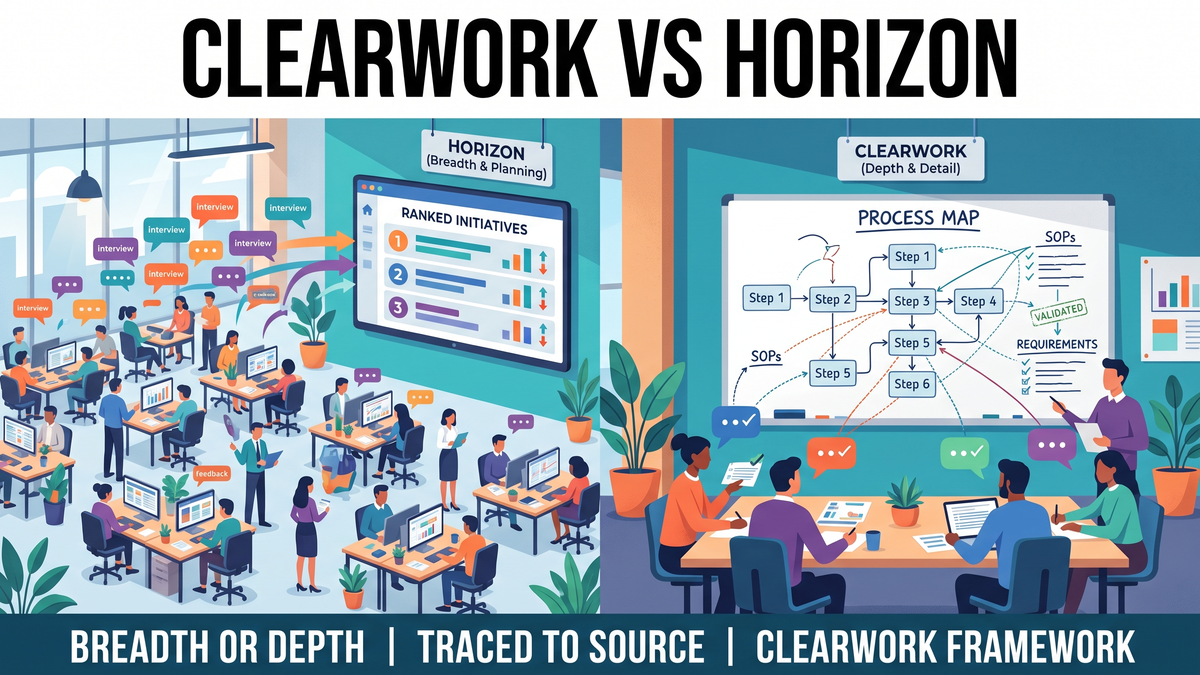
ClearWork and Horizon both use AI to interview employees, but they do different jobs. Horizon interviews people across a whole organization to find, rank and plan improvement initiatives. ClearWork interviews the people who do a specific process and produces current-state maps, SOPs and requirements, every line traced to who said it and validated by people.
ClearWork makes one of the tools in this comparison. We've described every tool as fairly as we can from its own site and documentation; if something is out of date, tell us at [email protected].
Both sit in the interview-based family of discovery tools, the third evidence source alongside system event logs and desktop capture. Our guide to process intelligence software and its evidence sources explains the three families; this page compares two products inside the interview family, because buyers increasingly shortlist both.
We compared the two on seven criteria, using each vendor's own site (opened on 19 October 2026):
Details are as listed on each vendor's site on 19 October 2026.
What it is: Horizon describes itself as an AI-powered continuous discovery platform. Its AI agents interview employees across the organization and ingest existing documents, build a map of processes, rank insights by impact and effort, and generate initiatives with estimated value. Its wider platform includes a strategic assistant (Superconsultant), Slack check-ins (Pulse) and employee-level improvement coaching (Efficiency Hub and Supercoach).
Best for: executive transformation teams that need to decide where to focus across many departments, and want a portfolio of initiatives with business cases at the end.
Limits: it is built around breadth and prioritization. If your question is "what exactly happens in this one process, step by step, with the exceptions, and can we sign off a requirements set against it?", you will need more depth on that process than an organization-wide cycle is designed to produce.
Pricing model: pricing on request, based on organization size and scope.
What it is: ClearWork is an AI discovery platform for processes and requirements. Its agent, Clarity, runs async AI interviews (voice or chat, about 20 minutes) with the people who do the work, ingests existing documents, gets findings validated and signed off by process owners, and traces every line to its source. Outputs include process maps, SOPs, requirements, traceability matrices, fit-gap analyses and improvement and AI opportunities by role.
Best for: teams about to change a process, a system or an operating model who need to know how the work really runs first, and consultants who need discovery they can defend when scope is questioned.
Limits: it doesn't run organization-wide census interviews, rank a whole-company initiative portfolio or coach individual employees on adoption. It augments a team's judgment; it doesn't decide which initiatives to fund.
Pricing model: pricing on request; engagements start with a 30-day focus-area sprint.
Both products start from the same belief: the people doing the work know things the documents don't, and AI interviews can reach more of them than workshops can. Both ingest documents alongside interviews, and both trace findings back to what people said.
The difference is what happens next. Horizon aggregates many conversations into themes, insights and initiatives, so leadership can see where the biggest opportunities are. ClearWork goes deep on one process and turns the conversations into the artifacts a change team works from: the as-is map, the SOP, the requirement with its source. Horizon answers "where should we act?" ClearWork answers "how does this work today, exactly, and can we prove it?"
That makes them more sequential than competing in many organizations. An organization-wide cycle can surface "invoice exception handling is a bottleneck." The project that follows still needs the validated current state and requirements for invoice exception handling before anyone configures a system or builds an agent. Our comparison of requirements gathering tools covers that second step in more depth.
Choose Horizon if your mandate is organization-wide: you need to hear from hundreds or thousands of employees, find the biggest improvement opportunities and present a ranked portfolio to leadership.
Choose ClearWork if you already know which process, system or engagement is in scope and you need a current-state record and requirements that the people involved have confirmed and that you can trace line by line.
Choose something else if:
No. Horizon works from AI interviews with employees and existing documents rather than system event logs. Its own site includes a comparison page explaining where it fits next to process mining.
No. ClearWork is an AI discovery platform for processes and requirements: Clarity interviews the people who do the work and takes in documents, meeting recordings and screen walkthroughs people choose to record. It does not track clicks or activity in the background.
Yes, in principle. An organization-wide cycle can identify which initiatives matter most, and interview-led discovery on each chosen process can then produce the validated current state and requirements the delivery team needs.
It depends on the engagement. For a client-wide diagnostic that ends in a portfolio of initiatives, Horizon's model fits. For implementation discovery, where you hand the client process maps, a BRD and an RTM traced to their own people, ClearWork is built for that job.
Horizon prices on request based on organization size and scope. ClearWork prices on request too; engagements start with a 30-day focus-area sprint.
See what a traced current state looks like before you choose your discovery approach.
ClearWork's AI agent, Clarity, interviews the people who do the work and turns it into process maps, SOPs and requirements, every line traced to source. See how ClearWork works, or book a demo and bring the process you're scoping.
ClearWork vs Horizon compared fairly: organization-wide AI interviews and initiatives, or traced process maps and requirements. Who each one is best for.