Last updated: 14 October 2026
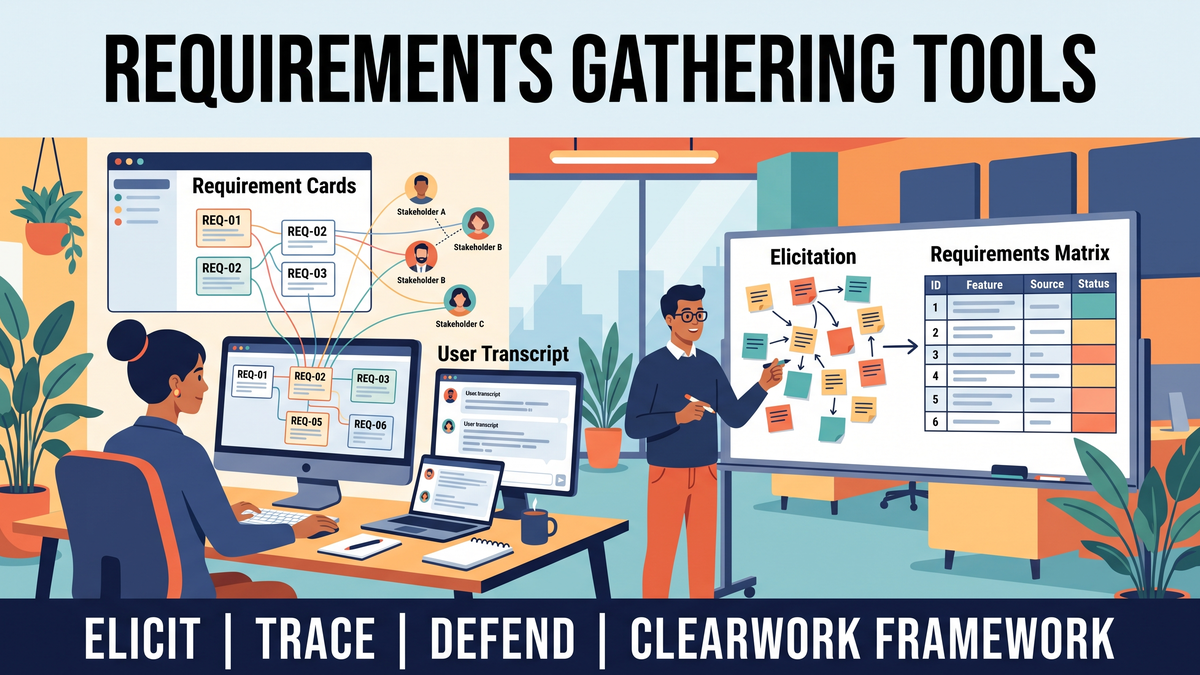
Requirements gathering tools help you elicit, document and manage what a system or process must do. They split into three jobs: capturing input from stakeholders (interviews, workshops, meetings), writing it up so people can review it, and managing requirements over time with traceability and change control. Most teams need one tool per job, not one tool for everything.
ClearWork makes one of the tools in this comparison. We've described every tool as fairly as we can from its own site and documentation; if something is out of date, tell us at [email protected].
The search for "requirements gathering software" usually starts after a painful project: a client who says "that's not what we agreed", a build team that discovers missing exceptions in testing, or a spreadsheet of requirements nobody can trace back to a decision. Our guide to process intelligence software and the evidence behind it covers where requirements come from in the first place; this page compares the tools that capture and manage them.
We judged every tool against the same six criteria, using each vendor's own product and pricing pages (opened on 12 October 2026):
We don't rank these tools. Each is the right choice for a different job, so each gets a "Best for" label.
Prices are as listed on each vendor's site on 12 October 2026 and may differ by region or at checkout.
What it is: ClearWork is an AI-led discovery platform. Its interviewer, Clarity, runs short asynchronous interviews with the people who actually do the work, then produces current-state process maps, SOPs, BRDs, requirements traceability matrices and user stories. Every step and requirement links back to who said it, and people validate it before it enters the record.
Best for: consultants and BAs running client discovery who need input from many stakeholders, including the ones who never make it to the workshop, and a requirements set they can defend when scope is challenged.
Limits: it isn't a requirements management system. It doesn't run baselines, formal change control or requirement-to-test coverage across a product's life; export to a management tool for that. It doesn't replace facilitation where a decision needs everyone in one room.
Pricing model: plans published on clearwork.io; 14-day free trial.
What it is: a requirements and engineering management platform that connects requirements, tests and reviews, with AI-assisted authoring and integrations to Jira, Azure DevOps and engineering tools.
Best for: regulated product development (medical devices, automotive, aerospace) where live traceability and audit trails matter.
Limits: it manages requirements once they exist; eliciting them from stakeholders still happens elsewhere. Heavier than most consulting discovery work needs.
Pricing model: pricing on request; Jama lists Creator, Stakeholder, Reviewer and Test Runner license types.
What it is: IBM's requirements management offering, with AI quality scoring of requirement text, relationship views, baselines and e-signatures.
Best for: large engineering and compliance-heavy programs already standardized on IBM tooling.
Limits: built for engineering requirements at scale rather than business-process discovery; setup and administration effort to match.
Pricing model: pricing on request.
What it is: requirements management built directly into Azure DevOps, with traceability matrices, baselines, document generation and an AI assistant (Copilot4DevOps).
Best for: teams whose delivery already runs in Azure DevOps and who want requirements in the same place as the work items.
Limits: tied to Azure DevOps; stakeholder elicitation still happens outside it.
Pricing model: pricing on request across its packages.
What it is: a requirements, risk and test management platform aimed at regulated industries, with ReqIF, Word and Excel import, integrations with Jira and Azure DevOps, and an AI assistant.
Best for: safety-critical and regulated programs that need requirements, risk and verification in one system.
Limits: a management platform, not an elicitation tool; more structure than a typical business-process engagement needs.
Pricing model: custom quote (perpetual or annual cloud subscription); 14-day trial.
What it is: Atlassian's workspace for pages, whiteboards and databases, linked to Jira for delivery tracking, with AI drafting built in.
Best for: teams that want requirement documents, decisions and user stories in the same ecosystem as delivery.
Limits: traceability is only as good as the links people maintain by hand; it doesn't help you get the input from stakeholders.
Pricing model: free tier; paid plans per user.
What it is: a visual workspace for workshops, process sketches, story maps and diagrams, with AI features and a large integration catalog.
Best for: facilitated requirements workshops, especially remote ones.
Limits: what's captured depends on who attends and what gets written on the board; turning sticky notes into structured, traceable requirements is a manual step.
Pricing model: free plan; Starter $8 and Business $20 per member/month billed yearly; Enterprise custom.
What it is: a meeting assistant that joins or records meetings, transcribes them and produces summaries and action items.
Best for: making sure nothing said in a stakeholder interview or workshop is lost.
Limits: a transcript isn't a requirement. Someone still has to extract, reconcile, structure and validate what was said.
Pricing model: free Basic plan; Pro from $8.33 and Business from $19.99 per user/month billed yearly; Enterprise custom.
Most engagements use more than one tool. This map shows where each one does its best work.
The techniques behind each phase (interviews, workshops, observation, document analysis) are covered in our guide to requirements elicitation techniques and tools, and the broader method in mastering requirements gathering.
The first question matters most in client work. When scope is disputed months later, a requirement you can trace to the person who said it settles the argument; our piece on evidence-linked requirements explains how that cuts change requests before build starts.
No. ClearWork is an AI-led discovery platform: it gathers requirements from the people who do the work, through asynchronous interviews, and produces BRDs, RTMs and user stories traced to who said each line. For baselines and change control through build, teams export to a requirements management or delivery tool.
Gathering (or elicitation) is getting the requirements out of stakeholders and documents. Management is keeping them controlled afterwards: versions, approvals, traceability to tests and changes. Different tools are built for each.
Yes, and many teams do for small projects. The weak points are traceability and change: it is hard to show where a requirement came from or what a change affects once the spreadsheet has been through a few versions.
No. A transcript records what was said in one meeting. Requirements gathering still needs the people who weren't in the meeting, reconciliation of conflicting accounts, and structured output someone has validated.
At minimum, each requirement should trace forward to design and test, and back to its source: the stakeholder, meeting or document it came from. The backward link is the one most RTMs leave out, and it is the one that settles scope disputes.
Run discovery on one live engagement and hand your client requirements traced to the stakeholder who said them.
ClearWork's AI agent, Clarity, interviews the people who do the work and turns it into process maps, SOPs and requirements, every line traced to source. Consultants can run the 14-day free trial on one live engagement, no card needed. See how ClearWork works for consulting teams, or book a 30-minute call to see a sample traced deliverable.
Eight requirements gathering tools compared by job: eliciting from stakeholders, documenting, tracing and change control, plus a phase-by-phase tool map.
Fourteen days, full access, no card required.
No credit card required.