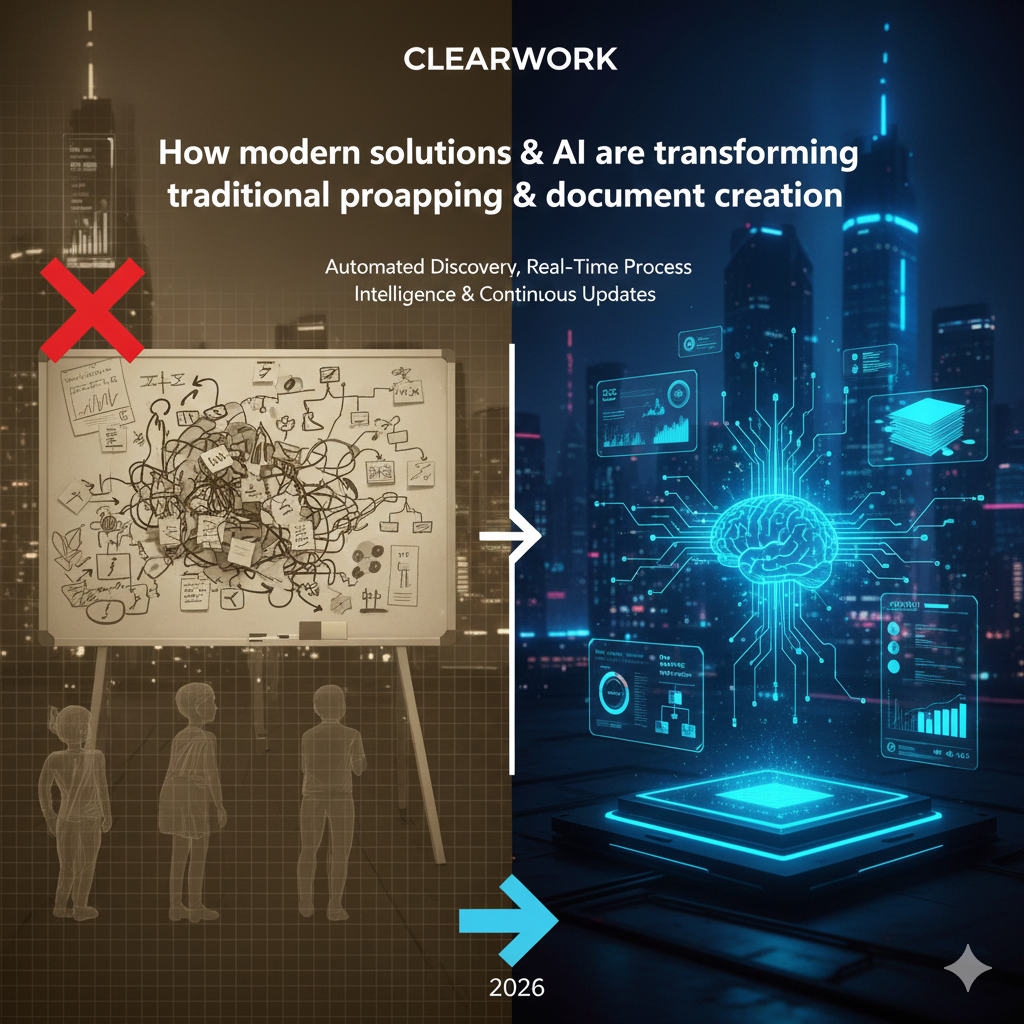
Why Traditional Process Mapping & Documentation Fail in Modern Enterprises — and How AI Is Fixing It in 2026
Avery Brooks
December 14, 2025
For decades, process mapping and documentation have been foundational to Process Excellence (PEX), continuous improvement, and enterprise transformation. But in 2026, most organizations are discovering a hard truth:
Traditional process mapping no longer works.
Not because teams aren’t trying hard enough.
Not because tools like Visio, Lucidchart, or PowerPoint are suddenly obsolete.
Not because methodologies like Lean Six Sigma or BPMN lack value.
Traditional mapping fails today because the way work happens has fundamentally changed, while the methods used to document it have not.
This article explains why manual, workshop-driven mapping consistently breaks down—and how AI, Process Intelligence, and Automated Discovery are transforming documentation into a fast, accurate, and continuously updated capability.
For broader context, see how Process Excellence itself is evolving:
👉 Modern Process Excellence: How Process Intelligence Is Reshaping Continuous Improvement in 2026
https://www.clearwork.io/blog-posts/modern-process-excellence-how-process-intelligence-is-reshaping-continuous-improvement-in-2026
And for a primer on the foundational technologies enabling the shift, read:
👉 What Is Process Intelligence? A 2026 Guide to Process Mining, Task Mining, Automated Discovery & AI
https://www.clearwork.io/blog-posts/what-is-process-intelligence-a-2026-guide-to-process-mining-task-mining-automated-discovery-ai
Enterprises today run on dozens—often hundreds—of SaaS applications. Work is fragmented across systems, browsers, digital channels, automations, and human handoffs. No single person knows the entire flow anymore.
Yet traditional process mapping still relies on:
This approach simply cannot keep pace with the reality of modern work.
Here are the seven reasons manual process mapping consistently fails, even when led by strong teams.
The first and most fundamental flaw:
Human memory is not a reliable source of truth for process design.
Most SMEs describe:
This leads to flawed or incomplete documentation.
And because processes today span multiple systems, channels, and teams, no single SME has full visibility. Traditional mapping starts with incomplete truth—and gets worse from there.
Modern processes change constantly due to:
A process map created in January can be wrong by February.
Traditional documentation methods lack continuous updates, making process maps:
In 2026, static documentation is a liability.
Large enterprises often require:
One medium-sized ERP transformation may require:
Multiply that across all business units, and organizations spend millions on mapping before improvement even begins.
When documenting manually, teams rely on:
But none of these expose:
Manual mapping is blind to reality.
This is why many organizations believe they understand a process—right up until they try to automate or transform it.
Legacy process mapping tools were built for linear workflows.
Modern processes are:
As complexity rises, diagrams become:
PEX leaders often joke that “our process maps look like subway maps—except with worse instructions.”
That’s because the format no longer matches the reality of work.
2026 is a year of massive ERP/CRM modernization:
These programs move fast.
But traditional discovery cannot keep up, causing:
Slow mapping is now a top transformation risk.
Even if a team maps one process well:
The answer: they can’t.
Manual documentation does not scale.
It fractures across SharePoint, email attachments, Confluence pages, and slide decks.
Enterprises need living process documentation, not static artifacts.
This is where Automated Discovery and Process Intelligence fundamentally change the game.
Modern platforms can now:
Policies, SOPs, emails, tickets, transcripts, screenshots, PDFs.
Revealing sequences, context, and variation.
No scheduling, no workshops, no transcription.
Including variants, decision points, and exception flows.
Requirements, stories, steps, business rules, SOPs.
Detect drift, anomalies, and compliance issues.
These capabilities eliminate the structural weaknesses of manual mapping.
Manual interviews ask people to remember processes.
Automated Discovery asks AI to observe and interpret them.
It produces:
All from authentic operational evidence—not human recollection.
This shift moves PEX teams from document creators → validation experts, dramatically increasing speed, accuracy, and output quality.
We’ve reached an inflection point:
In 2026, Process Documentation is no longer something teams create—it’s something systems generate.
PEX leaders who embrace this shift will outperform peers in:
Process Excellence becomes a data-driven discipline.
Maps and documentation are rooted in evidence, not memory.
Automation becomes more accurate and scalable.
Bots are built with real exception logic, not incomplete assumptions.
Transformations become smoother and faster.
Requirements are built from facts—not inconsistent stakeholder narratives.
Continuous improvement becomes continuous.
Documentation updates automatically as processes evolve.
ClearWork uses Automated Discovery and Process Intelligence to:
It is the modern foundation for documentation in a world too complex for manual methods.
Traditional process mapping is collapsing under the weight of modern work. AI and Process Intelligence are enabling organizations to document, understand, and improve processes in ways that were once impossible—faster, more accurately, and with continuous updates.
To understand how this fits into the broader evolution of Process Excellence, explore the foundational article:
👉 https://www.clearwork.io/blog-posts/modern-process-excellence-how-process-intelligence-is-reshaping-continuous-improvement-in-2026
If you're ready to replace outdated process documentation methods with fast, accurate, AI-generated insights, explore how ClearWork enables organizations to understand and improve their processes with unprecedented speed and clarity.
Because modern work spans dozens of systems, channels, and variations—none of which can be reliably captured through memory-based interviews or static diagrams.
Automated Discovery uses AI to ingest documents, analyze user activity, and generate process maps and documentation automatically, eliminating the need for manual workshops.
Process Intelligence unifies mining, task data, and automated discovery to provide a real-time, evidence-based view of how work actually happens across systems and teams.
Yes, but their role shifts from “explaining processes” to “validating AI-generated outputs,” reducing their workload dramatically.
Accurate, fast, continuous documentation ensures better requirements, fewer redesign cycles, clearer scope, and higher success rates for ERP, CRM, automation, and digital transformation initiatives.
Most organizations still rely on outdated, manual methods to map and document their processes, but these approaches break down in modern digital environments. AI-driven Process Intelligence and Automated Discovery eliminate these constraints by producing accurate, continuous, end-to-end process documentation without relying on SME memory or workshops. In 2026, this shift is transforming transformation readiness, automation accuracy, and enterprise-wide continuous improvement.
Fourteen days, full access, no card required.
No credit card required.