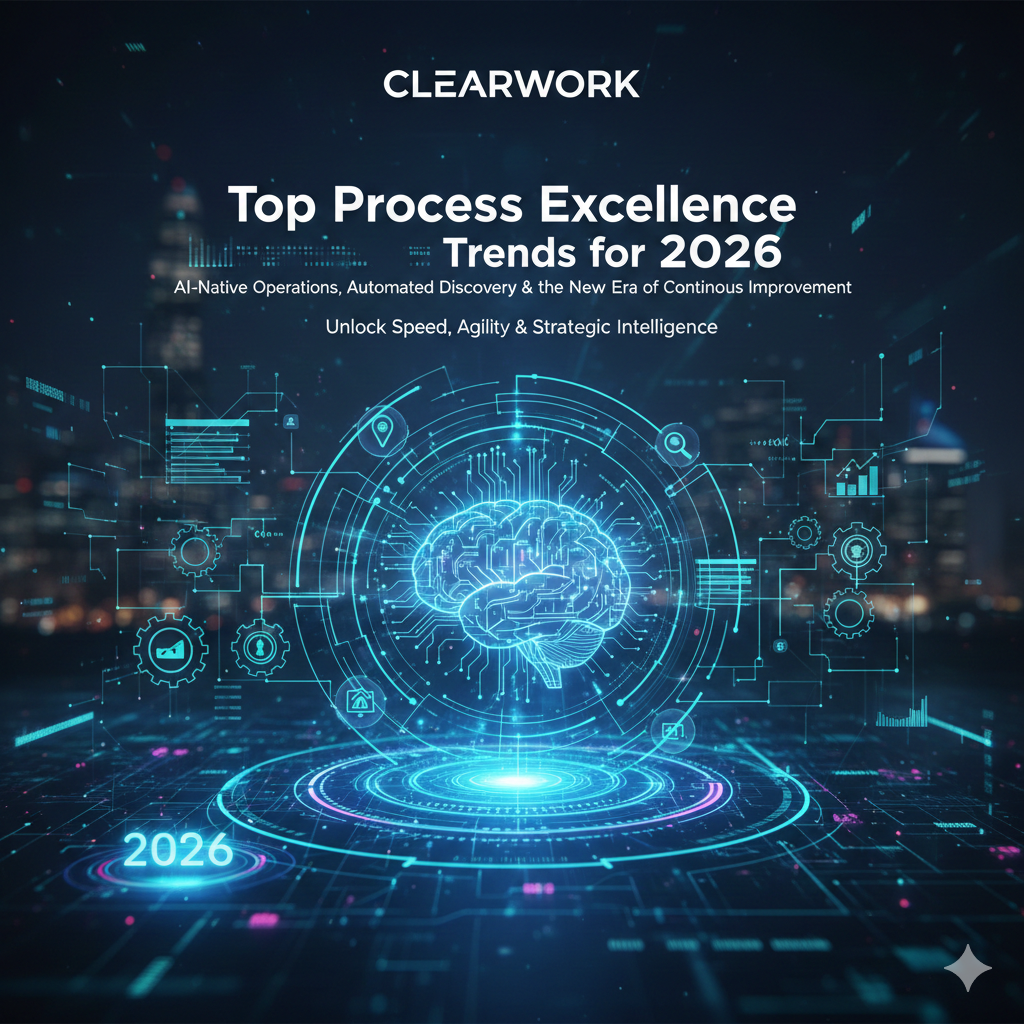
Process Excellence (PEX) has always been about driving efficiency, reducing friction, and improving the way work gets done. But in 2026, the discipline is undergoing its most significant transformation in two decades. Driven by rapid digital adoption, organizational complexity, and advances in Process Intelligence and AI, PEX is shifting from a slow, workshop-heavy discipline into a real-time, AI-native capability that touches every corner of the enterprise.
To understand the broader shift behind these changes, you can explore our feature article on how Process Intelligence is reshaping modern Process Excellence:
👉 Modern Process Excellence: How Process Intelligence Is Reshaping Continuous Improvement in 2026
https://www.clearwork.io/blog-posts/modern-process-excellence-how-process-intelligence-is-reshaping-continuous-improvement-in-2026
And for a foundational breakdown of the technologies powering this evolution, including mining, task mining, and automated discovery, see:
👉 What Is Process Intelligence? A 2026 Guide to Process Mining, Task Mining, Automated Discovery & AI
https://www.clearwork.io/blog-posts/what-is-process-intelligence-a-2026-guide-to-process-mining-task-mining-automated-discovery-ai
With that context, let’s examine the most important Process Excellence trends shaping 2026—and what they mean for organizations aiming to operate with more intelligence, agility, and speed.
For decades, discovery was a manual, interview-driven exercise requiring weeks of workshops, SME sessions, Visio diagrams, and painstaking documentation.
In 2026, this approach is quickly becoming obsolete.
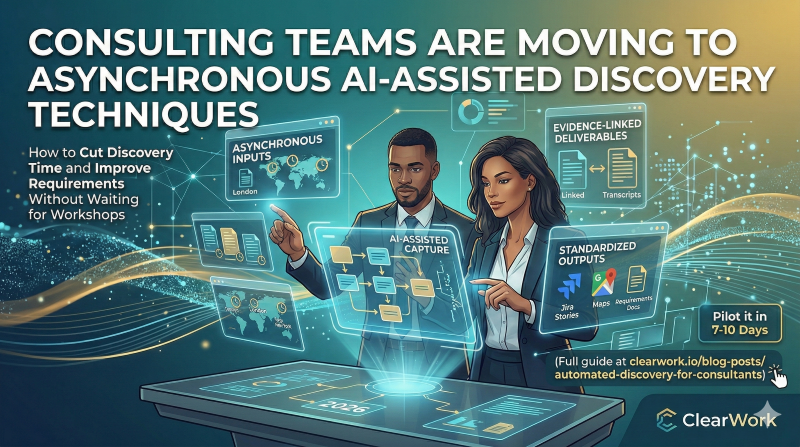
Automated Discovery—which ingests documents, unstructured content, system context, screen workflows, and automated AI interviews—now produces end-to-end process maps, requirements, SOPs, and user stories in a fraction of the time.
The shift is dramatic:
Automated Discovery has become the default starting point for transformation programs because it replaces the most time-consuming, error-prone, and variable part of the discovery process: manual interviews.
In the past, PEX teams relied heavily on workshops, stakeholder interviews, and point-in-time documentation. But work doesn’t happen in a conference room—it happens in systems, in browsers, in shared applications, and across distributed teams.
Process Intelligence (process mining + task mining + automated discovery + AI) gives organizations the ability to see:
PEX leaders are shifting from spreadsheet-based analysis to real-time, evidence-based decision-making, powered by system and user-level data.
This deep transparency helps bridge the gap between business and IT and ensures that transformation teams are finally working from the same source of truth.
AI is no longer a “nice-to-have” add-on—it is now deeply embedded inside the Process Excellence function.
In 2026, AI:
PEX teams are becoming interpreters of insights, not producers of documentation. This evolution frees analysts to focus on higher-value problem solving instead of transcription.
Traditionally, organizations revisited their processes once a year—or, in many cases, once every few years. But in 2026, processes change constantly due to:
This constant variation created a governance nightmare.
Process Intelligence now enables continuous monitoring, allowing organizations to:
PEX moves from reactive to proactively managing process health.
SAP S/4HANA migrations, Salesforce modernization, Workday expansions—2026 is packed with large platform transformations.
Historically, these projects suffered because organizations relied on SME memory and manual documentation to define the “as-is.”
Now, failure to perform accurate discovery is viewed as a top project risk.
Process Intelligence + Automated Discovery are becoming prerequisites for:
Leaders no longer gamble on assumptions. Transformations begin with real evidence.
Early RPA focused on tasks—simple, repetitive actions.
But automation at scale requires a full understanding of end-to-end processes, including:
In 2026, automation strategy depends on process-led discovery:
This combination creates a complete automation blueprint, increasing success rates and ensuring automation drives measurable ROI.
As companies globalize, they face massive variation in how teams execute the same process.
Variation is often the top driver of:
In 2026, organizations are using Process Intelligence to:
Automated Discovery accelerates global harmonization, providing clarity on why teams behave differently and what can realistically be standardized.
Subject matter experts have always been the bottleneck in discovery.
AI changes that.
Today, SMEs spend far less time explaining processes and far more time validating AI-generated outputs, including:
This dramatically reduces their workload while increasing documentation accuracy.
Historically, PEX teams were concentrated in operations, finance, and supply chain.
But in 2026, PEX is expanding into:
Why? Because complexity isn’t just operational anymore—it’s everywhere.
Process Intelligence provides the visibility needed for improvement across all these domains.
PEX is no longer a centralized function with limited reach.
Instead, modern organizations are democratizing process visibility using:
Process Excellence is now a shared responsibility across business, IT, and transformation teams.
The result:
Continuous improvement becomes everyone’s job.
In 2026, Process Excellence is:
Organizations that embrace these trends will build operational intelligence that compounds over time—unlocking speed, performance, and transformation outcomes their competitors can’t match.
ClearWork is built specifically for this new era of Process Excellence:
It is the modern foundation for transformation, automation, and continuous improvement.
The pace of business is accelerating. Systems are multiplying. Teams are distributed. Expectations are higher than ever.
Process Excellence is transforming to meet that demand—and the trends shaping 2026 reflect a discipline moving toward real-time intelligence, automated discovery, and continuous optimization.
If you're ready to modernize your Process Excellence practice and bring AI-powered discovery, real-time intelligence, and continuous improvement to your organization, explore how ClearWork helps teams operate with unmatched clarity, speed, and confidence.
Because processes now span multiple systems, geographies, and roles—making it nearly impossible for SMEs to accurately describe everything. Automated discovery captures the full picture quickly and reliably.
Process mining shows system behavior, task mining shows user behavior, but automated discovery captures context, logic, rules, exceptions, and documentation—replacing manual interviews entirely.
It provides real evidence about how work happens, which leads to better requirements, cleaner designs, less rework, and faster ERP/CRM implementations.
Because processes change weekly due to system updates, org changes, and human workarounds. Without monitoring, standardization and compliance fall apart.
Not diagramming or transcription—AI now automates those. Modern PEX teams excel in analysis, interpretation, design, governance, change management, and strategic decision-making.
Process Excellence is undergoing a major transformation as AI, automation, and Process Intelligence reshape how organizations understand and improve work. Manual discovery methods are being replaced by automated tools that generate maps, requirements, and SOPs instantly, enabling faster transformation and global standardization. In 2026, organizations that adopt these trends will operate with greater agility, accuracy, and strategic intelligence.
Enjoy our newsletter!