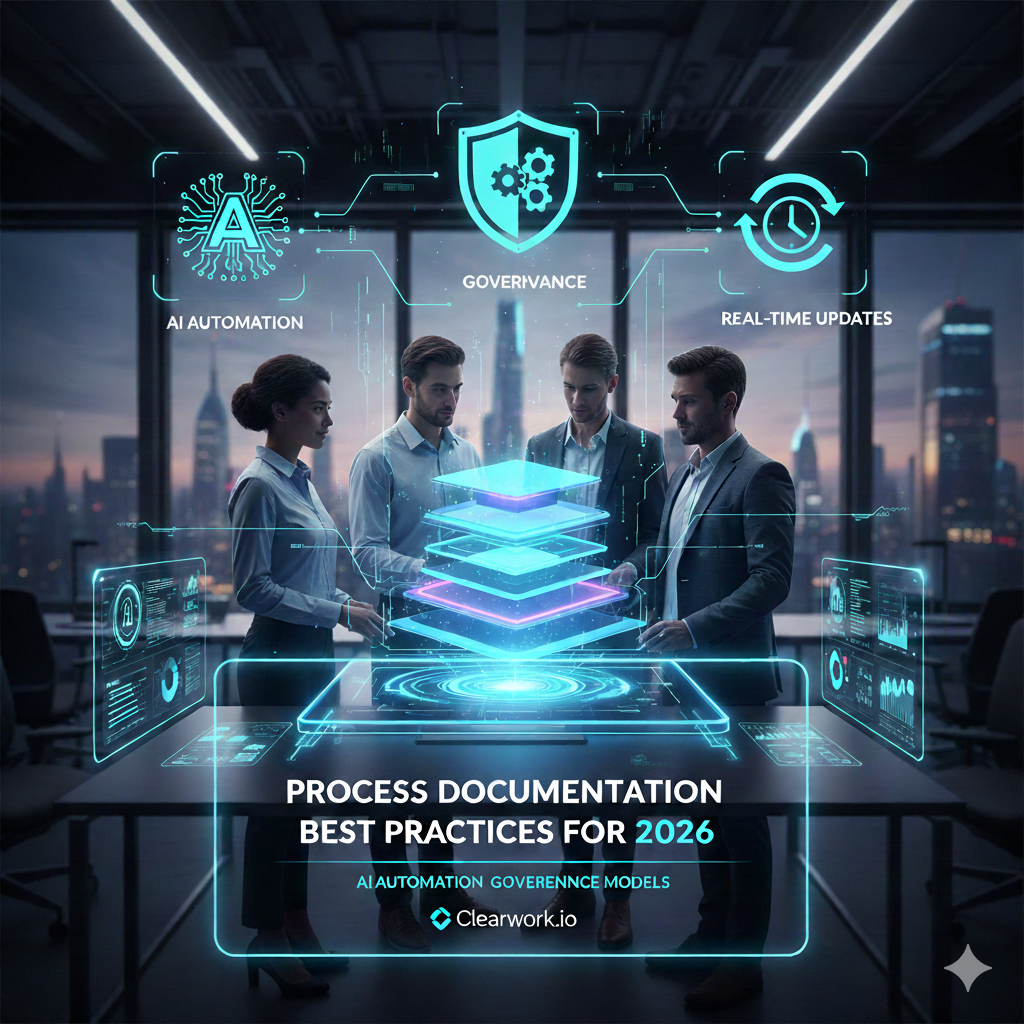
In 2026, process documentation is no longer a static deliverable that teams create once and file away. Instead, it has evolved into a dynamic, continuously updated, data-driven asset that powers transformation, supports automation, and underpins governance across the enterprise.
For organizations to keep pace with rapid change — driven by digital transformation, hybrid workflows, and AI-powered systems — traditional documentation methods simply aren’t sufficient. The old approach — sticky-note workshops, paper-based narratives, Visio swimlane diagrams — becomes outdated the moment it’s published.
To understand how the discipline of Process Excellence is evolving overall, see our foundational post on how Process Intelligence is reshaping the field. That article offers the big picture for all of the best practices discussed here:
Modern Process Excellence: How Process Intelligence Is Reshaping Continuous Improvement in 2026
https://www.clearwork.io/blog-posts/modern-process-excellence-how-process-intelligence-is-reshaping-continuous-improvement-in-2026
Before you document processes in 2026, you need to document reality — not assumptions. Let’s explore the best practices for process documentation and governance in 2026, and how AI and continuous monitoring are the new standards.
In a previous article, we explored why the old way of mapping and documenting processes breaks down under modern complexity:
Why Traditional Process Mapping & Documentation Fail in Modern Enterprises — and How AI Is Fixing It in 2026
https://www.clearwork.io/blog-posts/why-traditional-process-mapping-documentation-fail-in-modern-enterprises----and-how-ai-is-fixing-it-in-2026
That piece highlighted how static documentation becomes outdated, fails to capture real behavior, and cannot scale. In today’s world of rapid process change, documentation has to be continuous, connected, and context-aware.
In parallel, organizations must also understand the broader shifts shaping Process Excellence. Our article on the top trends driving PEX in 2026 explains how AI, automation, and real-time insights are transforming the discipline:
Top Process Excellence Trends for 2026: AI-Native Operations, Automated Discovery & the New Era of Continuous Improvement
https://www.clearwork.io/blog-posts/top-process-excellence-trends-for-2026-ai-native-operations-automated-discovery-the-new-era-of-continuous-improvement
Taken together, these insights help frame the best way to document and govern processes today.
To thrive in 2026, high-performing organizations adopt process documentation practices that are accurate, automated, continuously updated, and aligned to governance standards. Here are the principles every team should follow:
Documentation should reflect how work actually happens — not how people think it happens. In 2026, Process Intelligence technologies (including mining, task mining, and automated discovery) give teams the evidence they need to capture real processes.
Rather than a single diagram, documentation should be built in layers that serve different stakeholders:
This layered approach ensures documentation is usable and actionable, not just aesthetic.
Great documentation goes beyond boxes and arrows. It explains:
This contextual layer prevents the common problem where documentation becomes a list of steps without meaning — which often leads to failed transformation and automation efforts.
Manual interviews and workshops are slow and error-prone. They rely on memory, not data. Instead, modern teams start with Automated Discovery — an AI-driven approach that ingests documents, unstructured content, system logs, screen sequences, and user responses to build a factual foundation of process documentation.
Automated Discovery replaces weeks of manual work, producing:
This should be your starting point — not an afterthought.
Documentation without governance will decay — just like traditional process maps did. In 2026, governance models must:
Every documented process needs clear owners:
Set rules for:
For example:
Static documentation ages quickly. Modern governance includes:
This ensures that documentation remains accurate and actionable.
In 2026, documentation isn’t a download — it’s a data stream.
Living documentation is:
This requires platforms that can:
This is why organizations are moving away from static files and towards connected documentation repositories that integrate with ERP, CRM, and automation tools.
Documentation should not sit in a binder or wiki page — it should drive transformation outcomes.
When documentation is integrated into delivery workflows, teams build faster, smarter, and with far fewer surprises.
Not all stakeholders consume documentation the same way. Documentation platforms should support:
A frontline employee should be able to search “How do I handle exception X?” and get a direct answer — not a page of PDF pages.
To ensure documentation is effective, track:
📌 Coverage Percentage – How many core processes are documented?
📌 Update Frequency – How often are maps, SOPs, and rules refreshed?
📌 Accuracy Score – How closely documentation matches reality (validated via intelligence tools)?
📌 Time to Value – How fast documentation supports transformation work
📌 User Satisfaction – How stakeholders rate usability and relevance
Metrics like these elevate documentation from a compliance activity to a strategic capability.
AI is no longer a futuristic add-on — it is the foundation of how documentation gets created and sustained in 2026. AI enables:
This is the same AI that supports Automated Discovery, the core technique replacing manual interviews and document collection.
When documentation is accurate, governed, and continuously updated, teams see:
✅ Fewer rework cycles in transformation
✅ Faster automation delivery
✅ Higher compliance and audit readiness
✅ Reduced operational risk
✅ Better cross-team alignment
✅ Increased process maturity
Documentation stops being a hurdle and becomes a strategic asset.
Process documentation in 2026 is nothing like the static charts of the past. It must be:
Lean documentation practices aren’t enough. Modern teams need living, data-driven documentation that supports compliance, efficiency, transformation, and continuous improvement.
To understand how these practices fit into the broader evolution of Process Excellence, explore the pillar article on modern Process Excellence and Process Intelligence:
👉 Modern Process Excellence: How Process Intelligence Is Reshaping Continuous Improvement in 2026
https://www.clearwork.io/blog-posts/modern-process-excellence-how-process-intelligence-is-reshaping-continuous-improvement-in-2026
Because manual interviews, workshops, and static diagrams cannot keep pace with constant system changes, complex workflows, and the rapid evolution of modern enterprises. Documentation created manually becomes inaccurate almost immediately, creating risk for transformation and governance.
Automated Discovery replaces weeks of manual interviews by ingesting documents, analyzing user behavior, and generating accurate process maps, SOPs, requirements, and user stories — making it the most reliable foundation for 2026 documentation practices.
AI extracts rules, decisions, exceptions, and contextual logic; updates documentation instantly when processes change; and provides insights into variations and compliance risks — transforming documentation from static text into living intelligence.
Governance now includes defined ownership, standardized templates, automated update workflows, version control, and real-time monitoring for drift and exceptions. It ensures documentation stays aligned with reality and supports consistent execution across the enterprise.
With accurate, continuously updated documentation, transformation teams reduce rework, avoid gaps in requirements, design systems correctly the first time, and build more resilient automations. Documentation becomes a catalyst for faster, more predictable delivery.
Traditional documentation methods fail because they cannot keep up with the speed, complexity, and constant change of modern digital operations. In 2026, organizations rely on Automated Discovery, AI-generated documentation, and real-time governance models to ensure processes remain accurate, accessible, and continuously updated. This shift elevates documentation from a static deliverable to a strategic, always-current asset that fuels transformation, automation, and continuous improvement.
Enjoy our newsletter!