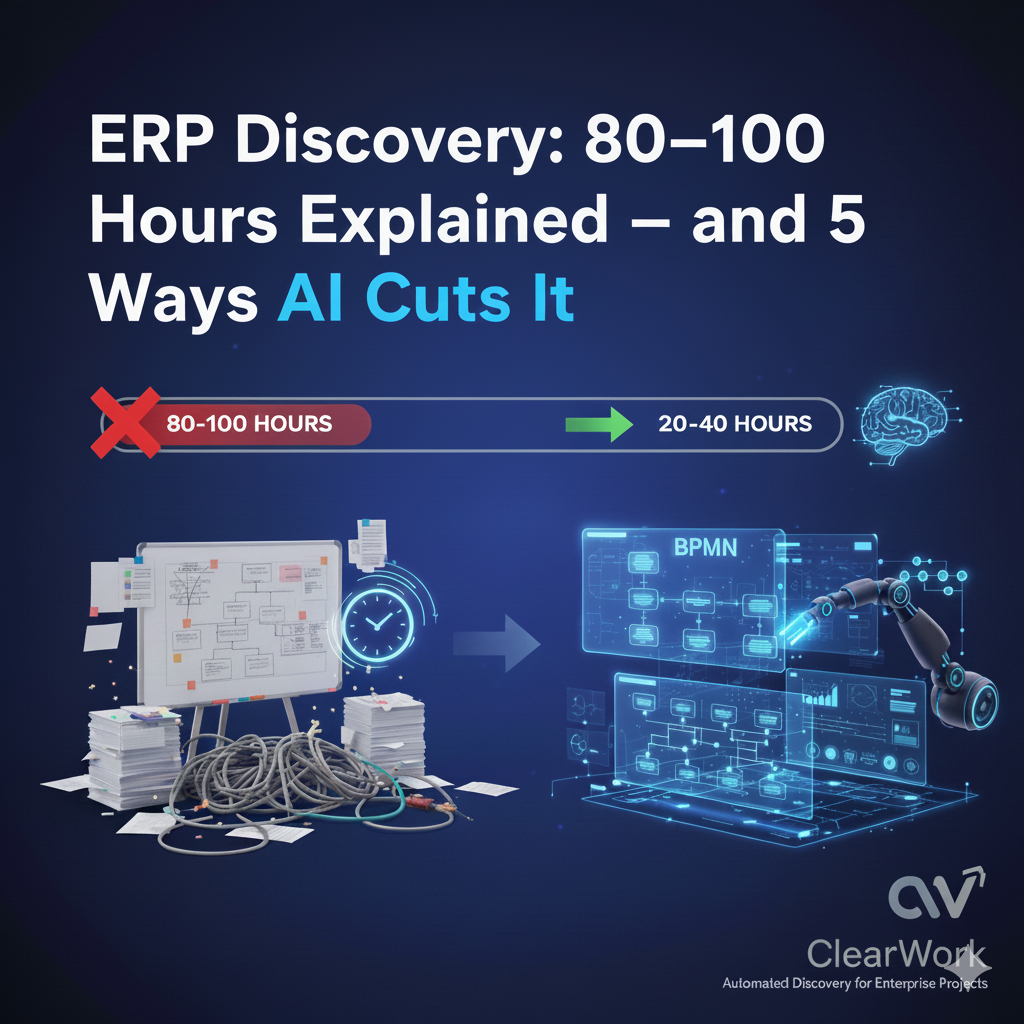

Oracle ERP transformations don’t fail because teams can’t configure the software.
They fail because teams underestimate how work actually happens—especially across shared services, approvals, exceptions, and the “in-between” steps that never show up cleanly in system reports.
In Oracle programs (whether you’re moving from Oracle E-Business Suite (EBS) to Oracle Fusion Cloud ERP, rolling out new modules, or standardizing global processes), the real process usually includes:
That’s why process excellence and transformation leaders are investing in process discovery tools earlier in the Oracle ERP lifecycle. In 2026, the best Oracle programs follow a simple rule:
If discovery doesn’t capture the real current state—including variants and exceptions—you’ll pay for it later in rework, change requests, UAT surprises, and delayed go-live.
If you want the broader overview across categories and vendors, this article is part of a spoke series linked to the main pillar post here: https://www.clearwork.io/blog-posts/best-process-discovery-tools-for-2026-automated-discovery-process-mining-and-task-mining-compared
Oracle transformations create complexity in a few predictable ways:
Even with Fusion Cloud ERP, real execution often spans:
Workshops document the “intended” flow. Delivery gets hit with the “real” flow.
Oracle ERP processes are full of exceptions:
If exceptions aren’t captured early, they become change requests late.
With quarterly updates and evolving operating models, Oracle ERP programs need living process documentation, not a one-time design artifact that goes stale after sign-off.
“Process discovery tools” is a broad label. For Oracle transformations, there are three approaches—and each serves a different purpose.
Process mining uses system event data to reconstruct process flows and quantify performance:
Best for: processes where the majority of work is represented in Oracle transactions and event trails.
Watch-out: system truth often misses what happens between systems—manual checks, approvals outside the system, “workarounds,” and tribal rules.
Task mining captures how people execute work in the real world—often the steps surrounding Oracle ERP:
Best for: shared services and operational teams where manual work and context switching drive cycle time and defects.
Watch-out: task data can be hard to translate into clean project deliverables unless you structure it intentionally.
Automated Process Discovery is the use of AI to bring tribal knowledge out of people’s heads and convert it into structured documentation and project-ready deliverables—powering the planning and discovery phases of a transformation.
In Oracle ERP terms, that means:
If your biggest risk is scope creep, missed requirements, or “we didn’t realize that workflow existed,” Automated Process Discovery becomes your foundation.
Oracle programs increasingly blend:
Because no single source contains the full reality.
Teams want usable outputs in days or weeks—not months of integration work before insights appear.
Process discovery is moving upstream to:
Many Oracle programs are measured not just by go-live, but by whether controls and compliance requirements are implemented cleanly—and proven.
When organizations talk about automation and agents, they need structured process truth—not just “a diagram.” The output must be usable for delivery.
Here’s the fastest way to build a shortlist:
The right combination depends on whether your goal is:
Use these criteria to prevent “vendor debates” without a decision structure.
Can the tool reasonably connect to your Oracle environment and produce usable event-level process signals?
Does it capture:
Can it surface:
Look for more than “insights.” The best tools produce:
Oracle programs require alignment across Finance, Procurement, IT, and often external stakeholders.
If your delivery happens in Jira/ADO and your testing happens elsewhere, you need a clean path from discovery to delivery artifacts.
How quickly can you generate usable truth that helps decisions this month, not next quarter?
The highest-performing Oracle programs don’t rely on a single method. They build a stack.
This is where process mining and analytics help:
This is where task capture and scaled stakeholder input matter:
This is where transformations gain speed and reduce churn:
Most transformations struggle in Layers 2 and 3. That’s where timelines slip.
Below is a practical view of common tools and how they fit Oracle ERP programs.
What it is: AI-driven discovery designed to pull tribal knowledge out of people’s heads and convert it into structured documentation and project-ready deliverables—powering the planning and discovery phases of Oracle transformations.
Best for: process excellence and transformation teams that need:
Strengths:
Trade-offs:
When to choose it: when your biggest risk is missed requirements, unclear scope, and late discovery of exceptions.
What it is: Enterprise process mining platform used for deep quantitative analysis across ERP/CRM environments.
Best for: organizations with mature data access who want:
Strengths: strong process analytics and performance measurement where event data is accessible.
Trade-offs: time-to-value depends on integration and governance; may not capture human work and workaround logic without complementary methods.
When to choose it: when the process is heavily system-driven and you need enterprise-grade quantitative insight.
What it is: Discovery aligned to an automation ecosystem.
Best for: teams with an automation-first strategy who want a path from discovery to automation execution.
Strengths: practical when the goal is automation throughput and speed-to-automation.
Trade-offs: can bias toward automation candidates vs full transformation planning; still needs human truth capture.
When to choose it: when your primary KPI is automation delivery and you want discovery integrated into that operating model.
What it is: Commonly used for governance-driven process visibility and standardization—often even in mixed ERP environments.
Best for: organizations prioritizing process ownership, governance, and standardization.
Strengths: process repository-style governance and alignment.
Trade-offs: still requires complementary discovery to capture work outside the system and translate into delivery artifacts.
When to choose it: when governance and standard process ownership are key program goals.
What it is: Desktop/human work visibility for manual steps, workarounds, and exception handling.
Best for: shared services, finance operations, procurement operations—where the real work includes spreadsheets, reconciliations, and approvals outside Oracle.
Strengths: surfaces the invisible work that drives delays and rework.
Trade-offs: needs structure to convert task-level insight into end-to-end deliverables.
When to choose it: when the biggest unknown is “what people actually do” around Oracle workflows.
Some teams prefer approaches that emphasize flexibility and internal control over modeling, analysis, and deployment.
Best for: organizations with internal maturity that want to tailor the approach.
Trade-offs: success depends more heavily on internal expertise and operating model discipline.
Use this decision tree to align stakeholders quickly.
Start mining-first when:
Bring in human truth when:
Start with Automated Process Discovery when:
In practice, the strongest Oracle programs combine methods:
If you want to avoid a heavy platform rollout before proving value, run a pilot on one process.
High-impact Oracle processes include:
Define:
Produce:
It depends on your goal: mining for quantitative system truth, task capture for manual work, or automated discovery when you need planning and delivery outputs that reduce rework.
If you need quantitative performance insight and you have strong data access, process mining can be valuable. Many teams still need human truth capture to see approvals, workarounds, and exception handling outside the system.
You need a human truth layer—task capture and structured stakeholder input—because those steps rarely show up cleanly in system-driven analysis.
Earlier than most teams expect. Discovery is most valuable before design and build lock in assumptions—because that’s when rework becomes expensive.
In 2026, the fastest Oracle ERP transformations aren’t the ones with the most workshops.
They’re the ones that can quickly answer:
If you want a discovery approach that brings tribal knowledge out of people’s heads and turns it into structured deliverables that power transformation planning, explore ClearWork Automated Process Discovery:
https://www.clearwork.io/clearwork-automated-discovery
And for the full landscape of tools and categories, see the pillar post here:
https://www.clearwork.io/blog-posts/best-process-discovery-tools-for-2026-automated-discovery-process-mining-and-task-mining-compared

They succeed or fail due to the processes and the people. Learn how ClearWork Automated Process Discovery can help you map out your processes and trace requirements before you kick off your project.
Enjoy our newsletter!