The OpEx Mindset: From One-Time Project to Continuous System
Avery Brooks
May 22, 2026
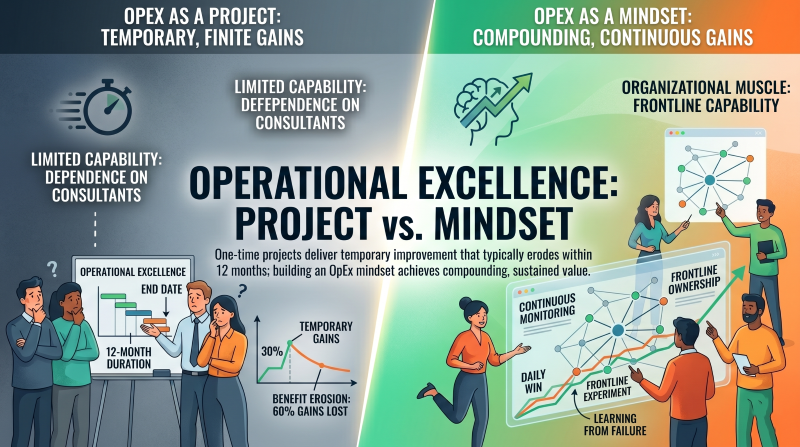
A company runs a Lean transformation. They eliminate waste, streamline workflows, reduce handoffs. For three months, metrics improve dramatically. Cycle time drops 30%. Defect rates fall. Throughput increases. The project is declared a success. The improvement team moves on to the next initiative.
Six months later, cycle time has crept back up 15%. The defect rate has drifted. The improvements are still there, but they’re fading. A year later, someone looks back and realizes that 60% of the gains have evaporated. The organization got temporary improvement, not lasting change.
This is what happens when organizations treat operational excellence as a project rather than a mindset. A project has a start date and an end date. It has a scope and a budget. It has a team and a timeline. When the project ends, improvement ends. And when improvement ends, performance drifts back to where it started. This is a specific example of the broader challenge described in “The Transformation Knowledge Gap” - when knowledge and improvement don’t flow continuously, transformation fails.
Operational excellence isn’t a project. It’s a way of thinking about work - how you pay attention, how you identify friction, how you question why things are done the way they are, how you take pride in doing work properly. When that mindset is embedded in the culture, improvement becomes continuous, not episodic. And continuous improvement delivers compounding value that one-time projects never reach.
The difference between a transformation that sticks and one that fades is the difference between treating operational excellence as a project and treating it as a mindset.
Traditional transformations follow a predictable pattern. An organization identifies a problem: “Our order-to-cash cycle is too slow.” They assemble a team. They conduct discovery, design a future state, and implement improvements. The project runs for 12-18 months. Metrics improve. The project ends. The team disperses. And within a year, improvement has plateaued or reversed.
A project is finite. It has a start date and an end date. When the project ends, the resource commitment ends. The external consultant leaves. The internal team moves to the next initiative. The daily attention to improvement stops. And when attention stops, momentum stops. Without active maintenance, performance drifts back to previous patterns.
Work isn’t static. New employees hire in. Systems change. Business conditions evolve. New problems emerge. A process that was optimized for last year’s business context might not be optimal for this year’s. A project-based approach assumes that once you improve something, it stays improved. Reality doesn’t work that way. Continuous drift is the normal state of complex systems. Managing it requires continuous attention, not one-time optimization.
An improvement to process A might create a new bottleneck in process B that wasn’t visible before. An optimization in one region might not work in another region with different operational constraints. A change that works for large customers might break for small customers. A project-based approach designs within scope and assumes that staying within scope prevents unintended consequences. But complex systems have interdependencies that scope boundaries don’t respect. Managing them requires continuous monitoring, not one-time design.
When a Lean transformation is executed by an external consultant, the organization gets the improvement but not the capability. The consultant leaves. The internal team hasn’t developed the skills to maintain improvement or identify new improvement opportunities. The organization can’t improve on its own. It’s dependent on hiring the consultant again.
Organizations that embed operational excellence as a mindset build muscle. They develop the capability to identify improvement opportunities, design solutions, and implement changes. Over time, frontline teams become expert at spotting inefficiencies and solving them without waiting for a formal project.
A transformation is something that happens to people. Management decides there’s a problem and a solution. Teams are expected to adopt the new way. Some people welcome it. Others resist. Resistance is framed as an impediment to be overcome. When the project ends, the energy that was used to overcome resistance dissipates. Without active change leadership, teams gradually drift back to familiar patterns.
When operational excellence is a mindset, improvement comes from within. It’s not something that’s imposed on people; it’s something they discover themselves. They see an inefficiency, they understand why it matters, and they fix it. Improvement is intrinsically motivated, not externally mandated. And intrinsic motivation is far stickier than compliance to a top-down mandate.
Organizations that sustain improvement don’t have special tools or methods. They have a way of thinking about work that makes continuous improvement the normal way of operating.
Frontline Ownership of Improvement: The people doing the work are the primary improvers. They notice friction first. They understand the constraints. They know where things break. In an OpEx mindset culture, frontline employees are expected to raise improvement opportunities, not wait for management to identify problems.
Continuous Attention to Waste and Friction: Waste and friction aren’t anomalies to be fixed in a project; they’re the normal state of any work system. The question isn’t “Should we eliminate waste?” The question is “What waste are we tolerating right now, and why?”
Structured Learning From Failure: When something breaks, an OpEx mindset treats it as a learning opportunity, not a failure to hide. What happened? Why did it happen? What did we learn? What will we do differently?
Measurement as a Diagnostic Tool: In a project-based approach, measurement proves that the improvement worked. In an OpEx mindset, measurement is a diagnostic tool. It tells you where the system is struggling.
Psychological Safety to Experiment: An OpEx mindset requires that people are safe to propose improvements and safe to try things that might not work. If every improvement experiment requires formal approval, people stop suggesting ideas.
Leadership That Models Curiosity: Leaders who ask “Why are we doing it this way?” and “Is there a better approach?” send a signal that questioning and improvement are valued.
Moving from a project-based transformation approach to an OpEx mindset requires deliberate change. It’s a cultural shift that takes 18-36 months to embed.
The leadership team must align on what OpEx means in your organizational context. What does improvement look like? What level of authority do frontline employees have to make improvements? How will we measure whether we’re building an OpEx culture? The leadership team needs to understand that the shift from projects to mindset means reduced control and increased empowerment.
Run Lean or continuous improvement training. Frame it as building capability that will live in the organization, not executing a one-time improvement. Train frontline teams on how to identify waste, how to run small experiments, how to learn from failures. Train supervisors on how to coach improvement, not how to enforce compliance.
Build the structures that enable continuous improvement. Daily huddles where teams raise issues and discuss them. Weekly forums where improvement ideas are reviewed and prioritized. Monthly measurement reviews to diagnose system behavior. Quarterly cross-functional forums to identify interdependencies and coordinate improvements.
The improvement structures are running. Management focuses on making them work. Are people actually raising improvement ideas? Are improvements actually being implemented? Is measurement being used to diagnose system behavior? Use the feedback to refine the structures.
Start Small - Building Frontline Ownership: Don’t try to transform the entire organization overnight. Pick a department or a value stream. Get the structures working. Let the culture change embed. Once it’s working in one area, expand to the next. Frontline ownership starts with choice, not mandate.
Make Leadership Visible - Operational Excellence as Leadership Practice: When a leader spends time on the floor, observes work, asks questions, and visibly acts on feedback, it signals that continuous improvement matters. Leadership visibility is how you build improvement culture from the top.
Celebrate Small Wins - Building Sustained Momentum: Operational excellence is driven by small, continuous wins. A team reduces a processing step. Celebrate it. A team solves a recurring problem. Recognize it. Each win builds the culture further.
Connect Improvement to Purpose: If people understand why improvement matters - if they see how efficiency gains allow the company to reinvest in better service - they’ll improve with more commitment to sustained success.
A project-based transformation costs money and produces improvement. Let’s say it costs $300,000 and produces $500,000 in annual benefit. The ROI in year one is 1.7x. But the benefit is one-time.
Building an OpEx mindset takes longer and requires ongoing investment. Year one costs $200,000 and produces $200,000 in benefit. Year two costs $150,000 and produces $400,000 in benefit. By year three, the cost plateaus at $100,000 and benefit is $600,000. By year five, the organization is producing $800,000 annually in benefit from a compounding system of improvement.
Over five years: Project-based approaches deliver roughly $700,000 total benefit. OpEx mindset delivers roughly $2,800,000 total benefit. The break-even point is around year 2.5. After that, the OpEx approach has produced more than double the value.
Building an OpEx mindset requires that frontline employees consistently identify improvement opportunities and that leaders understand the operational reality where improvement is needed. But frontline employees often lack visibility into how their work connects to organizational goals, and leaders often lack visibility into the specific friction points that block frontline efficiency.
ClearWork serves as the operational intelligence layer that enables OpEx mindset to flourish. Through continuous AI-driven interviews, ClearWork surfaces the specific inefficiencies, constraints, and friction points that frontline staff encounter. Rather than relying on improvement projects that happen periodically, ClearWork provides ongoing visibility into where work is breaking down and where improvement opportunities exist.
The platform identifies which inefficiencies matter most (by frequency, impact, and cost), what constraints are causing them, and what frontline staff already know about fixing them. This intelligence becomes the foundation for continuous improvement. Leaders can prioritize improvement initiatives based on actual operational impact. Frontline teams can see that their concerns are being heard and acted on. And the organization can shift from “improvement as projects” to “improvement as how we operate.”
A: Research suggests 18-36 months to truly embed OpEx thinking in an organization’s culture. The timeline depends on starting organizational culture and leadership commitment. Organizations with supportive leadership and a smaller scale (department-level starting point) can accelerate this. Organizations with entrenched project-based thinking or large scale take longer. Think of it as changing how people think about work, not implementing a new process.
A: OpEx mindset can’t succeed without leadership modeling curiosity and supporting frontline autonomy. If leadership views improvement as something to control and approve, rather than something to enable, the culture won’t shift. The organization will continue running improvement projects rather than embedding improvement as a way of operating. Leadership alignment in Phase 1 is critical - without it, don’t proceed.
A: No. You work with existing teams. What changes is how you deploy them and what authority you grant them. Instead of moving people to the next improvement project, you develop their improvement skills where they are. Instead of centralizing improvement decisions, you push decision authority to frontline teams. The people are the same; the structures and leadership approach change.
A: That’s the point of psychological safety. Failure is learning. An improvement experiment that fails teaches what doesn’t work and why. In an OpEx mindset, failure is expected and analyzed, not punished. The question isn’t “why did it fail?” as an accusation. The question is “what did we learn?” and “what will we do differently?” If people are afraid of failing, they won’t experiment. If they won’t experiment, you won’t get continuous improvement.
A: OpEx mindset actually helps during high-pressure periods because continuous improvement has already reduced inefficiencies and built organizational muscle. But OpEx also requires sustained attention, and high business pressure can erode it if leadership deprioritizes improvement. The answer is to make improvement part of normal work allocation, not something that happens when there’s free time. When 5-10% of team capacity is allocated to continuous improvement as normal operating procedure, it survives business pressure.
One-time transformation projects deliver temporary improvement that typically erodes within 12 months because they fail to account for continuous drift, interdependencies, and the fact that operational excellence requires sustained daily attention. Organizations that build an OpEx mindset - where frontline employees are empowered to identify improvements, leaders model curiosity, and improvement structures are embedded in normal work - achieve compounding improvement that grows year after year. The break-even point between project-based and OpEx approaches is around year 2.5; by year five, OpEx approaches deliver four times the sustained value.