Process Discovery Software Comparison 2026: How to Choose the Right Platform for Digital Transformation
Avery Brooks
January 9, 2026
Most digital transformation initiatives don't fail because of bad technology. They fail because organizations start building on an inaccurate picture of how work actually happens.
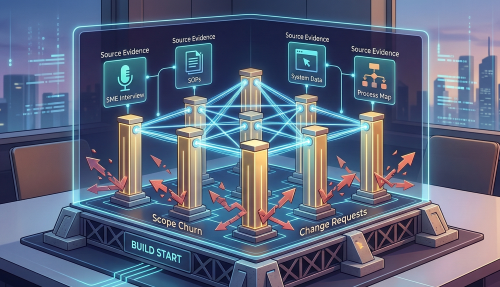
Manual workshops, stakeholder interviews, and consultant-led mapping sessions have been the default approach for decades. The problem: they're slow, expensive, and subjective. By the time documentation is complete, the process it describes has already drifted. And the exceptions, workarounds, and undocumented handoffs that cause the most rework? They rarely surface in a conference room.
The shift to AI-guided process discovery — platforms that automatically map, analyze, and structure how work actually runs — is changing the economics of transformation programs entirely.
This guide compares the leading process discovery software platforms for 2026: ClearWork, Celonis, UiPath, Skan, SAP Signavio, and Microsoft Power Automate Process Mining. It's designed to help transformation leaders, implementation PMs, and operations teams choose the right tool for their actual requirements — not the vendor with the largest marketing budget.
Looking for the deeper dive? Read our pillar post: Automated Process Discovery: The Missing Link in the Modern Project Management Stack
Process discovery software automatically captures how work flows through an organization — who does what, in what sequence, across which systems, with what variations — and turns that operational data into structured process maps, requirements, and improvement opportunities.
It replaces (or dramatically compresses) the traditional discovery phase: the workshops, the interviews, the weeks of synthesis, and the documentation that's already outdated by the time it gets signed off.
In 2026, the stakes are higher than they've ever been. Three forces are driving urgency:
1. AI agent deployments are exposing gaps in process knowledge. Organizations are discovering that AI agents fail not because of poor models, but because they lack accurate context about how work actually runs — the exceptions, the handoffs, the decision logic that lives in people's heads. Process discovery is becoming foundational infrastructure for AI readiness.
2. Transformation timelines have compressed. Boards and executives are no longer patient with six-month discovery phases. The expectation is operational clarity in weeks. Manual methods can't hit that bar.
3. The cost of wrong requirements is better understood. Industry data consistently shows that requirements errors account for 70–85% of rework costs, and late-stage fixes cost up to 100x more than early corrections. Getting discovery right has a direct ROI that's no longer hard to quantify.
Before comparing specific tools, it helps to understand the three primary approaches — because they answer very different questions.
Reconstructs process flows by analyzing event logs from enterprise systems (SAP, Salesforce, ServiceNow, Oracle). Excellent for transactional processes that run through structured systems. Misses anything that happens between system touchpoints — the emails, the spreadsheets, the judgment calls, the workarounds.
Best for: Organizations with mature ERP infrastructure and structured transactional workflows. Main platforms: Celonis, SAP Signavio, Microsoft Power Automate Process Mining.
Observes how employees interact with applications at the desktop level — clicks, keystrokes, application switching, time-in-step. Surfaces repetitive manual work and automation candidates. Strong for front-office and shared services visibility, but limited depth on the why behind behaviors.
Best for: Organizations identifying RPA opportunities and front-office inefficiencies. Main platforms: UiPath Task Mining, Skan.
Combines AI-led async discovery (text, voice, document analysis) with structured process capture to automatically generate process maps, requirements, and structured transformation artifacts — without requiring system log access or desktop agents. Produces the narrative and contextual layer that system logs and task mining miss. Designed for teams that need discovery to result in deliverables, not just dashboards.
Best for: Transformation programs, implementation teams, AI readiness initiatives, and organizations where work is distributed, knowledge-intensive, or cross-functional. Main platforms: ClearWork.
Overview
ClearWork takes a fundamentally different approach to process discovery than system-log-based platforms. Rather than requiring IT integration or desktop agents, ClearWork captures how work happens through AI-guided async discovery — pulling in input from end users via text, voice, and document uploads, then automatically structuring that input into process maps, requirements, user stories, and gap analyses.
The positioning is deliberate: ClearWork is built for the transformation team, not the data engineering team. It's designed to produce the structured deliverables that implementation programs actually need — not just visual dashboards.
How It Works
ClearWork's Automated Discovery replaces traditional workshops with AI-guided async interviews. Stakeholders contribute via their preferred format — written responses, voice recordings, or uploaded SOPs and documentation. ClearWork's AI synthesizes these inputs, identifies gaps, surfaces contradictions, and generates structured outputs automatically.
The result isn't a process diagram that lives in a slide deck. It's a working set of process artifacts — maps, requirements, user stories, and gap analysis — that feeds directly into project delivery. Outputs can be exported or pushed to Jira and other PM tools.
For organizations preparing for AI agent deployments, ClearWork's structured discovery outputs serve as the grounding layer that agents need to operate reliably: real exception logic, real handoff patterns, real decision context — not assumptions.
Key Strengths
Trade-offs
When to Choose ClearWork
When your transformation, implementation, or AI initiative depends on getting accurate, structured process knowledge before you build — and you can't afford to discover requirements gaps in sprint 3.
→ Learn more about ClearWork Automated Discovery
Overview
Celonis is the established leader in system-level process mining. It reconstructs business processes by extracting and analyzing event log data from enterprise systems — SAP, Oracle, Salesforce, ServiceNow — and surfaces conformance gaps, bottlenecks, and variants in transactional workflows.
Strengths
Trade-offs
When to Choose Celonis
When you're a large enterprise with mature SAP or ERP infrastructure, a dedicated analytics team, and a specific need for system-level process conformance and variant analysis.
Overview
UiPath combines system-level process mining, desktop task mining, and RPA execution in one platform. Its process discovery tools are primarily designed to identify automation candidates and feed them into the bot development pipeline.
The 2025/2026 addition of Autopilot — conversational AI querying of process data — has lowered the barrier for business users to extract insights without requiring analyst involvement.
Strengths
Trade-offs
When to Choose UiPath
When your organization is already invested in UiPath's RPA platform and wants process discovery tightly coupled to automation execution.
Overview
Skan focuses on real-time task capture from human work — observing how employees interact with applications via lightweight desktop agents, without requiring system log access.
Strengths
Trade-offs
When to Choose Skan
When your primary goal is rapid visibility into how front-office teams spend their time, with a focus on identifying repetitive manual tasks for automation.
Overview
SAP Signavio combines process mining, modeling, and governance in a platform tightly integrated with the SAP ecosystem. Particularly strong for organizations managing large SAP S/4HANA transformations who need a governed process repository alongside mining capabilities.
Strengths
Trade-offs
When to Choose SAP Signavio
When you're running an SAP-centric transformation and need process mining, modeling, and governance in one governed platform.
Overview
Microsoft's process mining capability is integrated directly into Power Platform, making it accessible to organizations already using Power Automate, Power BI, and Microsoft 365 without a separate platform investment.
Strengths
Trade-offs
When to Choose Power Automate Process Mining
When you're Microsoft-native, already using Power Automate, and want process mining insights without a separate vendor relationship.
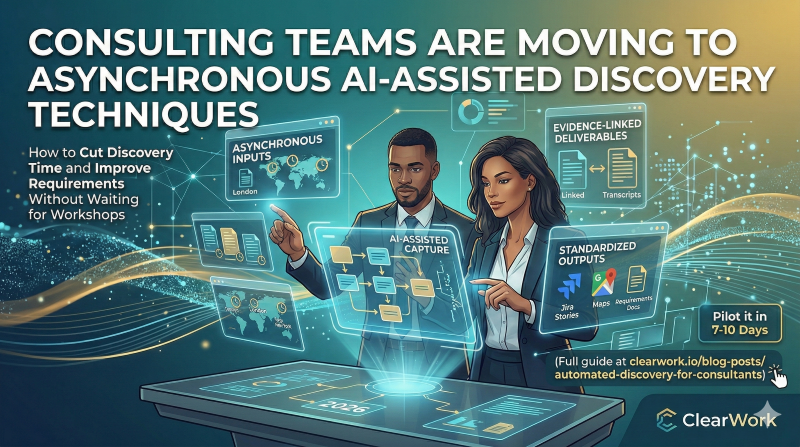
The five-day consultant workshop is being replaced by AI-guided async discovery that captures stakeholder input continuously, surfaces contradictions automatically, and produces structured outputs without manual synthesis. The teams moving fastest are the ones that have eliminated the bottleneck of human facilitation.
Autonomous AI agents need operational context to function reliably. Process discovery platforms that produce machine-readable process maps, exception logic, and handoff data are becoming the grounding layer for agentic AI deployments. This is changing the buyer profile — AI strategy teams are now as relevant a buyer as operations and IT.
Early process mining implementations often produced analytics dashboards that sat unused after the initial engagement. The market is shifting toward platforms that produce actionable deliverables — requirements, user stories, structured gap analyses — that feed directly into project execution. The value isn't the visual; it's what the team can build from it.
With transformation programs under pressure to compress timelines, discovery that takes months is a liability. Platforms that deliver structured current-state understanding in days — rather than requiring months of IT integration — are winning mandates from implementation teams under deadline pressure.
The tools that combine quantitative activity signals with qualitative human narrative are consistently producing more accurate and actionable process understanding than tools relying on either approach alone. The "interview vs. log" debate is being resolved by platforms that do both.
Use this framework to shortcut the evaluation:
Start with your primary output requirement:
Then ask these questions before committing:
Week 1: Define your discovery goal. Is this a transformation program, an automation initiative, an AI readiness assessment, or an operational improvement effort? The goal determines the right platform type before you look at any demos.
Week 2: Run a proof of concept on one process. Any serious platform should be able to deliver first outputs within days. If a vendor requires 6–8 weeks of integration before you see anything, factor that into your decision.
Week 3: Evaluate the outputs against your actual downstream needs. Will what this tool produces feed your project delivery process? Or will someone need to manually translate dashboards into requirements?
Week 4: Assess total cost of ownership — not just license cost. Integration, implementation services, and the ongoing cost of keeping discovery current are often larger than the software line item.
What's the difference between process mining and automated process discovery?
Process mining analyzes event log data from enterprise systems to reconstruct process flows. Automated process discovery is a broader term that includes process mining but also encompasses AI-guided discovery, task mining, document analysis, and human narrative capture. The key distinction: process mining sees what systems record; automated discovery can also capture what happens between system transactions — the human work that drives most transformation risk.
Which process discovery tool is best for digital transformation programs?
For transformation programs specifically — where the primary output is requirements, user stories, and structured current-state documentation — AI-guided platforms like ClearWork tend to deliver faster and more actionable results than system-log-based mining tools. Mining tools excel at operational analytics; transformation programs need structured deliverables.
How long does process discovery take with modern platforms?
With AI-guided discovery platforms, a structured current-state of a single process can be captured and documented in days rather than weeks. System-level process mining implementations typically require 3–6 months of IT integration before delivering first insights. The right answer depends on the platform type and your IT environment.
Do I need IT involvement to deploy process discovery software?
It depends on the platform type. System-level mining tools (Celonis, Signavio, UiPath Process Mining) require significant IT integration to connect to event log sources. AI-guided discovery platforms like ClearWork can be deployed without IT system access — users contribute via text, voice, and document uploads. For bootstrapped or fast-moving transformation teams, this distinction matters significantly.
What is transformation intelligence?
Transformation intelligence refers to the use of AI and automated discovery to build an accurate, structured understanding of how work actually happens — and to turn that understanding into the operational knowledge organizations need to make transformation, automation, and AI initiatives succeed. It goes beyond process documentation to produce the contextual, evidence-based intelligence that transformation programs are built on.
Process discovery software has matured significantly. The decision isn't "should we do this?" — it's "which approach fits the outcome we need?"
If your goal is system-level ERP conformance, deep transactional analytics, or RPA pipeline identification, established mining platforms have strong capabilities.
If your goal is accurate, structured process knowledge that feeds a transformation program — delivered fast, without months of IT integration, and designed to produce deliverables your team can actually build from — AI-guided transformation intelligence is the direction the market is moving.
That's the problem ClearWork is built to solve.
→ See how ClearWork Automated Discovery works
Preparing for a successful project is no longer about hundreds of hours and tens of thousands of dollars being spent to map out your current state. Let's figure out how you can utilize modern solutions to automate and augment this function saving you countless hours and tens or hundreds of thousands of dollars.