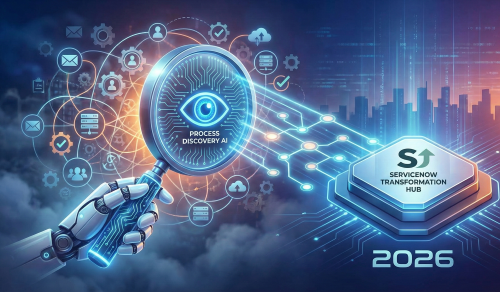
ServiceNow is one of the most powerful workflow platforms in the enterprise. It connects people, systems, approvals, and automation across IT, HR, customer service, security, and operations.
But that power cuts both ways.
When ServiceNow programs struggle, it’s rarely because of the platform itself. More often, the problem starts much earlier — during discovery.
Teams automate workflows they don’t fully understand. Requirements are gathered from a handful of stakeholders. Variations across roles, regions, and edge cases are missed. By the time ServiceNow goes live, the organization is locked into flows that don’t reflect how work actually happens.
That’s why discovery — real discovery — has become one of the most critical success factors for modern ServiceNow transformations.
This guide breaks down:
If you’re planning, re-platforming, or optimizing ServiceNow, this is where the work should start.
Process discovery is how organizations understand how work is actually done today — across people, systems, handoffs, approvals, exceptions, and workarounds.
In a ServiceNow environment, that includes:
Discovery answers questions like:
Without clear answers, ServiceNow becomes a beautifully automated version of an inaccurate process.
Automated Process Discovery uses AI to capture workflows directly from the people doing the work — at scale — and convert that reality into structured, delivery-ready outputs.
Instead of relying solely on workshops or system logs, it:
This matters because ServiceNow workflows are rarely uniform. What looks clean in a design session often looks very different in day-to-day execution.
Before choosing tools, it’s important to understand the approach differences, not just the products.
Process mining analyzes system event logs to reconstruct flows.
Strengths
Limitations in ServiceNow
Task mining captures individual user desktop activity.
Strengths
Limitations in ServiceNow
Automated discovery blends human reality with structure by analyzing documents and conducting agentic interviews - analyzing all unstructured data.
Why it fits ServiceNow
For ServiceNow programs, this approach closes the gap between how processes are designed and how they’re actually executed.
Most ServiceNow transformations still rely on the same discovery methods used a decade ago. The problem is that ServiceNow implementations have become far more complex — while discovery has not kept up.
Discovery workshops typically involve:
In reality:
ServiceNow then gets configured around a simplified version of reality.
One-on-one interviews add depth, but they still rely on memory and perception.
People describe how work should happen — not how it actually unfolds during a busy day, a major incident, or a compliance exception.
Even well-documented process maps become outdated as soon as:
ServiceNow environments evolve quickly. Static documentation can’t keep up.
ServiceNow logs show events, not intent.
They don’t explain:
Without that context, optimization efforts miss the root cause.
ServiceNow has evolved from an ITSM tool into an enterprise workflow platform. That shift has changed what discovery needs to deliver.
Modern ServiceNow teams face:
Discovery is no longer a phase you “get through.” It’s a foundation you build on.
Teams that succeed treat discovery as:
Here’s how the main discovery approaches stack up when applied to ServiceNow programs.
Best for:
Small, stable teams with limited variation
Where it breaks down:
Best for:
High-volume workflows fully contained in ServiceNow
Where it breaks down:
Best for:
Why it works:
It captures reality before automation locks assumptions into place.
When evaluating discovery tools for ServiceNow, focus on outcomes — not features.
Key questions to ask:
If a tool only visualizes system data, it’s not enough for full-scale ServiceNow transformations.
Discovery surfaces:
Discovery reveals:
Discovery highlights:
In each case, discovery prevents teams from automating assumptions.
A practical way to approach discovery before or during a ServiceNow initiative:
Days 1–7: Scope & Alignment
Days 8–21: Capture Reality
Days 22–30: Deliver Outputs
This approach shortens timelines while improving accuracy.
Do I need process discovery before implementing ServiceNow?
Yes. Discovery reduces rework, accelerates configuration, and improves adoption.
Can ServiceNow’s native tools replace discovery?
They help manage workflows — they don’t replace upfront discovery.
Is process mining enough for ServiceNow discovery?
Not on its own. It misses human context and pre-system work.
How long should discovery take for a ServiceNow program?
Modern discovery should take weeks, not months.
What should discovery produce?
Process maps, requirements, and artifacts teams can immediately build from.
ServiceNow is only as effective as the processes it automates.
Teams that rush discovery end up automating assumptions. Teams that ground discovery in real execution build workflows that scale, adapt, and deliver value faster.
If you’re evaluating approaches to discovery for a ServiceNow transformation, start with the one that reflects how work actually happens — not how it’s supposed to.
For a broader comparison of discovery approaches across platforms, see our pillar guide:
Best Process Discovery Tools for 2026: Automated Discovery vs Process Mining vs Task Mining
ServiceNow is incredibly powerful, but its success depends on the quality of the processes it automates. Teams that invest in discovery grounded in real execution — across people, systems, and exceptions — reduce rework, speed delivery, and improve adoption. If you’re planning or optimizing a ServiceNow program, start by choosing a discovery approach that reflects reality before automation locks assumptions in place.
Enjoy our newsletter!